Classification / Names
Populärnamn | synonymer | Catalog of Fishes(Släkte, Arter) | ITIS | CoL | WoRMS | Cloffa
>
Cypriniformes (Carps) >
Cyprinidae (Minnows or carps) > Labeoninae
Etymology: Garra: Name based on a vernacular Indian name (Hamilton, 1822:343, Ref. 1813); a fish living in mud (Ref. 128817); napata: Named after "Napata", the capital of the ancient Kush kingdom, which is very close to the type locality of this species; a noun in apposition (Ref. 122047).
Environment: milieu / climate zone / djupintervall / distribution range
Ekologi
; sötvatten bentopelagisk. Tropical
Africa: Main Nile River in Sudan and Egypt (Ref. 122047).
Size / Vikt / Age
Könsmognad: Lm ? range ? - ? cm
Max length : 7.0 cm SL hane/ej könsbestämd; (Ref. 122047)
Short description
Bestämningsnycklar | Morfologi | Morfometri
Taggstrålar i ryggfenan (totalt) : 0; Mjukstrålar i ryggfenan (totalt) : 9 - 10; Taggstrålar i analfenan: 0; Mjukstrålar i analfenan: 7 - 8; Ryggkotor: 34 - 36. Diagnosis: Garra napata differs from all other African Garra species, except G. jamila and G. ethelwynnae, in a scaleless area on the dorsal body area clearly exceeding beyond dorsal fin origin and thus in an incomplete count of only 1 to 2.5 scale rows between the origin of the dorsal fin and lateral line series vs. 3 or more (Ref. 122047). It is distinguished from G. ethelwynnae from the Damas River basin in Eritrea by: its intermediate, type B, developed disc and only minute free posterior flap vs. prominent disc of type C with well-developed posterior flap; and an asquamate postpelvic area vs. squamate (Ref. 122047). It is distinguished from G. jamila of the Atbara by: its intermediate type B developed disc with a very small free posterior flap vs. prominent disc type C with well-developed posterior flap; a smoother upper lip vs. crenate; and, in live specimens, an uncoloured anal fin vs. red anal fin; dark humeral spot large and nearly twice as big as red postopercular spot vs. equally sized small humeral and postopercular spots; fixed specimens usually display a pronounced lateral band and pale back vs. dark back strongly and contrasting light belly (Ref. 122047). It is distinguished from Garra vinciguerrae and G. sannarensis by: its narrow disc, width much smaller than mouth vs. as large as mouth width; virtually absent lateroposterior flap of the disc vs. clearly developed; and a relatively broad head, i.e. cheeks visible when viewed from dorsal vs. cheeks not visible; from G. vinciguerrae by its prominent dark colour markings in the centre of the dorsal-fin membrane near its base vs. no such pattern; from G. sp. "White Nile" by its visible cheeks when viewed from dorsal vs. not visible from above, and by its short barbels barely reaching margin of lower-lip pad vs. almost reaching each other (Ref. 122047).
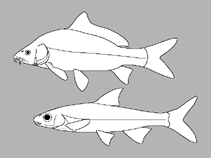
Body shape (shape guide): elongated.
Rheophilic and collected from swift water in strong current, likely prefers habitats with high velocity; occurs syntopically with other rheophilic species like Garra vinciguerrae, Chiloglanis niloticus, Andersonia leptura and Labeo forskalii (Ref. 122047).
Life cycle and mating behavior
Könsmognad | Reproduktion | Lek | Ägg | Fecundity | Larver
Moritz, T., N. Straube and D. Neumann, 2019. The Garra species (Cyprinidae) of the Main Nile basin with description of three new species. Cybium 43(4):311-329. (Ref. 122047)
IUCN Red List Status (Ref. 130435: Version 2025-1)
Threat to humans
Harmless
Human uses
Fiskeri: saknar intresse
Verktyg
Special reports
Download XML
Internet-källor
Estimates based on models
Phylogenetic diversity index (Ref.
82804): PD
50 = 0.5000 [Uniqueness, from 0.5 = low to 2.0 = high].
Bayesian length-weight: a=0.00776 (0.00354 - 0.01702), b=3.04 (2.87 - 3.21), in cm total length, based on LWR estimates for this Genus-body shape (Ref.
93245).
Resiliens (Ref.
120179): Hög, lägsta populationsfördubblingstid mindre än 15 månader (Preliminary K or Fecundity.).
Fishing Vulnerability (Ref.
59153): Low vulnerability (10 of 100).
🛈