



Carregue seu(sua) Fotos e vídeos
Imagem do Google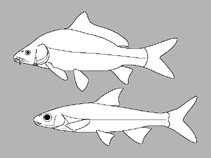 No image available for this species;
drawing shows typical species in Cyprinidae.
Imagem do Google
drawing shows typical species in Cyprinidae.
Classificação / Nomes Nomes comuns | Sinônimos | Catalog of Fishes(Gênero, Espécies) | ITIS | CoL | WoRMS | Cloffa
> Cypriniformes (Carps) > Cyprinidae (Minnows or carps) > Labeoninae
Etymology: Garra: Name based on a vernacular Indian name (Hamilton, 1822:343, Ref. 1813); a fish living in mud (Ref. 128817); jamila: Named after the Arabian word "jamila", meaning "beautiful", in reference to its bright colouration on body and fins of this pretty fish; a Latinised adjective (Ref. 122047).
Etymology: Garra: Name based on a vernacular Indian name (Hamilton, 1822:343, Ref. 1813); a fish living in mud (Ref. 128817); jamila: Named after the Arabian word "jamila", meaning "beautiful", in reference to its bright colouration on body and fins of this pretty fish; a Latinised adjective (Ref. 122047).
Meio ambiente: milieu / Zona climática / intervalo de profundidade / faixa de distribuição Ecologia
; Água doce bentopelágico. Tropical
Distribuição Territórios | Áreas da FAO | Ecossistemas | Ocorrências | Mapa de pontos | Introduções | Faunafri
Africa: Atbara River, tributary of Nile River, in Sudan (Ref. 122047).
Tamanho / Peso / Idade
Descrição suscinta Chaves de identificação | Morfologia | Morfometria
Espinhos dorsais (total) : 0; Raios dorsais (total) : 9 - 11; Espinhos anais: 0; Raios anais : 8; Vértebras: 35 - 37. Diagnosis: Garra jamila differs from all other African Garra species, except G. napata and G. ethelwynnae, in an asquamate area along the dorsum which exceeds well beyond the dorsal fin insertion and laterally onto flanks and thus accounting for an incomplete scale row count of only 2 to 2.5 scales between dorsal fin insertion and the lateral line vs. 3 or more scales (Ref. 122047). It is distinguished from G. ethelwynnae from the Damas River basin in Eritrea by: an asquamate postpelvic area vs. squamate, and more scales in lateral line, 34-38 vs. 32-34 (Ref. 122047). It is distinguished from G. napata from the Main Nile basin by its well-developed disc, type C, with prominent free posterior flap vs. intermediate, type B, with very small or absent posterior flap; crenate upper lip vs. smooth; its vivid red colouration of the distal end of the anal fin when alive vs. anal fin lacking any red colours; a small dark humeral spot usually as large or smaller than the red postopercular spot vs. humeral spot twice as large as postopercular spot; fixed specimens with very dark blackish to brown colouration on back ad contrasting light belly vs. entire body grey beige (Ref. 122047). It is distinguished from G. vinciguerrae by a naked predorsal area that exceeds laterally beyond dorsal fin vs. at least single, irregular predorsal scales present on nape; middle of dorsal fin membrane with prominent dark horizontal band vs. no such band; from G. sannarensis by its well-developed disc, type C, vs. intermediate, type B disc, and posterior disc flap rounded and of equal width vs. caudally slightly extended, oval shaped flap with bulky middle; from G. sp. "White Nile" in having prominent stout short barbels, not reaching onto lower lip pad when flexed inwards vas. barbels nearly touching each other when flexed inwards (Ref. 122047).
Body shape (shape guide): elongated.
Body shape (shape guide): elongated.
Ciclo de vida ou comportamento de acasalamento Maturidade | Reprodução | Desova | Ovos | Fecundidade | Larvas
Referência principal
Carregar suas referências | Referências | Coordenador | Colaboradores
Moritz, T., N. Straube and D. Neumann, 2019. The Garra species (Cyprinidae) of the Main Nile basin with description of three new species. Cybium 43(4):311-329. (Ref. 122047)
CITES
Not Evaluated
Ameaça para os humanos
Harmless
Uso pelos humanos
Pescarias: sem interesse
FAO - Publication: search | FishSource |
Mais informação
Ecologia Trófica
Itens alimentares (presas)
Composição da dieta
Consumo alimentar
Rações alimentares
Predadores
Itens alimentares (presas)
Composição da dieta
Consumo alimentar
Rações alimentares
Predadores
Ecologia
Ecologia
Ecologia
Dinâmica populacional
Parâmetros de crescimento
Idade máxima / tamanhos
Relação comprimento-peso.
Relação comprimento-comprimento.
Frequências de comprimento
Conversão de massa
Recrutamento
Abundância
Parâmetros de crescimento
Idade máxima / tamanhos
Relação comprimento-peso.
Relação comprimento-comprimento.
Frequências de comprimento
Conversão de massa
Recrutamento
Abundância
Ciclo de vida
Reprodução
Maturidade
Maturidade/Rel. das guelras
Fecundidade
Desova
Agregações de desova
Ovos
Desenvolvimento dos ovos
Larvas
Dinâmica larval
Reprodução
Maturidade
Maturidade/Rel. das guelras
Fecundidade
Desova
Agregações de desova
Ovos
Desenvolvimento dos ovos
Larvas
Dinâmica larval
Anatomia
Área branquial
Cérebro
Otólito
Área branquial
Cérebro
Otólito
Fisiologia
Composição corporal
Nutrientes
Consumo de oxigênio
Tipo de natação
Velocidade de natação
Pigmentos visuais
Som de peixe
Doenças e Parasitas
Toxicidade (LC50s)
Composição corporal
Nutrientes
Consumo de oxigênio
Tipo de natação
Velocidade de natação
Pigmentos visuais
Som de peixe
Doenças e Parasitas
Toxicidade (LC50s)
Genética
genoma
Genética
Heterozigosidade
Hereditariedade
Diversidade genética
genoma
Genética
Heterozigosidade
Hereditariedade
Diversidade genética
Relacionado a humanos
Sistemas de aquicultura
Perfis para aquacultura
Estirpes
Casos de Ciguatera
Selos, moedas, diversos.
Sistemas de aquicultura
Perfis para aquacultura
Estirpes
Casos de Ciguatera
Selos, moedas, diversos.
Ferramentas
Livro eletrônico | Guia de campo | Ferramenta auxiliar de frequências de comprimento | Ferramenta sobre a história de vida | Mapa de pontos |
Catch-MSY |
Relatórios especiais
Checar Manutenção em Aquário | Checar Planilhas de Fatos sobre as Espécies | Checar Planilhas de Fatos sobre Aquicultura
Baixar XML
Fontes da internet
AFORO (otoliths) | Aquatic Commons | BHL | Cloffa | Websites from users | Checar Observador de Peixes (FishWatcher) | CISTI | Catalog of Fishes: Gênero, Espécies | DiscoverLife | ECOTOX | FAO - Publication: search | Faunafri | Fishipedia | Fishtrace | GloBI | Google Books | Google Scholar | Google | IGFA World Record | OneZoom | Open Tree of Life | Otolith Atlas of Taiwan Fishes | PubMed | Reef Life Survey | Socotra Atlas | TreeBase | Árvore da vida | Wikipedia: Ir para, procura | World Records Freshwater Fishing | Zoobank | Registro zoológico
Estimativas baseadas em modelos
Índice de diversidade filogenética (Ref. 82804): PD50 = 0.5000 [Uniqueness, from 0.5 = low to 2.0 = high].
Bayesian length-weight: a=0.00794 (0.00359 - 0.01758), b=3.04 (2.87 - 3.21), in cm total length, based on LWR estimates for this Genus-body shape (Ref. 93245).
Resiliência (Ref. 120179): Elevada, tempo mínimo de duplicação da população menor que 15 meses (Preliminary K or Fecundity.).