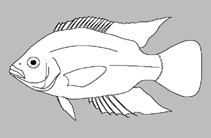
Classification / Names
Κοινά ονόματα | Συνώνυμα | Catalog of Fishes(Γένος, Είδη) | ITIS | CoL | WoRMS | Cloffa
>
Cichliformes (Cichlids, convict blennies) >
Cichlidae (Cichlids) > Pseudocrenilabrinae
Etymology: Orthochromis: Greek, ortho = straight + Greek, chromis = a fish, perhaps a perch (Ref. 45335); indermauri: The species name indermauri honours the Swiss ichthyologist Dr. Adrian Indermaur, who was the first to document this new species with underwater photographs, videos, and with aquarium observations, thereby contributing to a large extent to our knowledge of behaviour and ecology of this species (Ref. 122085).
Eponymy: Dr Adrian Indermaur (d: 1984) is a Swiss ichthyologist who is (2014) Head of the animal facility at the Waler Salzburger Laboratory. [...] (Ref. 128868), visit book page.
Environment: milieu / climate zone / εύρος βάθους / distribution range
Οικολογία
; Γλυκού νερού βενθοπελαγικό; pH range: 8.0 - 8.6. Tropical; 23°C - 28°C (Ref. 122085)
Africa: lower reaches of Lufubu River, tributary of Lake Tanganyika, in Zambia (Ref. 122085).
Μέγεθος / Βάρος / Age
Γεννητική Ωρίμανση: Lm ? range ? - ? cm
Max length : 6.9 cm SL αρσενικό/απροσδιόριστο; (Ref. 122085)
Short description
Κλείδες προσδιορισμού | Μορφολογία | Μορφομετρία
Ραχιαίες άκανθες (συνολικά) : 17 - 18; Μαλακές ραχιαίες ακτίνες (συνολικά) : 8 - 10; Εδρικές άκανθες: 3; Μαλακές εδρικές ακτίνες: 7 - 9; Σπόνδυλοι: 28 - 29. Diagnosis: Orthochromis indermauri is distinguished from all species currently placed in Orthochromis, except O. torrenticola, by having hypurals 1 and 2 clearly separated or separated by distinct seam vs. always fused (Ref. 122085). It is further distinguished from Malagarasi-Orthochromis species, except O. mazimeroensis, O. malagaraziensis, and O. rubrolabialis, by having fewer caudal vertebrae, 14-15 vs. 16-18, and total vertebrae, 28-29 vs. 30-32; it is also distinguished from O. luichensis, O. malagaraziensis, O. mazimeroensis, O. mosoensis by having more inner series of teeth in upper jaw, 3-5 vs. 1-2; moreover, it differs from O. kasuluensis by having fewer anal-fin rays, 7-9 vs. 10; from O. malagaraziensis by having more scales between upper lateral line and dorsal-fin origin, 5-7 vs. 3-4, and by having more ceratobranchial gill rakers, 8-11 vs. 6-7; from O. mazimeroensis by having more abdominal vertebrae, 14-15 vs. 12-13; from O. mosoensis and O. rubrolabialis by having more ceratobranchial gill rakers, 8-11 vs. 5-7, and total gill rakers, 11-15 vs. 8-10; from O. uvinzae by having fewer horizontal line scales, 25-29 vs. 30-32, fewer dorsal-fin spines, 17-18 vs. 19-20, and by position of pterygiophore supporting last dorsal-fin spine, vertebral count 16-17 vs. 18-19 (Ref. 122085). It is distinguished from O. kalungwishiensis, O. luongoensis, and O. torrenticola by having fewer horizontal line scales, 28-29 vs. 30-32, and by having fewer caudal vertebrae, 14-15 vs. 17-18; further, it differs from O. luongoensis and O. machadoi by having fewer series of scales on cheek, 0-1 vs. 2-5; from O. kalungwishiensis by having fewer total vertebrae, 28-29 vs. 31-33 (Ref. 122085). It is distinguished from Schwetzochromis neodon by having fewer horizontal line scales, 28-29 vs. 30-31, more circumpeduncular scales, 16 vs. 12, fewer caudal vertebrae, 14-15 vs. 16-17, fewer total vertebrae, 28-29 vs. 30-32, fewer dorsal-fin rays, 8-10 vs. 11-12, and by having hypurals 1 and 2 clearly separated or separated by distinct seam vs. fused; it differs from Haplochromis snoeksi by having fewer scales on cheek, 0-1 vs. 2-3, fewer horizontal line scales, 25-29 vs. 30-31, more abdominal vertebrae, 14-15 vs. 13, fewer caudal vertebrae, 14-15 vs. 17, fewer total vertebrae, 28-29 vs. 30, more anal-fin rays, 7-9 vs. 5-6, more dorsal-fin spines, 17-18 vs. 16, more ceratobranchial gill rakers, 8-11 vs. 6, and total gill rakers, 11-15 vs. 9; from Haplochromis bakongo by having more inner series of teeth, 3-5 vs. 1-2, more dorsal-fin spines, 17-18 vs. 14-15, and in position of pterygiophore supporting last dorsal-fin spine, vertebral count 16-18 vs. 13-14; from Haplochromis moeruensis by having hypurals 1 and 2 clearly separated or separated by distinct seam vs. always fused; meristic values of O. indermauri overlap with those of Haplochromis vanheusdeni but is distinguished in head mask, nostril stripe present vs. absent, caudal corner of cheek with blackish element vs. no such element present, and by size and colouration of eggspot-like maculae on anal fin, deep red centre vs. orange centre in Haplochromis vanheusdeni (Ref. 122085). It is distinguished from O. mporokoso and O. katumbii by having fewer caudal vertebrae, 14-15 vs. 16-17, fewer total vertebrae, 28-29 vs. 30-31, and by having hypurals 1 and 2 and hypurals 3 and 4 clearly separated or separated by distinct seam vs. always fused; further from O. mporokoso by having fewer series of scales on cheek, 0-1 vs. 2-4; from O. katumbii by having fewer horizontal line scales, 25-29 vs. 30-31; it is distinguished from O. kimpala by having fewer series of scales on cheek, 0-1 vs. 3-4, and by having more dorsal-fin spines, 17-18 vs. 15-16; meristic values of O. indermauri overlap with those of O. gecki but is distinguished by having a wider interorbital width, 13.5-18.2% of head length vs. 9.6-12.9% (Ref. 122085).
Body shape (shape guide): fusiform / normal.
Found in part of river which is rocky with some patches of sand and gravel, about 20 meters wide and on average 50 cm deep (Ref. 122085). This species is benthic-rheophilic and prefers stretches of fast flowing water where it is found between and among large rocks or patches of gravel (Ref. 122085). It is a maternal mouthbrooder (Ref. 122085).
Life cycle and mating behavior
Γεννητική Ωρίμανση | Αναπαραγωγή | Γεννοβολία | Αβγά | Γονιμότητα | Προνύμφες
Schedel, F.D.B., E.J.W.M.N. Vreven, B. Katemo Manda, E. Abwe, A. Chocha Manda and U.K. Schliewen, 2018. Description of five new rheophilic Orthochromis species (Teleostei: Cichlidae) from the Upper Congo drainage in Zambia and the Democratic Republic of the Congo. Zootaxa 4461(3):301-349. (Ref. 122085)
IUCN Red List Status (Ref. 130435: Version 2025-1)
Threat to humans
Harmless
Human uses
Εργαλεία
Special reports
Download XML
Διαδικτυακές πηγές
Estimates based on models
Phylogenetic diversity index (Αναφ.
82804): PD
50 = 0.5000 [Uniqueness, from 0.5 = low to 2.0 = high].
Bayesian length-weight: a=0.01000 (0.00244 - 0.04107), b=3.04 (2.81 - 3.27), in cm total length, based on all LWR estimates for this body shape (Ref.
93245).
Ελαστικότητα (Αναφ.
120179): Υψηλό, ελάχιστος χρόνος για διπλασιασμό πληθυσμού < 15 μήνες (Preliminary K or Fecundity.).
Fishing Vulnerability (Ref.
59153): Low vulnerability (10 of 100).
🛈