Classification / Names
Nomi Comuni | Sinonimi | Catalog of Fishes(Genere, Specie) | ITIS | CoL | WoRMS | Cloffa
>
Siluriformes (Catfishes) >
Loricariidae (Armored catfishes) > Hypoptopomatinae
Etymology: Pareiorhaphis: Greek, pareia = jaw + Greek, rhaphis = needle (Ref. 45335); mucurina: Named for its type locality, Mucuri River basin; an adjective.
Environment: milieu / climate zone / distribuzione batimetrica / distribution range
Ecologia
; acqua dolce benthopelagico; distribuzione batimetrica 0 - 2 m (Ref. 119415). Tropical
South America: Brazil.
Size / Peso / Age
Maturità: Lm ? range ? - ? cm
Max length : 9.7 cm SL maschio/sesso non determinato; (Ref. 119415)
Short description
Chiavi di identificazione | Morfologia | Morfometria
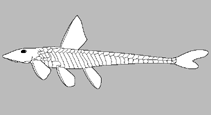
This species is distinguished from its congeners by the following characters: lower lip with a distinct narrow area completely lacking of papillae along and just posterior to each emergent tooth series of the dentary (vs. area posterior to tooth series of the dentary covered by papillae) and by having a short maxillary barbel, mostly adnate to lower lip by distinctly enlarged skin flap forming a continuous connection from the base to almost the end of the maxillary barbel (vs. small flap of skin connecting the maxillary barbel); further distinguished by the papillae in upper lip coalesced to form 3 or 4 transverse series of elongate skin folds anterior to the premaxillary tooth series (vs. papillae rounded, not fused to form skin folds); differs from all its congeners, except P. garapia, P. garbei, P. nasuta, P. proskynita, P. splendens, P. vestigipinnis, P. vetula by having a smaller eye diameter 8.5-11.3% (vs. 11.7-18.8% HL) and it differs from these seven species by having the soft fleshy lobe on the lateral margin of head progressively wider posteriorly in adult males (vs. soft fleshy lobe not widening posteriorly along the lateral margin of the head); differs from P. garapia, P. vestigipinnis, P. vetula by having a well-developed dorsal-fin spinelet (vs. dorsal-fin spinelet absent); differs from P. garbei by having bifid teeth, with a small lateral cusp in both the dentary and the premaxilla (vs. teeth simple, without lateral cusp in both dentary and premaxilla); differs from P. proskynita, P. vestigipinnis in having an adipose fin (vs. adipose fin absent); differs from P. splendens by the long first unbranched pelvic-fin ray, approximately equal in size or longer than the pectoral-fin spine (vs. first unbranched pelvic-fin ray short, always shorter than the pectoral-fin spine); differs from P. nasuta by having the lateral tooth cusp longer, almost reaching or reaching to middle of medial cusp (vs. lateral cusp minute, never reaching to middle of medial cusp) (Ref. 119415).
Cross section: angular.
Facultative air-breathing in the genus (Ref. 126274); Collected from a fast flowing, tea-colored water running on a bedrock bottom, and a fair amount of preserved marginal vegetation. Captured specimens in places 0.2-1.7 m deep and 3-16 m wide. Individuals are very abundant, and most were hand-caught among rocks and inside cracks and crevices of the bedrock. Associated species caught are Euryochus thysanos, Astyanax aff. fasciatus, and unidentified species of Characidium and Trichomycterus (Ref. 119415).
Life cycle and mating behavior
Maturità | Riproduzione | Deposizione | Uova | Fecundity | Larve
Pereira, E.H.L., T.C. Pessali and R.E. Reis, 2018. A new species of Pareiorhaphis (Loricariidae: Neoplecostominae) from the Mucuri River Basin, Minas Gerais, Eastern Brazil. Copeia 106(4):632-640. (Ref. 119415)
IUCN Red List Status (Ref. 130435: Version 2025-1)
Threat to humans
Harmless
Human uses
Strumenti
Special reports
Download XML
Fonti Internet
Estimates based on models
Phylogenetic diversity index (Fonte Biblio.
82804): PD
50 = 0.5000 [Uniqueness, from 0.5 = low to 2.0 = high].
Bayesian length-weight: a=0.00851 (0.00374 - 0.01935), b=3.09 (2.90 - 3.28), in cm total length, based on LWR estimates for this (Sub)family-body shape (Ref.
93245).
Resilienza (Fonte Biblio.
120179): Alto, tempo minimo di raddoppiamento della popolazione meno di 15 mesi (Preliminary K or Fecundity.).
Fishing Vulnerability (Ref.
59153): Low vulnerability (10 of 100).
🛈