Classification / Names
Populärnamn | synonymer | Catalog of Fishes(Släkte, Arter) | ITIS | CoL | WoRMS | Cloffa
>
Gobiesociformes (Clingfishes) >
Gobiesocidae (Clingfishes and singleslits) > Lepadogastrinae
Etymology: Diplecogaster: Greek, di = two + Greek, pleko = plait, pigtail (Ref. 45335); umutturali: Named for Umut Tural, former coordinator of the Kaş-Kekova Specially Protected Area Management Plan and Implementation Project on behalf of WWF-Türkiye, a promising conservation biologist passionate for marine life, who passed away in 2012. He was the in which he also actively participated in by collecting clingfish samples.
Eponymy: Umut Tural (d: 2012) was, according to the etymology, a “promising conservation biologist passionate for marine life”. [...] (Ref. 128868), visit book page.
Environment: milieu / climate zone / djupintervall / distribution range
Ekologi
marina bentopelagisk; djupintervall 0 - 20 m (Ref. 117931). Tropical
Mediterranean Sea: Iskenderun Bay.
Size / Vikt / Age
Könsmognad: Lm ? range ? - ? cm
Max length : 2.7 cm SL hane/ej könsbestämd; (Ref. 117931)
Short description
Bestämningsnycklar | Morfologi | Morfometri
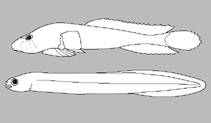
Mjukstrålar i ryggfenan (totalt) : 5 - 6; Mjukstrålar i analfenan: 4. This species is distinguished from all its congeners by the following set of characters: snout small, its length 3.80-6.08 in head length); caudal peduncle short, its depth 0.77-0.96 in its length; eyes large, its diameter 0.59-0.88 in interorbital distance; anal fin short, its length
1.92-2.35 in Y; upper attachment of gill membrane opposite to the 7th-8th pectoral ray; disc region A with 4-6 rows of flattened papillae across its width, 5-7 rows across width of region B and 3-4 rows across width of region C; anus is located closer to sucking disk than to anal fin (Ref. 117931).
Cross section: oval.
Known from three discrete localities along the Turkish Levant coast; Akıncı Burnu (Iskenderun Bay), Kaş and Fethiye Bay. The type locality (Akıncı Burnu) is a broad cove, a pebble beach of ca. 1000 m long. Smooth pebbles with various dimensions (1x1 cm to 15x10 cm) extend from the high water mark to one meter of depth, as a large band throughout the coast. The deeper parts of the shore (>1 m) with dense rocky substrates encircled by fine sand. Large rocks were covered with two dominant algae, Jania rubens and Cystoseira spp., together with chthamalid barnacles. The holotype was collected from under a greyish flattened stone at a depth of 0.3 m, salinity at 39.2 ppt, bottom water temperature 28.5°C and dissolved oxygen 4.75 mg/l while the paratypes were observed and collected on coarse shell grits around the Posidonia oceanica (Ref. 117931).
Life cycle and mating behavior
Könsmognad | Reproduktion | Lek | Ägg | Fecundity | Larver
Bilecenoğlu, M., M.B. Yokes and M. Kovacic, 2017. A new species of Diplecogaster (Actinopterygii: Gobiesocidae) from the Mediterranean Sea. Zool. Mid. East 63(3):210-218. (Ref. 117931)
IUCN Red List Status (Ref. 130435: Version 2025-1)
Threat to humans
Harmless
Human uses
Verktyg
Special reports
Download XML
Internet-källor
Estimates based on models
Phylogenetic diversity index (Ref.
82804): PD
50 = 0.5039 [Uniqueness, from 0.5 = low to 2.0 = high].
Bayesian length-weight: a=0.00513 (0.00205 - 0.01282), b=3.10 (2.88 - 3.32), in cm total length, based on LWR estimates for this (Sub)family-body shape (Ref.
93245).
Trofisk nivå (Ref.
69278): 3.1 ±0.5 se; based on size and trophs of closest relatives
Resiliens (Ref.
120179): Hög, lägsta populationsfördubblingstid mindre än 15 månader (Preliminary K or Fecundity.).
Fishing Vulnerability (Ref.
59153): Low vulnerability (10 of 100).
🛈