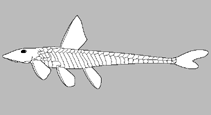
Classificatie / Namen
Lokale namen | Synoniemen | Catalog of Fishes(Genus, Soort(en)) | ITIS | CoL | WoRMS | Cloffa
>
Siluriformes (Catfishes) >
Loricariidae (Armored catfishes) > Hypostominae
Etymology: Pseudolithoxus: Greek, pseudes = false + Greek, lithos = stone + Greek, oxys = sharp; kinja: Named for the Waimiri-Atroari indigenous people, the Kinja people inhabiting areas surrounding the rio Uatuma and part of the rio Negro in the states of Amazonas and Roraima, Brazil. 'Kinja' ('true people') pays homage to this brave people who survived three attempts of genocide in the last century, and survive and thrive today in their protected area; noun in apposition.
Environment: milieu / Klimaatzone / Diepte / distribution range
Ecologie
; zoet water demersaal; diepte 1 - 2 m (Ref. 119352). Tropical
South America: Brazil.
Grootte / Gewicht / Leeftijd
Maturiteit: Lm ? range ? - ? cm
Max length : 15.3 cm SL mannelijk / geslacht onbekend; (Ref. 119352)
Korte beschrijving
Determinatiesleutels | Morfologie | Morfometrie
Dorsale stekels (totaal) : 2; Dorsale zachte stralen (totaal) : 7; Wervels: 28. This species is distinguished from its congeners by the following characters: a colour pattern of large pale spots on a dark background (vs. pale bands on a dark background in P. kelsorum, P. tigris; small pale dots on a dark background in P. anthrax, P. nicoi; dark spots on a lighter background in P. dumus); differs further from P. anthrax, P. nicoi by having dark bands on the caudal fin (vs. none) and by the cleithral width 30.0-33.5% SL (vs. 27.2-30.5% in P. anthrax and 27.0-28.6% in P. nicoi (Ref. 119352).
Cross section: angular.
Collected in shallow (depth <1.5 m), fast-flowing water over a substrate of eroded bedrock, living among narrow cracks between rocks, and were abundant at the sampling site. However, this type of habitat was not frequently encountered on the lower Nhamunda, and the species was not found associated with more common woody-debris sites, or rocky sites lacking any appreciable water current. Water temperature 28.3C and conductivity 6 mS/cm. Syntopic fishes encountered during the night survey were species of Leporinus, Symphysodon, Cichla, Pimelodella, Tatia, Dekeyseria, Peckoltia, Lasiancistrus, and this species was the dominant loricariid in this habitat (Ref. 119352).
Levenscyclus en paargedrag
Maturiteit | Voortplanting | Paaien | Eieren | Fecunditeit | Larven
Collins, R.A., A.G. Bifi, R.R. De Oliveira, E.D. Ribeiro, N.K. Lujan, L.H. Rapp Py-Daniel and T. Hrbek, 2018. Biogeography and species delimitation of the rheophilic suckermouth catfish genus Pseudolithoxus (Siluriformes: Loricariidae), with the description of a new species from the Brazilian Amazon. Systematics and Biodiversity 16(6):538-550. (Ref. 119352)
Status op de Rode Lijst van het IUCN (Ref. 130435: Version 2025-1)
Gevaar voor de mens
Harmless
Gebruik door de mens
Tools
Speciale rapporten
Download XML
Internetbronnen
Estimates based on models
Fylogenetische diversiteitsindex (Ref.
82804): PD
50 = 0.5156 [Uniqueness, from 0.5 = low to 2.0 = high].
Bayesian length-weight: a=0.01549 (0.00719 - 0.03336), b=2.98 (2.81 - 3.15), in cm total length, based on LWR estimates for this (Sub)family-body shape (Ref.
93245).
Weerstandsvermogen (Ref.
120179): Gemiddeld, minimale populatieverdubbelingstijd 1,4-4,4 jaar (Preliminary K or Fecundity.).
Fishing Vulnerability (Ref.
59153): Low vulnerability (10 of 100).
🛈