



Rhynchobatus mononoke Koeda, Itou, Yamada & Motomura, 2020
Japanese wedgefish
Sube tu fotos y Vídeos
Google image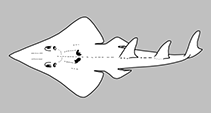 No image available for this species;
drawing shows typical species in Rhinidae.
Google image
drawing shows typical species in Rhinidae.
Clasificación / Nombres Nombres comunes | Sinónimos | Catalog of Fishes(Género, Especie) | ITIS | CoL | WoRMS | Cloffa
Elasmobranquios (tiburones y rayas) (sharks and rays) > Rhinopristiformes (Shovelnose rays) > Rhinidae (Wedgefishes)
Etymology: Rhynchobatus: Greek, rhingchos = snout + Greek, batis, -idos = a sting ray (Raja sp.) (Ref. 45335); mononoke: Name 'mononoke' means 'specter' in Japanese, due to the ventral surface of specimens appearing like a traditional Japanese specter, wearing a triangular white hat (crown) on its forehead; noun in apposition.
Etymology: Rhynchobatus: Greek, rhingchos = snout + Greek, batis, -idos = a sting ray (Raja sp.) (Ref. 45335); mononoke: Name 'mononoke' means 'specter' in Japanese, due to the ventral surface of specimens appearing like a traditional Japanese specter, wearing a triangular white hat (crown) on its forehead; noun in apposition.
Taxonomic Remarks
Published online.
Entorno: milieu / zona climática / rango de profundidad / gama de distribución Ecología
marino pelagic-neritic; rango de profundidad 15 - 136 m (Ref. 123186). Subtropical
Distribución Territorios | Áreas FAO | Ecosistemas | Ocurrencias, apariciones | Mapa de puntos | Introducciones | Faunafri
Northwest Pacific: southern Japan.
Tamaño / Peso / Edad
Madurez: Lm ? range ? - ? cm
Max length : 130 cm TL macho / no sexado; (Ref. 123186); 200.0 cm TL (female)
Max length : 130 cm TL macho / no sexado; (Ref. 123186); 200.0 cm TL (female)
Descripción breve Claves de identificación | Morfología | Morfometría
This species is distinguished by the following set of characters: snout obtusely wedge shaped, angle ca. 52-57°; preoral length 17.4-17.9% TL, prespiracular length 19.3-19.5%; interdorsal space 16.7-17.9%; total pectoral-fn radials 54-56; total free vertebral centra 136-144; tooth rows on upper jaw ca. 54-66; no spines on snout; outer fold on posterior margin of spiracle is more pronounced than inner fold; pre-first dorsal-fin length 46.4-48.6%; apex of dorsal fins bluntly rounded; origin of first dorsal fn about level with the pelvic-fin origin; middle of pectoral disc with a spiracle-sized black blotch followed by a single white spot (rarely absent) posterodorsally; distal region of pectoral disc to mid-dorsal area without distinct white spots; a single blotch below the eye is usually absent; anterior half of undersurface covered with a rounded black blotch; near the snout tip, a pair of small distinct black spots (Ref. 123186).
Cross section: flattened.
Cross section: flattened.
This species is currently known only from nearshore to offshore waters and have been collected by set net from 15-35 m, but was also reported to have been taken at 135 m by bottom trawl. Based on photos of landed individuals, this species probably attains close to 3 m TL. The captive female individual held for at least 15 years in the Kagoshima City Aquarium reached to 2 m TL. This wedgefish is occasionally landed at fish markets in Kagoshima Prefecture and used for culinary purpose. Reported catches of the species were very rare in the East China Sea and is apparently restricted distribution and increasing rarity indicate that the species should immediately be included in the IUCN Red List CR “Critically Endangered” category, together with other congeners (Ref. 123186).
Ciclo vital y comportamiento de apareamiento Madurez | Reproducción | Puesta | Huevos | Fecundidad | Larva
Referencia principal
Suba sus referencias | Referencias | Coordinador | Colaboradores
Koeda, K., M. Itou, M. Yamada and H. Motomura, 2020. Rhynchobatus mononoke, a new species of wedgefish (Rhinopristiformes: Rhinidae) from Japan, with comments on Rhynchobatus laevis (Bloch and Schneider 1801). Ichthyol. Res. 68:223-238. (Ref. 123186)
Situación en la Lista Roja de la UICN (Ref. 130435: Version 2025-2 (Global))
Critically Endangered (CR) (A2bd); Date assessed: 16 July 2023
CITES
Not Evaluated
Amenaza para el ser humano
Harmless
Usos humanos
FAO - Publication: search | FishSource |
Más información
Ecología Trófica
Alimentos (presas)
Composición de la dieta
consumo de alimento
Raciones de comida
Despredadores
Alimentos (presas)
Composición de la dieta
consumo de alimento
Raciones de comida
Despredadores
Ecología
Ecología
Ecología
Dinámica de la población
Coeficiente del crecimiento para
Edades / tallas máximas
Longitud-peso rel.
Longitud-longitud rel.
Longitud-frecuencias
Conversión de masas
Reclutamiento
Abundancia
Coeficiente del crecimiento para
Edades / tallas máximas
Longitud-peso rel.
Longitud-longitud rel.
Longitud-frecuencias
Conversión de masas
Reclutamiento
Abundancia
Ciclo de vida
Reproducción
Madurez
Madurez/Gills rel.
Fecundidad
Puesta
Agregaciones de desove
Huevos
Desarrollo de los huevos
Larva
Dinámica larvaria
Reproducción
Madurez
Madurez/Gills rel.
Fecundidad
Puesta
Agregaciones de desove
Huevos
Desarrollo de los huevos
Larva
Dinámica larvaria
Distribución
Territorios
Áreas FAO
Ecosistemas
Ocurrencias, apariciones
Introducciones
BRUVS - Vídeos
Territorios
Áreas FAO
Ecosistemas
Ocurrencias, apariciones
Introducciones
BRUVS - Vídeos
Anatomía
Superficie branquial
Cerebro
Otolito
Superficie branquial
Cerebro
Otolito
Fisiología
Composición corporal
Nutrientes
Consumo del oxígeno
Tipo de natación
Velocidad de natación
Pigmentos visuales
Sonido de peces
Enfermedades y parásitos
Toxicidad (CL50)
Composición corporal
Nutrientes
Consumo del oxígeno
Tipo de natación
Velocidad de natación
Pigmentos visuales
Sonido de peces
Enfermedades y parásitos
Toxicidad (CL50)
Genética
Genoma
Genética
Heterocigosidad
heritabilidad
Diversidad genética
Genoma
Genética
Heterocigosidad
heritabilidad
Diversidad genética
Relacionados con el ser humano
Sistemas de acuicultura
Perfiles de acuicultura
Razas
Ciguatera cases
Sellos, monedas, varios
Sistemas de acuicultura
Perfiles de acuicultura
Razas
Ciguatera cases
Sellos, monedas, varios
Herramientas
Libro electrónico | Guía de campo | Asistente para frecuencias de tallas | Herramienta de ciclo de vida | Mapa de puntos |
Catch-MSY |
Informes especiales
Comprobar el mantenimiento del acuario | Buscar fichas sobre especies | Consulte las hojas informativas sobre acuicultura
Descargar XML
Fuentes de Internet
AFORO (otoliths) | Aquatic Commons | BHL | Cloffa | Websites from users | Check FishWatcher | CISTI | Catalog of Fishes: Género, Especie | DiscoverLife | ECOTOX | FAO - Publication: search | Faunafri | Fishipedia | Fishtrace | GloBI | Google Books | Google Scholar | Google | IGFA World Record | OneZoom | Open Tree of Life | Otolith Atlas of Taiwan Fishes | PubMed | Reef Life Survey | Socotra Atlas | TreeBase | Árbol de la vida | Wikipedia: Go, búsqueda | World Records Freshwater Fishing | Zoobank | Expediente Zoológico
Estimaciones basadas en modelos
Índice de diversidad filogenética (Referencia 82804): PD50 = 0.5024 [Uniqueness, from 0.5 = low to 2.0 = high].
Bayesian length-weight: a=0.00372 (0.00166 - 0.00830), b=3.11 (2.91 - 3.31), in cm total length, based on LWR estimates for this (Sub)family-body shape (Ref. 93245).
Nivel trófico (Referencia 69278): 3.6 ±0.6 se; based on size and trophs of closest relatives