



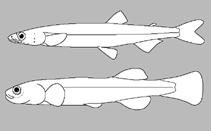
分類 / 名前 共通名の | 類義語 | Catalog of Fishes(部類, 種) | ITIS | CoL | WoRMS | Cloffa
> Galaxiiformes (Southern smelts) > Galaxiidae (Galaxiids) > Galaxiinae
Etymology: Galaxias: Greek, galaxias, ou = a kind of fish (Ref. 45335); terenasus: Name from Latin 'teres', meaning rounded or smooth, and 'nasus' for nose, referring to the rounded snout of this species.
Etymology: Galaxias: Greek, galaxias, ou = a kind of fish (Ref. 45335); terenasus: Name from Latin 'teres', meaning rounded or smooth, and 'nasus' for nose, referring to the rounded snout of this species.
環境:環境 / 気候帯 / 深さの範囲 / 分布範囲 生態学
; 新鮮な水 底生の漂泳性; 移住性ではない; 深さの範囲 0 - 1 m (Ref. 98815). Subtropical
分布 領土 | 国連食糧農業機関の区域 | エコシステム | 事件 | 目的のマップ | 導入 | Faunafri
Oceania: Australia.
サイズ / 重さ / 年齢
成熟: Lm ? range ? - ? cm
Max length : 7.0 cm FL オス/雌雄の選別がない; (Ref. 98815); 最大公表体重: 3.00 g (Ref. 98815)
Max length : 7.0 cm FL オス/雌雄の選別がない; (Ref. 98815); 最大公表体重: 3.00 g (Ref. 98815)
簡単な記述 検索表 | 形態学 | 形態計測学
背鰭 (合計) : 8 - 11; 臀鰭: 10 - 13; 脊つい: 49 - 53. This species is the most distinctive species and is distinguished from its congeners in the Galaxias olidus complex by the following characters: diminutive size; long anterior nostrils, often visible anterio-laterally from ventral view; distinct body colour pattern and thin fins; low mean total pectoral fin segmented ray count of 13; low mean vertebral count of 51; the dorsal and ventral trunk profiles straight or nearly so; lateral snout profile usually rounded; body depth shallow through pectoral fin base (11.2-14.3 % SL); dorsal midline is usually flattened anteriorly from dorsal fin base; mouth small, usually reaching back to the anterior margin of eye with posterior extent of mouth about 0.4 eye diameter below ventral margin of eye; head and interorbital narrow (49.8-64.0 and 31.4-40.5 % HL, respectively), the head length greater than pelvic-anal distance; eye large (17.5-27.7 % HL and 45.7-73.3 % HD); gape is narrow (26.4-34.4 % HL and 48.7-64.2 % HW); snout, upper and lower jaws are short (17.6-29.8, 24.4-29.9 and 21.2-29.2 % HL, respectively); lower jaw about 95 (82.9-100.0) % length of upper; caudal peduncle is moderately long and longer than length of caudal fin; caudal peduncle flanges are moderately developed but short, usually not reaching to the adpressed anal fin; dorsal fin base short (7.1-11.6 % SL); distance between pelvic and anal fins is short (17.8-24.6 % SL); pelvic fin very short (6.3-11.2 % SL), only about 74.4 % of length of the pectoral fin; no raised lamellae from ventral surface of rays of paired fins; no accessory lateral line; anal fin origin usually under 0.42 distance posteriorly along the dorsal fin base; pyloric caecae 2 thin to moderately thick and long (5.1 % SL); gill rakers are short and stout; no distinct black bars along lateral line (Ref. 98815).
Cross section: oval.
Cross section: oval.
Facultative air-breathing in the genus (Ref. 126274); A freshwater fish that is unable to undertake diadromous migrations. Typically recorded from clear water in slow to moderately flowing creeks to large rivers (1.0-12.0 m average width and 0.1-0.6 m average depth), flowing through light to heavily forested (and shaded) catchments, consisting mainly of pools, glides and riffles with smaller areas of still backwaters. It is also recorded from modified streams in areas almost completely cleared for grazing. Substrate often consists of bedrock, boulder, cobble and coarse sand with smaller amounts of pebble, gravel and silt. Instream cover is typically provided by rock, timber debris, and smaller amounts of aquatic vegetation, leaf litter and bank and vegetation overhang. Average pool depth ranged from 0.2-1.8 m. It is collected at densities ranging from < 0.1-1.5 fish/m2 and found with other native fish species Shortfinned eel, Anguilla reinhardtii (Longfinned Eel), Retropinna sp. (Eastern smelt), and River Blackfish, native decapod crustaceans, Common Freshwater Shrimp, East Gippsland Spiny Crayfish and Variable Spiny Crayfish (Euastacus yanga), and a native bivalve mollusc (Hyridella sp.). Recorded with the alien species Brown Trout, though probably occupies a discrete micro-habitat (Ref. 98815).
ライフサイクルと交尾行動 成熟 | 繁殖 | 放精 | 卵 | 生産力 | 幼生
主な参考文献
参考文献のアップロード | 参考文献 | コーディネーター : Berra, Tim M. | 協力者
Raadik, T.A., 2014. Fifteen from one: a revision of the Galaxias olidus Günther, 1866 complex (Teleostei, Galaxiidae) in south-eastern Australia recognises three previously described taxa and describes 12 new species. Zootaxa 3898(1):001-198. (Ref. 98815)
IUCNのレッドリストの状況は (Ref. 130435: Version 2025-2 (Global))
絶滅危惧 (EN) (B1ab(i,ii,iii,iv)+2ab(i,ii,iii,iv)); Date assessed: 15 February 2019
CITES
Not Evaluated
人間に対する脅威
Harmless
人間の用途
FAO - Publication: search | FishSource |
より多くの情報
養殖生態
食料品(獲物)
餌の構成
摂食量
食料配給
捕食動物
食料品(獲物)
餌の構成
摂食量
食料配給
捕食動物
生態学
生態学
生態学
人口動態
成長のパラメーター
最大年齢/サイズ
長さ-重量比。
長短関係。
体長組成
質量変換
補充
豊度
成長のパラメーター
最大年齢/サイズ
長さ-重量比。
長短関係。
体長組成
質量変換
補充
豊度
ライフサイクル
繁殖
成熟
成熟度/エラ
生産力
放精
産卵群
卵
卵の開発
幼生
幼生の動力
繁殖
成熟
成熟度/エラ
生産力
放精
産卵群
卵
卵の開発
幼生
幼生の動力
解剖学
カマ
脳
オトリス
カマ
脳
オトリス
生理学
体組成
栄養素
酸素消費
水泳タイプ
泳ぐ速さ
視覚色素
フィッシュ・サウンド
病気と寄生虫
毒性(LC50)
体組成
栄養素
酸素消費
水泳タイプ
泳ぐ速さ
視覚色素
フィッシュ・サウンド
病気と寄生虫
毒性(LC50)
遺伝子の
ゲノム
遺伝子の
ヘテロ接合性
遺伝
遺伝的多様性
ゲノム
遺伝子の
ヘテロ接合性
遺伝
遺伝的多様性
用具
特記事項
XMLをダウンロードして下さい
インターネットの情報源
AFORO (otoliths) | Aquatic Commons | BHL | Cloffa | Websites from users | Check FishWatcher | CISTI | Catalog of Fishes: 部類, 種 | DiscoverLife | ECOTOX | FAO - Publication: search | Faunafri | Fishipedia | Fishtrace | GloBI | Google Books | Google Scholar | Google | IGFA World Record | OneZoom | Open Tree of Life | Otolith Atlas of Taiwan Fishes | PubMed | Reef Life Survey | Socotra Atlas | TreeBase | 生命の木 | Wikipedia: 行く, 検索する | World Records Freshwater Fishing | Zoobank | 動物に関する記録
モデルに基づく推定値
系統多様性指数 (参照 82804): PD50 = 0.5000 [Uniqueness, from 0.5 = low to 2.0 = high].
Bayesian length-weight: a=0.00490 (0.00206 - 0.01165), b=3.12 (2.91 - 3.33), in cm total length, based on LWR estimates for this (Sub)family-body shape (Ref. 93245).
栄養段階 (参照 69278): 3.1 ±0.4 se; based on size and trophs of closest relatives
回復力 (参照 120179): 高い, 15か月以下の倍増期間の最小個体群 (Preliminary K or Fecundity.).