>
Perciformes/Cottoidei (Sculpins) >
Liparidae (Snailfishes)
Etymology: Careproctus: Greek, kara = face + Greek, proktos = anus (Ref. 45335); spiraki: Name from Greek rptqia´, meaning small rice-like bumps; referring to the small bumps covering the body; noun in apposition.
Environment: milieu / Zona climática / intervalo de profundidade / distribution range
Ecologia
marinhas demersal; intervalo de profundidade 193 - 447 m (Ref. 124469). Temperate; 54°N - 51°N, 177°E - 169°W (Ref. 124469)
Northeast Pacific: Alaska (Aleutian Islands).
Tamanho / Peso / Idade
Maturidade: Lm ? range ? - ? cm
Max length : 5.5 cm SL macho/indeterminado; (Ref. 124469)
Descrição suscinta
Chaves de identificação | Morfologia | Morfometria
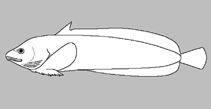
Raios dorsais (total) : 38 - 43; Raios anais : 32 - 37; Vértebras: 42 - 46. This species is distinguished from its congeners described in North Pacific by having a slender body covered with small bumps and with the anterior dorsal-fin rays forming a lobe with deeply exserted rays. It differs from C. maslenikovae by having a more slender, longer body reflected in the following morphometric characters: body depth at pelvic disc less than 17.3-24.6 % (vs. 24.1-31.0 %); head width less than 11.1-14.9 % (vs. 15.1-20.1 %); anus placed more anteriorly, with snout to anus length less 24.9-33.1 % (vs. 34.4-37.2 %), anus closer to the posterior edge of the pelvic disc 1.6-5.6 % (vs. 5.8-7.0 %); pre-anal-fin length shorter 34.4-43.2 % (vs. 43.9-47.7 %); and length posterior to anal-fin origin longer 56.8-65.6 (vs. 52.3-56.1 %); and, meristic characters are also different between the two species: vertebrae 42-46 (vs. 42-43), dorsal-fin rays 38-43 (vs. 38-40), and pectoral-fin rays 28-32 (vs. 26-29). This species differs from C. lacrima with its more slender body with its tight skin (vs. more robust body with loose thin skin in C. lacrima), suprabranchial pores 2 (vs. one), chin pores 2 and separate (vs. one), and with lower meristic counts: dorsal-fin rays 38-43 (vs. 47-52); anal-fin rays 32-37 (vs. 43-45); pectoral-fin rays 28-32 (vs. 32-38); and total vertebrae 42-46 (vs. 53-57) (Ref. 124469).
Cross section: compressed.
A partially digested specimen (discarded) was found in the stomach of a Malacocottus zonurus collected from central Aleutian Islands (Ref. 124469).
Ciclo de vida ou comportamento de acasalamento
Maturidade | Reprodução | Desova | Ovos | Fecundidade | Larvas
Orr, J.W., 2021. Three new small snailfishes of the genus Careproctus (Teleostei: Cottiformes: Liparidae) from the Aleutian Islands, Alaska. Ichthyology & Herpetology 109(2):456-466. (Ref. 124469)
Status na Lista Vermelha da UICN (Ref. 130435: Version 2025-1)
Ameaça para os humanos
Harmless
Uso pelos humanos
Pescarias: sem interesse
Ferramentas
Relatórios especiais
Baixar XML
Fontes da internet
Estimates based on models
Índice de diversidade filogenética (Ref.
82804): PD
50 = 0.5000 [Uniqueness, from 0.5 = low to 2.0 = high].
Bayesian length-weight: a=0.00457 (0.00208 - 0.01002), b=3.17 (2.99 - 3.35), in cm total length, based on LWR estimates for this Genus-body shape (Ref.
93245).
Nível Trófico (Ref.
69278): 3.1 ±0.5 se; based on size and trophs of closest relatives
Resiliência (Ref.
120179): Elevada, tempo mínimo de duplicação da população menor que 15 meses (Preliminary K or Fecundity.).
Fishing Vulnerability (Ref.
59153): Low vulnerability (10 of 100).
🛈