Classification / Names
आम नाम | उपशब्द | Catalog of Fishes(वर्ग, प्रजाति) | ITIS | CoL | WoRMS | Cloffa
इलाज़मौबरांकी (शारक और रेज़) (sharks and rays) >
Carcharhiniformes (Ground sharks) >
Scyliorhinidae (Cat sharks) > Schroederichthyinae
Etymology: Akheilos: Named for the Greek mythological sea daemon Akheilos, who was a handsome boy until turned into a shark by the goddess Aphrodite as punishment for boasting that he was more beautiful than she (no deep meaning or special relevance to the shark, simply a “cool name” that “just seemed to click”; William T. White, pers. comm.) (See ETYFish); suwartanai: In honor of Atjep Suwartana, first director of the Research and Development Center of Oceanology, Indonesian Institute of Sciences in Ambon (where the second author works) (See ETYFish).
Environment: milieu / climate zone / गहराई सीमा / distribution range
पारिस्थितिकी
समुद्री ड़िमरसल. Tropical
Western Pacific: Indonesia.
आकार / वज़न / Age
परिपक्व अवधि: Lm ? range ? - ? cm
Max length : 53.7 cm TL पुल्लिंग / अलिंग; (Ref. 120897)
Short description
पहचान कुंजी | आकृति विज्ञान | मौरफोमैटरिक्स
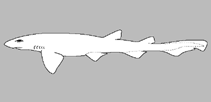
This moderately small scyliorhinid catshark is distinguished by the following set of characters: a moderately long precaudal tail region (tail much longer than trunk); dorsal fins are of similar size and shape; snout short and narrowly parabolic; eyes are large and narrowly oval (length 5.0 times in head length), broad suborbital grooves; nostrils are oblique with triangular anterior nasal flaps not reaching to mouth and distinct but low posterior nasal flaps; mouth is broadly rounded, its width 1.2 times preoral length; upper and lower labial furrows are well developed, uppers not reaching midpoint between mouth corner and posterior margin of nostril; jaws with ~60 upper and ~53 lower tooth rows, teeth are mostly multicuspid, posterolaterals not strongly differentiated from anterolaterals; caudal fin ventral lobe is low but distinct; claspers long and slender, glans elongate, long and low envelope present, cover rhipidion small without an anterior fold or tab, pseudosiphon small and slit-like; with supraorbital crests on cranium; precaudal vertebral centra 96, total centra ~137. Colouration: pale brown with numerous rusty brown spots, small brown spots forming two indistinct saddles on dorsal surface of predorsal body, broken ocellus-like marking on side behind pectoral fins and under each dorsal fin (Ref. 120897).
Cross section: oval.
Depth of occurrence unknown. Stomach contained several anterior sections of a small snake eel (Ophichthidae) (Ref. 120897).
Life cycle and mating behavior
परिपक्व अवधि | पुनरुत्पत्ति | मछलीऔ का अंडे देना | अंडे | Fecundity | लार्वा
White, W.T., Fahmi and S. Weigmann, 2019. A new genus and species of catshark (Carcharhiniformes: Scyliorhinidae) from eastern Indonesia. Zootaxa 4691(5):444-460. (Ref. 120897)
IUCN Red List Status (Ref. 130435: Version 2025-1)
Threat to humans
Harmless
Human uses
साधन
Special reports
Download XML
इंटरनेट स्रोत
Estimates based on models
Phylogenetic diversity index (संदर्भ
82804): PD
50 = 1.0000 [Uniqueness, from 0.5 = low to 2.0 = high].
Bayesian length-weight: a=0.00389 (0.00180 - 0.00842), b=3.12 (2.94 - 3.30), in cm total length, based on all LWR estimates for this body shape (Ref.
93245).
Trophic level (संदर्भ
69278): 3.9 ±0.6 se; based on size and trophs of closest relatives
लौटाव (संदर्भ
120179): निम्न, न्यूनतम जनसंख्या दुगनी होने का समय 4.5 - 14 वर्ष। (Preliminary low fecundity).
Fishing Vulnerability (Ref.
59153): Moderate vulnerability (41 of 100).
🛈