



Parmaturus angelae Soares, Carvalho, Schwingel & Gadig, 2019
Brazilian filetail catshark
Uploaden van uw Foto's en video's
Google afbeelding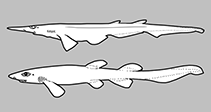 No image available for this species;
drawing shows typical species in Pentanchidae.
Google afbeelding
drawing shows typical species in Pentanchidae.
Classificatie / Namen Lokale namen | Synoniemen | Catalog of Fishes(Genus, Soort(en)) | ITIS | CoL | WoRMS | Cloffa
Elasmobranchii (haaien en roggen) (sharks and rays) > Carcharhiniformes (Ground sharks) > Pentanchidae (Deepwater catsharks)
Etymology: Parmaturus: parma (L.), from parme (Gr.), small shield; oura (Gr.), tail, presumably referring to upper edge of caudal fin “armed with modified” scales (per Garman 1913) (See ETYFish); angelae: In honor of the fourth author’s granddaughter, Angela (See ETYFish).
Eponymy: The etymology says the fish was “… dedicated to the last author’s granddaughter, Ângela.” (Ref. 128868), visit book page.
Etymology: Parmaturus: parma (L.), from parme (Gr.), small shield; oura (Gr.), tail, presumably referring to upper edge of caudal fin “armed with modified” scales (per Garman 1913) (See ETYFish); angelae: In honor of the fourth author’s granddaughter, Angela (See ETYFish).
Eponymy: The etymology says the fish was “… dedicated to the last author’s granddaughter, Ângela.” (Ref. 128868), visit book page.
Milieu: milieu / Klimaatzone / Diepte / verspreidingsgebied Ecologie
marien demersaal; diepte 500 - 600 m (Ref. 125615). Deep-water
Verspreiding Gebieden | FAO regio's | Ecosystemen | Voorkomen | Verspreidingskaart | Introducties | Faunafri
Southwestern Atlantic: Brazil.
Grootte / Gewicht / Leeftijd
Maturiteit: Lm ? range ? - ? cm
Max length : 42.5 cm TL (female)
Max length : 42.5 cm TL (female)
Korte beschrijving Determinatiesleutels | Morfologie | Morfometrie
Wervels: 121 - 122. Thie species is distinguished from its congeners by the following set of of characters: first dorsal-fin origin slightly anterior to pelvic-fin origin (vs. well anterior in P. campechiensis); dorsal fins subequal (vs. first dorsal fin smaller in P. campechiensis and first dorsal fin slightly larger in P. xaniurus); upper caudal crest of denticles separated from lateral denticles by naked strip (vs. barely separated in P. xaniurus); lower caudal crest of denticles well developed and extending until last third of ventral caudal-fin lobe (vs. extending until the end of ventral caudal-fin lobe in P. campechiensis and reduced or absent in P. xaniurus; labial furrows discontinuous (vs. continuous in P. campechiensis and P. xaniurus); anal-fin base 1.6 times anal-fin height (vs. 3 times in P. campechiensis and 2.2-2.5 in P. xaniurus); pre-first dorsal-fin length 4.3 times interdorsal space (vs. 4.9 times in P. xaniurus); prenarial length 0.8-1.1 times in prepectoral length (vs. 0.3 times in P. campechiensis); mouth width 2.6 times mouth length (vs. 1.9 times in P. campechiensis); monospondylous precaudal centra 38 (vs. 39 in P. campechiensis), and total vertebrae counts 121-122 (vs. 111 in P. campechiensis and 109-121 in P. xaniurus) (Ref. 125615).
Cross section: angular.
Cross section: angular.
Probably a demersal-benthic dwelling shark. The stomach (8.5 cm in length) of the paratype was almost empty, except for one fish eye lens, but an analysis of the intestine (9.0 cm) revealed small pieces of teleostean musculature and a fin spine, a crustacean appendage (pleopod or pereopod), a well-digested 5.0 cm long polychaete body piece, and five dark 22 mm long chaetae, possibly from this same annelid specimen. Reproductive mode oviparous, with just one functional ovary, the right, with four follicles (between 5 and 17 mm diameter), a well-developed nidamental gland, 18 mm (right) and 15 mm (left) in width and fully developed oviducts. Two completely formed slender vase-like dark brown (after fixation) egg cases, one in each oviduct, and both measuring 73 mm in length and 24 mm in width, narrowing at about 1/4 of its length from the anterior border. The surface seems to be smooth in macro view, but with numerous delicate longitudinal ridges and lateral keel along the entire both sides. Both small lateral keel-associated respiratory fissures not reaching to the borders, the anterior measuring 8 mm and the posterior 6 mm in length. Anterior border slightly convex, measuring 1.81 cm in width, pointed in each corner. Posterior margin very small, not measured, with two horn tendrils 3 mm in length in each tip and very small fringed fibrous hair-like filaments between the horns (Ref. 125615).
Levenscyclus en paargedrag Maturiteit | Voortplanting | Paaien | Eieren | Fecunditeit | Larven
Hoofdreferentie
Upload uw referenties | Referenties | Coördinator | Medewerkers
Soares, K.D.D.A., M.R. De Carvalho, P.R. Schwingel and O.B.F. Gadig, 2019. A new species of Parmaturus (Chondrichthyes: Carcharhiniformes: Scyliorhinidae) from Brazil, Southwestern Atlantic. Copeia, 107(2):314-322. (Ref. 125615)
Status op de Rode Lijst van het IUCN (Ref. 130435: Version 2025-2 (Global))
Kwetsbaar (VU) (A2d); Date assessed: 08 August 2019
CITES
Not Evaluated
Gevaar voor de mens
Harmless
Gebruik door de mens
FAO - Publication: search | FishSource |
Meer informatie
Trofische ecologie
Voedsel (prooien)
Dieetsamenstelling
Voedselconsumptie
Voedselrantsoenen
Predatoren
Voedsel (prooien)
Dieetsamenstelling
Voedselconsumptie
Voedselrantsoenen
Predatoren
Ecologie
Ecologie
Ecologie
Populatiedynamica
Groeiparameters
Max. leeftijden / maten
Lengte-gewicht rel.
Lengte-lengte rel.
Lengtefrequenties
Massaconversie
Rekrutering
Abundantie
Groeiparameters
Max. leeftijden / maten
Lengte-gewicht rel.
Lengte-lengte rel.
Lengtefrequenties
Massaconversie
Rekrutering
Abundantie
Levenscyclus
Voortplanting
Maturiteit
Rijpheid/kieuwen rel.
Fecunditeit
Paaien
Paaibestanden
Eieren
Ontwikkeling van de eieren
Larven
Larvale populatiedynamiek
Voortplanting
Maturiteit
Rijpheid/kieuwen rel.
Fecunditeit
Paaien
Paaibestanden
Eieren
Ontwikkeling van de eieren
Larven
Larvale populatiedynamiek
Anatomie
Kieuwoppervlak
Hersenen
Otoliet
Kieuwoppervlak
Hersenen
Otoliet
Fysiologie
Lichaamssamenstelling
Voedingsstoffen
Zuurstofverbruik
Type zwemmen
Zwemsnelheid
Visuele pigmenten
Vis geluid
Ziekten en parasieten
Toxiciteit (LC50)
Lichaamssamenstelling
Voedingsstoffen
Zuurstofverbruik
Type zwemmen
Zwemsnelheid
Visuele pigmenten
Vis geluid
Ziekten en parasieten
Toxiciteit (LC50)
Genetica
genoom
Genetica
Heterozygositeit
Erfelijkheid
Genetische diversiteit
genoom
Genetica
Heterozygositeit
Erfelijkheid
Genetische diversiteit
Menselijk gerelateerd
Aquacultuursystemen
Aquacultuurprofielen
Kweeklijnen
Ciguatera gevallen
Postzegels, munten, diversen.
Aquacultuursystemen
Aquacultuurprofielen
Kweeklijnen
Ciguatera gevallen
Postzegels, munten, diversen.
Tools
Speciale rapporten
Bekijk gegevens voor het houden in een aquarium | Bekijk Fact Sheets voor de soort | Bekijk Aquacultuur Fact Sheets
Download XML
Internetbronnen
AFORO (otoliths) | Aquatic Commons | BHL | Cloffa | Websites from users | Bekijk FishWatcher | CISTI | Catalog of Fishes: Genus, Soort(en) | DiscoverLife | ECOTOX | FAO - Publication: search | Faunafri | Fishipedia | Fishtrace | GloBI | Google Books | Google Scholar | Google | IGFA World Record | OneZoom | Open Tree of Life | Otolith Atlas of Taiwan Fishes | PubMed | Reef Life Survey | Socotra Atlas | TreeBase | Tree of Life | Wikipedia: ga naar, zoek | World Records Freshwater Fishing | Zoobank | Zoological Record
Schattingen op basis van modellen
Fylogenetische diversiteitsindex (Ref. 82804): PD50 = 0.5078 [Uniqueness, from 0.5 = low to 2.0 = high].
Bayesian length-weight: a=0.00347 (0.00172 - 0.00698), b=3.08 (2.90 - 3.26), in cm total length, based on LWR estimates for this (Sub)family-body shape (Ref. 93245).
Trofisch niveau (Ref. 69278): 4.0 ±0.5 se; based on size and trophs of closest relatives
Weerstandsvermogen (Ref. 120179): Hoog, minimale populatieverdubbelingstijd minder dan 15 maanden (Preliminary K or Fecundity.).