Classification / Names
Noms communs | Synonymes | Catalog of Fishes(Genre, Espèce) | ITIS | CoL | WoRMS | Cloffa
>
Gobiiformes (Gobies) >
Gobiidae (Gobies) > Gobionellinae
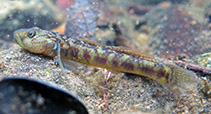
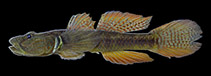
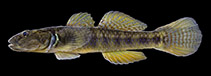
Etymology: Rhinogobius: Greek, rhinos = nose + Latin, gobius = gudgeon (Ref. 45335); tandikan: Named after the local name of Palawan peacock-pheasant, Polyplectron napoleonis Lesson, known as a symbol of Puerto Princesa City and locally known as Tandikan; referring to the blue markings on the body, suggestive of the plumage of the Palawan peacock-pheasant; noun in apposition.
Environment: milieu / climate zone / profondeur / distribution range
Écologie
; eau douce benthopélagique. Tropical
Asia: Philippines.
Taille / Poids / Âge
Maturité: Lm ? range ? - ? cm
Max length : 4.7 cm SL mâle / non sexé; (Ref. 125663); 4.6 cm SL (female)
Description synthétique
Clés d'identification | Morphologie | Morphométrie
Épines dorsales (Total) : 7; Rayons mous dorsaux (Total) : 8; Épines anales: 1; Rayons mous anaux: 8; Vertèbres: 26. This species is distinguished by the following characters pectoral fin 16-17 rays; nape and posterior part of occipital region covered by cycloid scales with the scaled area extending anteriorly to around a vertical line through posterior margin of preopercle or a little posterior to this line; longitudinal scales 29-34, predorsal scales 5-13; total vertebrae 26; cephalic sensory pore system usually with B´, C, D(S), E, F, H´, K´, L´, M´, N, and O´, but often lacking one or both side(s) of pore C; cheek with transverse rows of sensory papillae. Colouration: when preserved, the lateral and dorsal sides of body with no mesh-like markings, obscure markings on cheek, and upper half of pectoral fin with dark brown band vertically across proximal part; when fresh, pectoral-fin base with a bright white vertical band reaching near bottom of fin (Ref. 125663).
Cross section: oval.
This species is found only in the Cayulo River which is a small stream (length approximately 4 km in�cluding 1 km of an estuary) flowing into Ulugan Bay on South China Sea-side of the island. The stream system is surrounded by mountains of about 200-400 m above sea level. The Cayulo Falls is composed of a series of small waterfalls, located at the middle reaches of this stream and the species was found at both the lower and upper reaches of this waterfall, as well as pools in the middle of the falls. It was abundant in this site with many other goby species, cyprinids, and a jungle perch species (Ref. 125663).
Life cycle and mating behavior
Maturité | Reproduction | Frai | Œufs | Fécondité | Larves
Maeda, K., C. Shinzato, R. Koyanagi, T. Kunishima, H. Kobayashi, N. Satoh and H.P. Palla, 2021. Two new species of Rhinogobius (Gobiiformes: Oxudercidae) from Palawan, Philippines, with their phylogenetic placement. Zootaxa 5068(1):81-98. (Ref. 125663)
Statut dans la liste rouge de l'IUCN (Ref. 130435: Version 2025-1)
Menace pour l'homme
Harmless
Utilisations par l'homme
Pêcheries: sans intérêt
Outils
Articles particuliers
Télécharger en XML
Sources Internet
Estimates based on models
Phylogenetic diversity index (Réf.
82804): PD
50 = 0.5000 [Uniqueness, from 0.5 = low to 2.0 = high].
Bayesian length-weight: a=0.00724 (0.00338 - 0.01553), b=3.05 (2.87 - 3.23), in cm total length, based on LWR estimates for this (Sub)family-body shape (Ref.
93245).
Niveau trophique (Réf.
69278): 3.2 ±0.4 se; based on size and trophs of closest relatives
Résilience (Réf.
120179): Haut, temps minimum de doublement de population inférieur à 15 mois (Preliminary K or Fecundity.).
Fishing Vulnerability (Ref.
59153): Low vulnerability (10 of 100).
🛈