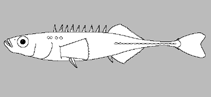
Classification / Names
Populärnamn | synonymer | Catalog of Fishes(Släkte, Arter) | ITIS | CoL | WoRMS | Cloffa
Environment: milieu / climate zone / djupintervall / distribution range
Ekologi
; sötvatten bentopelagisk. Temperate
Europe: France.
Size / Vikt / Age
Könsmognad: Lm ? range ? - ? cm
Max length : 3.9 cm SL hane/ej könsbestämd; (Ref. 125067); 4.6 cm SL (female)
Short description
Bestämningsnycklar | Morfologi | Morfometri
This species is redescribed and is distinguished from its congeners by tThe following characters: head rounded with a straight or slightly convex snout; pectoral rays 11 (vs. typically 10-11) and no scute on the caudal peduncle (vs. 0-12 P. pungitius and 0-4 P. laevis); D VIII-IX (neotype IX); no scute on the caudal peduncle; pectoral fin rays (10) 11 (12-13) (neotype 11). Colouration: adult specimens with a yellowish coloration and with very thin black dots, whereas the young ones are blueish green; however, color pattern is very variable between individuals from a same population, or having the same age or sex (Ref. 125067).
Cross section: compressed.
Inhabits streams, tributaries, and ponds. May also have a tolerance of salinity like the other species of Pungitius. In the Garonne drainage, it has a very restrictive habitat with low elevation and short distance from the source. Monogamy observed, also nest building, but monogamy needs to be verified because ordinarily, the ninespined-sticklebacks are polygamous. It can hybridize with the two other species where they are in sympatry: with P. pungitius in the Vienne basin and P. laevis in the coastal Atlantic Basins (Ref. 125067).
Life cycle and mating behavior
Könsmognad | Reproduktion | Lek | Ägg | Fecundity | Larver
Denys, G.P.J., H. Persat, A. Dettaï, M.F. Geiger, J. Freyhof, J. Fesquet and P. Keith, 2017. Genetic and morphological discrimination of three species of ninespined stickleback Pungitius spp. (Teleostei, Gasterosteidae) in France with the revalidation of Pungitius vulgaris (Mauduyt, 1848). J Zool Syst Evol Res. 2018;56:77-101. (Ref. 125067)
IUCN Red List Status (Ref. 130435: Version 2025-1)
Threat to humans
Harmless
Human uses
Verktyg
Special reports
Download XML
Internet-källor
Estimates based on models
Phylogenetic diversity index (Ref.
82804): PD
50 = 0.5005 [Uniqueness, from 0.5 = low to 2.0 = high].
Bayesian length-weight: a=0.00468 (0.00204 - 0.01073), b=3.05 (2.84 - 3.26), in cm total length, based on LWR estimates for this (Sub)family-body shape (Ref.
93245).
Trofisk nivå (Ref.
69278): 3.3 ±0.2 se; based on size and trophs of closest relatives
Resiliens (Ref.
120179): Hög, lägsta populationsfördubblingstid mindre än 15 månader (Preliminary K or Fecundity.).
Fishing Vulnerability (Ref.
59153): Low vulnerability (10 of 100).
🛈