



Haplochromis erutus Vranken, Van Steenberge & Snoeks, 2020
Carica il tuo foto e Video
Google image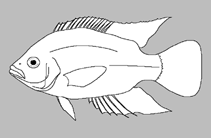 No image available for this species;
drawing shows typical species in Cichlidae.
Google image
drawing shows typical species in Cichlidae.
Classificazione / Nomi Nomi Comuni | Sinonimi | Catalog of Fishes(Genere, Specie) | ITIS | CoL | WoRMS | Cloffa
> Cichliformes (Cichlids, convict blennies) > Cichlidae (Cichlids) > Pseudocrenilabrinae
Etymology: Haplochromis: Greek, Haploos = single + Greek, chromis = a fish, perhaps a perch (Ref. 45335); erutus: Specific name noun in apposition from Latin erutus, torn out, and refers to its oral-shelling ecology, in which soft bodies of snails are wrenched or torn out of their shells (Ref. 126074).
Etymology: Haplochromis: Greek, Haploos = single + Greek, chromis = a fish, perhaps a perch (Ref. 45335); erutus: Specific name noun in apposition from Latin erutus, torn out, and refers to its oral-shelling ecology, in which soft bodies of snails are wrenched or torn out of their shells (Ref. 126074).
Ambiente: milieu / zona climatica / distribuzione batimetrica / gamma di distribuzione Ecologia
; acqua dolce pelagico. Tropical
Distribuzione Territories | Aree FAO | Ecosistemi | Presenze | Mappa dei ritrovamenti | Introduzioni | Faunafri
Africa: endemic to Lake Edward (Ref. 126074).
Dimensione / Peso / Età
Breve descrizione Chiavi di identificazione | Morfologia | Morfometria
Spine dorsali (totale) : 15 - 16; Raggi dorsali molli (totale) : 8 - 10; Spine anali: 3; Raggi anali molli: 7 - 9; Vertebre: 29 - 30. Diagnosis: Haplochromis erutus differs from all other species of Haplochromis, except H. bicolor from Lake Victoria, by a small and rectangular mouth with a short upper jaw that curves downwards halfway its length, in combination with blunt, bicuspid and recurved outer oral teeth and, in lateral part of upper jaw, more stout inner teeth, mostly more distinct in dextral side; it differs from H. bicolor by much larger eyes, 35.4-40.7% of head length vs. 21.4-32.0%, slightly more slender interorbital width, 22.5-26.1% of head length vs. 25.8-34.5%, and slightly shorter snout, 23.2-27.1% of head length vs. 26.5-34.2; it differs further by a shallower supraoccipital crest, dominant males with beige-silver vs. red flanks and piebald colouration seemingly absent in H. erutus, while frequently observed in females of H. bicolor (Ref. 126074). Within Lake Edward system, it shares with H. concilians, H. labiatus, H. eduardianus and H. planus stout jaws and large or more strongly developed lips; it differs from H. labiatus by a shorter snout, 22.4-25.4% of head length vs. 26.5-30.2%, and large vs. lobed lips; from H. eduardianus and H. planus by a shorter upper jaw, 20.9-26.% of head length vs. 27.5-33.8% and 27.6-32.1% respectively; and from H. concilians by large vs. strongly thickened lips, a longer premaxillary pedicel, 21.4-24.0% of head length vs. 16.1-21.6%, and beige-silver vs. silver-blue dominant males (Ref. 126074).
Diet mainly mollucivorous (Ref. 126074).
Ciclo vitale e comportamento di accoppiamento Maturità | Riproduzione | Deposizione | Uova | Fecondità | Larve
Riferimento principale
Caricare le referenze | Bibliografia | Coordinatore : Kullander, Sven O. | Collaboratori
Vranken, N., M. Van Steenberge and J. Snoeks, 2020. Similar ecology, different morphology: three new species of oral-mollusc shellers from Lake Edward. J. Fish Biol. 96(5):1202-1217. (Ref. 126074)
CITES
Not Evaluated
Minaccia per l'uomo
Harmless
Usi umani
FAO - Publication: search | FishSource |
Informazioni ulteriori
Ecologia trofica
Articoli alimentari (prede)
Alimentazione
Consumo di cibo
Razioni alimentari
Predatori
Articoli alimentari (prede)
Alimentazione
Consumo di cibo
Razioni alimentari
Predatori
Dinamica della popolazione
Parametri di crescita
Età massima / dimensioni massime
Rapporto lunghezza-peso.
Lunghezza-lunghezza rel.
Lunghezza-frequenze
Conversione di massa
Reclutamento
Abbondanza
Parametri di crescita
Età massima / dimensioni massime
Rapporto lunghezza-peso.
Lunghezza-lunghezza rel.
Lunghezza-frequenze
Conversione di massa
Reclutamento
Abbondanza
Ciclo di vita
Riproduzione
Maturità
Maturità/Gli occhielli sono relativi.
Fecondità
Deposizione
Aggregazioni riproduttive
Uova
Sviluppo delle uova
Larve
Dinamica popolazioni larvali
Riproduzione
Maturità
Maturità/Gli occhielli sono relativi.
Fecondità
Deposizione
Aggregazioni riproduttive
Uova
Sviluppo delle uova
Larve
Dinamica popolazioni larvali
Anatomia
Area branchiale
Cervello
Otolite
Area branchiale
Cervello
Otolite
Fisiologia
Composizione corporea
Nutrienti
Consumo di ossigeno
Tipo di nuoto
Velocità di nuoto
Pigmenti visivi
Suono del pesce
Malattie e parassiti
Tossicità (LC50)
Composizione corporea
Nutrienti
Consumo di ossigeno
Tipo di nuoto
Velocità di nuoto
Pigmenti visivi
Suono del pesce
Malattie e parassiti
Tossicità (LC50)
Genetica
Genome
Genetica
Eterozigosi
Ereditarietà
Diversità genetica
Genome
Genetica
Eterozigosi
Ereditarietà
Diversità genetica
Legato all'uomo
Sistemi di acquacoltura
Profili di acquacoltura
Varietà
Casi di Ciguatera
Francobolli, monete, materiale vario.
Sistemi di acquacoltura
Profili di acquacoltura
Varietà
Casi di Ciguatera
Francobolli, monete, materiale vario.
Strumenti
Libro elettronico | Giuda pratica | Generatore frequenze di lunghezza | Strumento Parametri Biologici | Mappa dei ritrovamenti |
Cattura-MSY |
Rapporti speciali
Controllo della manutenzione dell'acquario | Verificare la presenza di schede informative sulle specie | Verifica delle schede informative sull'acquacoltura
Scarica XML
Fonti Internet
AFORO (otoliths) | Aquatic Commons | BHL | Cloffa | Websites from users | Check FishWatcher | CISTI | Catalog of Fishes: Genere, Specie | DiscoverLife | ECOTOX | FAO - Publication: search | Faunafri | Fishipedia | Fishtrace | GloBI | Google Books | Google Scholar | Google | IGFA World Record | OneZoom | Open Tree of Life | Otolith Atlas of Taiwan Fishes | PubMed | Reef Life Survey | Socotra Atlas | TreeBase | Tree of Life | Wikipedia: Go, ricerca | World Records Freshwater Fishing | Zoobank | Record zoologico
Stime basate su modelli
Indice di diversità filogenetica (Fonte Biblio. 82804): PD50 = 0.5000 [Uniqueness, from 0.5 = low to 2.0 = high].
Bayesian length-weight: a=0.01445 (0.00671 - 0.03113), b=2.99 (2.82 - 3.16), in cm total length, based on LWR estimates for this (Sub)family-body shape (Ref. 93245).
Livello trofico (Fonte Biblio. 69278): 3.3 ±0.4 se; based on size and trophs of closest relatives
Resilienza (Fonte Biblio. 120179): Alto, tempo minimo di raddoppiamento della popolazione meno di 15 mesi (Preliminary K or Fecundity.).