>
Pleuronectiformes (Flatfishes) >
Pleuronectidae (Righteye flounders) > Pleuronichthyinae
Etymology: Pleuronichthys: Greek, pleura = side, ribe Greek, ichthys = fish (Ref. 45335).
Eponymy: Dr Sol Felty Light (1886–1947) was an American zoologist who taught at the University of California, Berkeley. [...] (Ref. 128868), visit book page.
Environment: milieu / climate zone / rango de profundidad / distribution range
Ecología
marino; salobre demersal. Subtropical
Northwest Pacific: Japan Arch. (southward from southern Hokkaido), Korean Peninsula, China and Taiwan; including offshore waters of the Bohai, Yellow and East China Seas; latitudinal range extending from Peter the Great Bay (northern limit) to Hong Kong.
Tamaño / Peso / Age
Madurez: Lm ? range ? - ? cm
Short description
Claves de identificación | Morfología | Morfometría
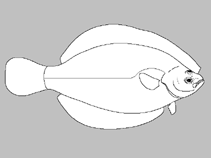
Radios blandos dorsales (total) : 71 - 83; Radios blandos anales: 50 - 62; Vértebra: 36 - 39. This species is distinguished by the following characters: scale length (trunk area) less than 1.23% of SL, the whole scale outline fan-shaped, exposed margin rhombic; scales non-deciduous, longitudinal and vertical scale rows essentially regular; upper eye area usually less than lower eye area, area ratio 0.70–1.08; central longitudinal scales 88-105, scales below lateral line 59-74, abdominal vertebrae 12-14 (usually 13) (Ref. 126213).
Cross section: flattened.
Occurs mainly on sandy bottoms in shallow coastal waters (relatively dominant over P. cornutus in Tokyo and Ise Bays, and the Seto Inland, Ariake and Yatsushiro Seas. Probably have some tolerance for reduced salinity forit is reported to be occasionally occurring in river estuaries in China and Korea and brackish waters in Japan (Ref. 126213).
Life cycle and mating behavior
Madurez | Reproducción | Puesta | Huevos | Fecundidad | Larva
Yokogawa, K., K.-I. Watanabe and G. Ogihara, 2016. Redescriptions of two closely related East Asian flatfish species of the genus Pleuronichthys. Zootaxa 4205(1):1-23. (Ref. 126213)
IUCN Red List Status (Ref. 130435: Version 2025-1)
Threat to humans
Harmless
Human uses
Herramientas
Special reports
Download XML
Fuentes de Internet
Estimates based on models
Phylogenetic diversity index (Referencia
82804): PD
50 = 0.5039 [Uniqueness, from 0.5 = low to 2.0 = high].
Bayesian length-weight: a=0.01660 (0.00691 - 0.03983), b=3.01 (2.80 - 3.22), in cm total length, based on LWR estimates for this (Sub)family-body shape (Ref.
93245).
Nivel trófico (Referencia
69278): 3.2 ±0.3 se; based on size and trophs of closest relatives
Resiliencia (Referencia
120179): Medio, población duplicada en un tiempo mínimo de 1.4-4.4 años (Preliminary K or Fecundity.).
Fishing Vulnerability (Ref.
59153): Low to moderate vulnerability (25 of 100).
🛈