Elasmobranquios (tiburones y rayas) (sharks and rays) >
Rajiformes (Skates and rays) >
Arhynchobatidae (Softnose skates)
Etymology: Bathyraja: Greek, bathys = deep + Latin, raja, -ae = a ray (Raja sp) (Ref. 45335); kincaidii: Named after Professor Trevor Kincaid from the University of Washington (Ref. 6885).
Environment: milieu / climate zone / rango de profundidad / distribution range
Ecología
marino batidemersal; rango de profundidad 119 - 1372 m (Ref. 126515). Temperate
North Pacific: Canada (British Columbia) south to Baja California, Mexico. Possibly up to Alaska (may be confused with Bathyraja interrupta), but this northern extent cannot be verified.
Tamaño / Peso / Age
Madurez: Lm ? range ? - ? cm
Max length : 62.0 cm TL macho / no sexado; (Ref. 126515); 58.0 cm TL (female); edad máxima reportada: 18 años (Ref. 126515)
Short description
Claves de identificación | Morfología | Morfometría
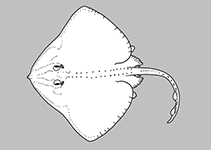
This small and rounded skate (max 56.0 cm TL), with short disc length (29.0-54.1% TL), width (61.2-67.3% TL), head length (15.9-21.3% TL), and internarial distance (5.2-6.7% TL); claspers are long and thin, rounded tip not bulbous, no pseudosiphon, with an average pseudorhipidion and not conspicuously projecting from the tip, V-shaped cleft, has a projection and an average sentina, projection is pointed; teeth in 22-31 rows on upper jaw and 18-31 rows on lower jaw; pectoral radials 69-72; pelvic fins17-22; total vertebrae 132; dorsal surface covered in uniform prickles; thorns present on dorsal surface, males with well-developed alar thorns, no malar thorns, middorsal thorns range in number (0-9), nuchal thorns strong (3-7), tail thorns few (14-22), scapular vary in count (0-2), interdorsal thorns weak or obsolete (0-2), thorns in a continuous row. Colouration: dorsal mottled brown to grey, with numerous small dark spots; ventral coloration white, usually with dark brown blotches on underside of tail (Ref. 126515).
Cross section: flattened.
Common on the continental shelf-slope break. Inhabits deep waters where inidividuals are usually in deeper waters at the southern edge of distribution. Reported to feed on invertebrates (euphausiids, polychaetes, amphipods, crabs, and mysids). Size at maturity for males 44 cm TL and 45 cm TL for females, where males grow to 62 cm TL and females to 58 cm TL; size at birth is 12-16 cm TL. Estimated maximum age for females 17 years and for males 18 years, Egg cases are very small (5.0-6.6 cm TL), colour light to dark brown, with dorsal surface covered with fine fibers, while ventral with either a thin fibrous layer or without. The egg cases reported to have long, inward bending horns at each corner and strong lateral keels, the horns flattening and becoming thread-like at the tips (Ref. 126515).
Life cycle and mating behavior
Madurez | Reproducción | Puesta | Huevos | Fecundidad | Larva
Knuckey, J.D.S. and D.A. Ebert, 2022. A taxonomic revision of Northeast Pacific softnose skates (Rajiformes: Arhynchobatidae: Bathyraja Ishiyama). Zootaxa 5142(1):1-89. (Ref. 126515)
IUCN Red List Status (Ref. 130435: Version 2025-1)
Threat to humans
Harmless
Human uses
Herramientas
Special reports
Download XML
Fuentes de Internet
Estimates based on models
Phylogenetic diversity index (Referencia
82804): PD
50 = 0.5000 [Uniqueness, from 0.5 = low to 2.0 = high].
Bayesian length-weight: a=0.00550 (0.00291 - 0.01038), b=3.13 (2.97 - 3.29), in cm total length, based on LWR estimates for this Genus-body shape (Ref.
93245).
Nivel trófico (Referencia
69278): 3.9 ±0.7 se; based on size and trophs of closest relatives
Generation time: 6.6 ( na - na) years. Estimated as median ln(3)/K based on 2
growth studies.
Resiliencia (Referencia
120179): Bajo, población duplicada en un tiempo mínimo de 4.5-14 años (Preliminary K or Fecundity.).
Fishing Vulnerability (Ref.
59153): Moderate vulnerability (45 of 100).
🛈