Classification / Names
ชื่อสามัญ | ชื่อพ้อง | Catalog of Fishes(สกุล, ชนิด) | ITIS | CoL | WoRMS | Cloffa
>
Cichliformes (Cichlids, convict blennies) >
Cichlidae (Cichlids) > Pseudocrenilabrinae
Etymology: Hemichromis: Greek, hemis = half + Greek, chromis = a fish, perhaps a perch (Ref. 45335); camerounensis: The specific name refers to the country "Cameroun" or "Cameroon" where the species was discovered and found to be common in the major coastal Atlantic river systems (Ref. 123791).
Environment: milieu / climate zone / ระดับความลึก / distribution range
นิเวศวิทยา
; น้ำจืด ผิวน้ำ. Tropical
Africa: coastal basins of Cameroon and south-eastern Nigeria, from Cross River to Lobe River (Ref. 123791). Also in upper Chad basin in Cameroon (Ref. 123791).
ขนาด / น้ำหนัก / Age
วัยเจริญพันธุ์: Lm ? range ? - ? cm
Max length : 14.6 cm SL เพศผู้/กระเทย; (Ref. 123791)
Short description
เครื่องมือที่ใช้ในการแยกชนิดสัตว์,สิ่งมีชีวิตออกจากกัน | สัณฐานวิทยา | ความยาวต่างๆ
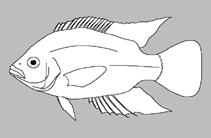
เงี่ยงครีบหลัง (รวม) : 14 - 15; ก้านครีบอ่อนที่หาง (รวม) : 10 - 12; ก้านครีบอ่อนที่ก้น: 8 - 11. Diagnosis: Live or freshly caught specimens of Hemichromis camerounensis can be distinguished from H. fasciatus by the two distinct red opercular spots on either side of the single large black opercular spot while there is no or just one red spot present in the latter species; it can be further distinguished from H. fasciatus by a combination of overlapping morphometrics: a low number of dorsal fin soft rays, 10-12 vs. 11-14; few cheek row scales, 3-5 vs. 5-7; low number of longitudinal line scales, 28-30 vs. 29-32; a shallow cheek, 20.0-31.4% of head length vs. 21.6-34.0%; short snout, 27.2-35.2% of head length vs. 27.4-36.4%; large eyes, 22.4-32.5% of head length vs. 19.7-27.2%; broad interorbital region and head, respectively 24.3-31.1% and 40.8-48.3% of head length vs. 23.0-30.1% and 39.0-46.6%; in addition, the lower pharyngeal jaw in H. camerounensis is more V-shaped with a dentigerous area more long than that of H. fasciatus which is more Y-shaped with a dentigerous area less long (Ref. 123791). Hemichromis camerounensis can be distinguished from H. elongatus by the two distinct red opercular spots on either side of the single large black opercular spot in live or freshly-caught specimens while in H. elongatus there is one red spot or a mixture of reddish and yellowish spots above the large black opercular spot; the ventral parts of the body and head of H. camerounensis are variable in colour and vary from dark to white sometimes reddish, while a homogeneous red colour is present on the ventral parts of the body and head in adults of H. elongatus; it can further be distinguished from H. elongatus by a combination of overlapping morphometrics, mainly by a low number of dorsal fin soft rays, 10-12 vs. 11-13; high number of upper transverse line scales, 3-5 vs. 3-4.5; low number of pectoral to pelvic fins row scales, 4-6 vs. 4-7; a short premaxillary pedicel, 39.1-48.8% of head length vs. 38.0-51.2%; broad interorbital region, 24.3-31.1% of head length vs. 21.8-30.4%; short head, 33.1-38.7% of standard length vs. 34.2-40.3%; short predorsal, prepectoral and prepelvic distances, respectively 33.8-39.0%, 34.3-42.7% and 37.6-43.7% of standard length vs. 34.3-41.3%, 35.1-42.3% and 38.2-48.1%; long dorsal and anal fin bases, respectively 50.8-57.3% and 13.7-18.4% of standard length vs. 48.1-56.8% and 12.8-18.2%; the posterior margin of this pharyngeal bone in H. camerounensis is noticeably less concave and wider than that of H. elongatus and it comprises on average fewer teeth, 16-24 vs. 19-26 (Ref. 123791).
Life cycle and mating behavior
วัยเจริญพันธุ์ | การสืบพันธุ์ | การวางไข่ | เซลสืบพันธ์ของเพศเมีย(ไข่) | ความดกของไข่ | ตัวอ่อน
Bitja-Nyom, A.R., J.-F. Agnèse, A. Pariselle, C.F. Bilong-Bilong, A. Gilles and J. Snoeks, 2021. A systematic revision of the five-spotted Hemichromis complex (Cichliformes: Cichlidae) from West Africa and Lower Guinea, with the description of a new species from Cameroon. Hydrobiologia 848:3779-3803. (Ref. 123791)
IUCN Red List Status (Ref. 130435: Version 2025-1)
Threat to humans
Harmless
Human uses
เครื่องมือ
Special reports
Download XML
แหล่งที่มาจากอินเตอร์เน็ต
Estimates based on models
Phylogenetic diversity index (อ้างอิง
82804): PD
50 = 0.5625 [Uniqueness, from 0.5 = low to 2.0 = high].
Bayesian length-weight: a=0.01445 (0.00674 - 0.03099), b=2.99 (2.82 - 3.16), in cm total length, based on LWR estimates for this (Sub)family-body shape (Ref.
93245).
ระดับชั้นอาหาร (อ้างอิง
69278): 3.4 ±0.5 se; based on size and trophs of closest relatives
ความสามารถในการกลับคืนสู่ปกติ (อ้างอิง
120179): ความสูง, เวลาต่ำสุดที่จะทำให้ประชากรเพิ่มขึ้นเป็น 2 เท่าใช้เวลาน้อยกว่า 15 เดือน (Preliminary K or Fecundity.).
Fishing Vulnerability (Ref.
59153): Low vulnerability (10 of 100).
🛈