



Scymnodalatias sherwoodi (Archey, 1921)
Sherwood dogfish
Envoyez vos Photos et vidéos
Images | Images Google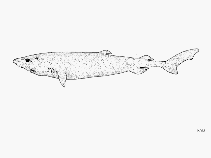 Scymnodalatias sherwoodi
Photo de FAO
Images | Images Google
Photo de FAO
Classification / Noms Noms communs | Synonymes | Catalog of Fishes(Genre, Espèce) | ITIS | CoL | WoRMS | Cloffa
Élasmobranches (requins et raies) (sharks and rays) > Squaliformes (Sleeper and dogfish sharks) > Somniosidae (Sleeper sharks)
Etymology: Scymnodalatias: scymno-, referring to previous placement in Scymnodon; dalatias, referring to lack of dorsal spines like most sharks in the family Dalatiidae (sometimes included within Somniosidae) (See ETYFish); sherwoodi: In honor of C. W. Sherwood, who discovered the shark washed up on a beach in Canterbury, New Zealand, and presented it to the local museum (See ETYFish).
Eponymy: C W Sherwood discovered the holotype lying washed up on the beach at New Brighton, New Zealand (1920) and presented it to the Canterbury Museum. Nothing further was recorded. (Ref. 128868), visit book page.
Etymology: Scymnodalatias: scymno-, referring to previous placement in Scymnodon; dalatias, referring to lack of dorsal spines like most sharks in the family Dalatiidae (sometimes included within Somniosidae) (See ETYFish); sherwoodi: In honor of C. W. Sherwood, who discovered the shark washed up on a beach in Canterbury, New Zealand, and presented it to the local museum (See ETYFish).
Eponymy: C W Sherwood discovered the holotype lying washed up on the beach at New Brighton, New Zealand (1920) and presented it to the Canterbury Museum. Nothing further was recorded. (Ref. 128868), visit book page.
Environnement : milieu / zone climatique / profondeur / gamme de distribution Écologie
marin benthopélagique. Subtropical; 42°S - 44°S
Distribution Territoires | Zones FAO | Écosystèmes | Occurrences | Carte par point | Introductions | Faunafri
Southwest Pacific: New Zealand. Possibly occurring off Australia (Ref. 6871).
Taille / Poids / Âge
Description synthétique Clés d'identification | Morphologie | Morphométrie
Épines dorsales (Total) : 0. Dark brown or black with a grey blaze on the back behind the eyes (Ref. 26346). Scymnodon-like, but with no dorsal spines and the first dorsal fin slightly more posterior than in Scymnodon species; snout somewhat flattened, not bulbous, lower teeth with very high, erect or semi-erect cusps, distal blades and no serrations, first dorsal on middle of back behind pectoral fins, caudal fin asymmetrical, with a short lower lobe, fins without prominent light edges (Ref. 247).
Body shape (shape guide): elongated.
Body shape (shape guide): elongated.
A rare species (Ref. 26346) presumably inhabiting the insular slope of New Zealand (Ref. 247). Ovoviviparous (Ref. 205).
Cycle de vie et comportement reproducteur Maturité | Reproduction | Frai | Œufs | Fécondité | Larves
Distinct pairing with embrace (Ref. 205).
Référence principale
Téléchargez vos références | Références | Coordinateur | Collaborateurs
Compagno, L.J.V., 1984. FAO Species Catalogue. Vol. 4. Sharks of the world. An annotated and illustrated catalogue of shark species known to date. Part 1 - Hexanchiformes to Lamniformes. FAO Fish. Synop. 125(4/1):1-249. Rome, FAO. (Ref. 247)
Statut dans la liste rouge de l'IUCN (Ref. 130435: Version 2025-2 (Global))
Données manquantes (DD) ; Date assessed: 23 June 2017
CITES
Not Evaluated
Menace pour l'homme
Harmless
Utilisations par l'homme
Pêcheries: sans intérêt
FAO - Publication: search | FishSource |
Plus d'informations
Écologie trophique
Aliments (proies)
Composition du régime alimentaire
Consommation alimentaire
Rations alimentaires
Prédateurs
Aliments (proies)
Composition du régime alimentaire
Consommation alimentaire
Rations alimentaires
Prédateurs
Écologie
Écologie
Écologie
Dynamique des populations
Paramètres de croissance
Âges / tailles maximales
Longueur-poids rel.
Rel. longueur-longueur.
Fréquences de longueurs
Conversion de masse
Recrutement
Abondance
Paramètres de croissance
Âges / tailles maximales
Longueur-poids rel.
Rel. longueur-longueur.
Fréquences de longueurs
Conversion de masse
Recrutement
Abondance
Cycle de vie
Reproduction
Maturité
Maturité/épines rel.
Fécondité
Frai
Agrégats de frai
Œufs
Développement de l'œuf
Larves
Dynamique des populations larvaires
Reproduction
Maturité
Maturité/épines rel.
Fécondité
Frai
Agrégats de frai
Œufs
Développement de l'œuf
Larves
Dynamique des populations larvaires
Anatomie
Surface branchiale
Cerveau
Otolithe
Surface branchiale
Cerveau
Otolithe
Physiologie
Composition corporelle
Nutriments
Consommation d'oxygène
Type de natation
Vitesse de nage
Pigments visuels
Son de poisson
Maladies et parasites
Toxicité (CL50)
Composition corporelle
Nutriments
Consommation d'oxygène
Type de natation
Vitesse de nage
Pigments visuels
Son de poisson
Maladies et parasites
Toxicité (CL50)
Génétique
génôme
Génétique
Hétérozygotie
Héritabilité
Diversité génétique
génôme
Génétique
Hétérozygotie
Héritabilité
Diversité génétique
Liées à l'homme
Systèmes d'aquaculture
Profils d'aquaculture
Souches
Cas de ciguatera
Timbres, pièces de monnaie, divers
Systèmes d'aquaculture
Profils d'aquaculture
Souches
Cas de ciguatera
Timbres, pièces de monnaie, divers
Outils
E-book | Guide de terrain | Générateur de fréquences de longueur | Outil de dynamique de population | Carte par point |
Capture-MSY |
Articles particuliers
Télécharger en XML
Sources Internet
AFORO (otoliths) | Aquatic Commons | BHL | Cloffa | Websites from users | FishWatcher | CISTI | Catalog of Fishes: Genre, Espèce | DiscoverLife | ECOTOX | FAO - Publication: search | Faunafri | Fishipedia | Fishtrace | GloBI | Google Books | Google Scholar | Google | IGFA World Record | OneZoom | Open Tree of Life | Otolith Atlas of Taiwan Fishes | PubMed | Reef Life Survey | Socotra Atlas | TreeBase | Arbre de Vie | Wikipedia: aller à, chercher | World Records Freshwater Fishing | Zoological Record
Estimations basées sur des modèles
Indice de diversité phylogénétique (Réf. 82804): PD50 = 0.5625 [Uniqueness, from 0.5 = low to 2.0 = high].
Bayesian length-weight: a=0.00398 (0.00172 - 0.00922), b=3.13 (2.94 - 3.32), in cm total length, based on LWR estimates for this (Sub)family-body shape (Ref. 93245).
Niveau trophique (Réf. 69278): 4.0 ±0.4 se; based on size and trophs of closest relatives
Résilience (Réf. 120179): Faible, temps minimum de doublement de population : 4,5 à 14 années (Fec assumed to be <100).
Nutriments (Ref. 124155): Calcium = 15 [3, 74] mg/100g; Iron = 0.552 [0.142, 1.667] mg/100g; Protein = 19.7 [17.4, 22.0] %; Omega3 = 0.27 [0.10, 0.78] g/100g; Selenium = 27.5 [7.9, 98.4] μg/100g; VitaminA = 31.4 [7.8, 139.6] μg/100g; Zinc = 0.658 [0.308, 1.290] mg/100g (wet weight);