التصنيف / Names
الأسماء الشائعة | مرادفات | Catalog of Fishes(جنس, الانواع) | ITIS | CoL | WoRMS | Cloffa
>
Characiformes (Characins) >
Distichodontidae (Distichodus)
Etymology: Nannocharax: Latin, nannus = small + Greek, charax = a marine fish without identification (Ref. 45335); hadros: The specific name is derived from the Greek adjective 'hadros', meaning well-developed, strong, great, bulky and refers to its large maximum size, exceeding that of its currently known congeners (Ref. 127100).
Environment: milieu / climate zone / نطاق العمق / distribution range
البيئة
; المياه العذبة محيطي; pH range: 7.0 - 8.4; نطاق العمق 1 - 1 m (Ref. 127100). Tropical; 18°C - 28°C (Ref. 127100)
Africa: Kalule Nord River, Upper Lualaba, Congo River basin in Democratic Republic of the Congo (Ref. 127100).
الحجم / وزن / العمر
النضج: Lm ? range ? - ? cm
Max length : 7.8 cm SL ذكر/ مختلط الجنس; (Ref. 127100)
وصف مختصر
مفاتيح التعريف | الوصف الخارجي | قياسات المظهر الخارجي
الأشواك الظهرية (المجموع) : 0; الأشعة الظهرية الناعمة (المجموع) : 13 - 14; شوكة شرجية: 0; أشعه شرجية لينه: 8 - 9; فقرات: 32 - 33. Diagnosis: Nannocharax hadros is distinguished from all its congeners by the possession of a completely pored lateral line vs. incompletely in N. angolensis, N. dageti, N. hastatus, N. lineostriatus, N. machadoi, N. minutus, N. monardi, N. multifasciatus, N. ocellicauda, N. rubensteini, N. uniocellatus and N. wittei; 37-43 lateral line scales vs. fewer scales in N. ogoensis (36) and N. pteron (35), and more scales in N. elongatus (52-57), N. intermedius (46-55), N. lineomaculatus (47-53), N. luapulae (49-55), N. macropterus (45-47), N. maculicauda (55-61), N. niloticus (50-55), N. occidentalis (50-56), N. reidi (46-48), N. rubrolabiatus (45-50), and N. signifer (46-48); 14-16 circumpeduncular scales, vs. 12 in N. altus and N. schoutedeni; 11-12 scales between the dorsal and adipose fins, vs. 9-10 in N. brevis, and 8-9 in N. seyboldi (Ref. 127100). In N. hadros, the dorsal-fin origin is situated well behind the pelvic-fin origin, vs. origin situated anterior to pelvic-fin origin in N. ansorgii, N. fasciolaris, N. gracilis, N. hollyi, N. latifasciatus, N. micros, and N. taenia or at the same level as the pelvic-fin origin in N. fasciatus; Nannocharax hadros has the tip of the longest pectoral-fin ray extending beyond the vertical through the insertion of the pelvic fin, vs. not reaching the pelvic-fin insertion in N. parvus, and a large distance between the posterior margin of the anus and the insertion of first anal-fin ray, 5.5-8.4% of standard length vs. 0.9-1.9% in N. usongo and 2.2-3.8% in N. zebra; it is most similar to N. procatopus and can be distinguished from it by a higher number of pectoral-fin rays, 16-17 vs. 12-15, respectively, a deeper body at the anal-fin origin, 15.5-19.3% of standard length vs. 10.9-15.0%, respectively, and a smaller internostril distance, 11-16% of head length vs. 17-23%, respectively (Ref. 127100).
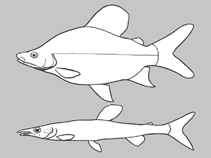
Body shape (shape guide): elongated.
Found in a shallow water zone with a high current over the rocky substrate (Ref. 127100)
Life cycle and mating behavior
النضج | التكاثر | وضع البيض | بيض | الخصوبة | Larvae
Katemo Manda, B., J. Snoeks, A. Chocha Manda and E. Vreven, 2021. Nannocharax hadros (Teleostei: Distichodontidae), a new species from the Kalule Nord River in the Upemba National Park, Upper Congo basin. Ichthyol. Explor. Freshwaters 30(4):317-330. (Ref. 127100)
IUCN Red List Status (Ref. 130435: Version 2025-1)
استخدامات بشرية
مصائد: فوائد محتملة
أدوات
تقارير خاصة
Download XML
مصادر علي الأنترنت
Estimates based on models
Phylogenetic diversity index (مرجع
82804): PD
50 = 0.5000 [Uniqueness, from 0.5 = low to 2.0 = high].
Bayesian length-weight: a=0.00447 (0.00189 - 0.01058), b=3.17 (2.96 - 3.38), in cm total length, based on LWR estimates for this (Sub)family-body shape (Ref.
93245).
مستوى غذائي (مرجع
69278): 3.2 ±0.4 se; based on size and trophs of closest relatives
Fishing Vulnerability (Ref.
59153): Low vulnerability (10 of 100).
🛈