>
Cypriniformes (Carps) >
Danionidae (Danios) > Rasborinae
Etymology: Rasbora: Rasbora, an Indian word for a fish, also used in Malay peninsula; adisi: Name 'adisi' means mysterious or enigmatic in Sinhala, referring to the cryptic nature of this species; noun in apposition.
Environment: milieu / climate zone / rango de profundidad / distribution range
Ecología
; agua dulce bentopelágico. Tropical
Asia: Sri Lanka.
Tamaño / Peso / Age
Madurez: Lm ? range ? - ? cm
Max length : 7.7 cm SL macho / no sexado; (Ref. 123756)
Short description
Claves de identificación | Morfología | Morfometría
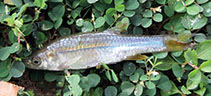
This species is distinguished from its congeners by the following set of characters: symphysial knob is not well-developed; postdorsal length, when pressed forward, falling short of the posterior margin of the eye; lachrymal groove not distinct; lateral line complete, 29-33 (mode 31) perforated scales; scales between the dorsal-fin origin and the lateral line usually 4½ (rarely 5 or 5½); predorsal scales usually 15-16 (rarely 14 or 17); circumpeduncular scales 14; midlateral stripe intense, about ¼-? scale width wide anteriorly, ½ scale width wide posteriorly; basal reticulation is parenthesis-shaped; 3-3½ scales wide, not apparent posterior to the origin of the anal fin; no dark patch in the mid-humeral region (Ref. 123756).
Cross section: compressed.
This is a common fish found in both lotic and lentic habitats, usually in groups of more than 10 individuals. Occurs close to the bank, occupying the upper levels of the water column. Associated species frequently encountered with this species include R. dandia, Devario malabaricus, Dawkinsia singhala, Puntius bimaculatus, Puntius dorsalis and Laubuka species (Ref. 123756).
Life cycle and mating behavior
Madurez | Reproducción | Puesta | Huevos | Fecundidad | Larva
Sudasinghe, H., R. Pethiyagoda, R. Hettiarachchige, T. Ranasinghe, R. Raghavan, N. Dahanukar and M. Meegaskumbura, 2020. A molecular phylogeny of the freshwater-fish genus Rasbora (Teleostei: Cyprinidae) in Sri Lanka reveals a remarkable diversification - And a cryptic species. J. Zool. Syst. Evol. Res. 58(4):1076-1110. (Ref. 123756)
IUCN Red List Status (Ref. 130435: Version 2025-1)
Threat to humans
Harmless
Human uses
Pesquerías: de interés potencial
Herramientas
Special reports
Download XML
Fuentes de Internet
Estimates based on models
Phylogenetic diversity index (Referencia
82804): PD
50 = 0.5000 [Uniqueness, from 0.5 = low to 2.0 = high].
Bayesian length-weight: a=0.00692 (0.00286 - 0.01676), b=3.08 (2.89 - 3.27), in cm total length, based on LWR estimates for this Genus-body shape (Ref.
93245).
Nivel trófico (Referencia
69278): 3.2 ±0.4 se; based on size and trophs of closest relatives
Resiliencia (Referencia
120179): Alto, población duplicada en un tiempo mínimo inferior a 15 meses (Preliminary K or Fecundity.).
Fishing Vulnerability (Ref.
59153): Low vulnerability (10 of 100).
🛈