Classificação / Names
Nomes comuns | Sinónimos | Catalog of Fishes(Género, Espécies) | ITIS | CoL | WoRMS | Cloffa
>
Cichliformes (Cichlids, convict blennies) >
Cichlidae (Cichlids) > Pseudocrenilabrinae
Etymology: Haplochromis: Greek, Haploos = single + Greek, chromis = a fish, perhaps a perch (Ref. 45335); gracilifur: Specific name derived from Latin 'gracilis', slender, and 'fur', thief; in reference to its slender body and paedophagous diet, it steals fry from buccal cavities of mouthbrooding cichlids; specific name noun in apposition (Ref. 127594).
Environment: milieu / climate zone / intervalo de profundidade / distribution range
Ecologia
; Água doce bentopelágico. Tropical
Africa: Lake Edward system (Ref. 127594).
Tamanho / Peso / Idade
Maturidade: Lm ? range ? - ? cm
Max length : 10.3 cm SL macho/indeterminado; (Ref. 127594)
Descrição breve
Chaves de identificação | Morfologia | Morfometria
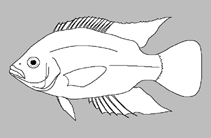
Espinhos dorsais (total) : 15; Raios dorsais moles (total) : 9 - 10; Espinhos anais: 3; Raios anais moles: 8 - 9; Vértebras: 29 - 30. Diagnosis: Haplochromis gracilifur differs from all other known paedophages from Lake Edward by its shorter premaxillary pedicel, 18.1-21.6% of head length vs. 21.6-29.1%, smaller number of lower lateral line scales, 7-9 vs. 9-15, exceptionally 7, and bicuspid outer teeth with long minor cusps (Ref. 127594). It resembles H. molossus and H. taurinus by its rounded jaws and small lachrymal bones; it differs from both by its more slender body, 30.2-34.8% of standard length vs. 33.5-38.6% and 33.9-40.1%, respectively; it is further distinct from H. taurinus by its shorter lower jaws, 42.4-44.7% of head length vs. 44.5-51.3%, and smaller eyes, 29.0-32.3% of head length vs. 32.9-40.2%; from H. molossus by its more slender jaws, 61.9-69.4% of lower jaw length vs. 67.0-87.0%, steeper gape inclination, 40-50° vs. 20-30°, and more gentle snout inclination, 10-20° vs. 45-55° (Ref. 127594). In addition, it has more outer teeth in upper jaw than H. relictidens and fewer than H. paradoxus, 26-35 vs. 16-26 and 36-65, respectively; clearly distinct from both by its smaller lachrymal bones, 13.7-14.3% of head length vs. 15.8-18.4% and 14.7-21.5%, respectively; further separated from H. relictidens by lower jaws rounded, whereas pointed in latter (Ref. 127594). Males of H. gracilifur have bright red flanks with two horizontal stripes vs. different colour patterns in all other paedophages (Ref. 127594).
This species has a paedophagous diet (Ref. 127594).
Life cycle and mating behavior
Maturidade | Reprodução | Desova | Ovos | Fecundidade | Larvas
Vranken, N., M. Van Steenberge and J. Snoeks, 2019. Grasping ecological opportunities: not one but five paedophagous species of Haplochromis (Teleostei: Cichlidae) in the Lake Edward system. Hydrobiologia 832(1):105-134. (Ref. 127594)
Categoria na Lista Vermelha da IUCN (Ref. 130435: Version 2025-1)
Ameaça para o homem
Harmless
Utilização humana
Ferramentas
Relatórios especiais
Descarregue XML
Fontes da internet
Estimates based on models
Phylogenetic diversity index (Ref.
82804): PD
50 = 0.5000 [Uniqueness, from 0.5 = low to 2.0 = high].
Bayesian length-weight: a=0.01445 (0.00674 - 0.03099), b=2.99 (2.82 - 3.16), in cm total length, based on LWR estimates for this (Sub)family-body shape (Ref.
93245).
Nível Trófico (Ref.
69278): 3.3 ±0.4 se; based on size and trophs of closest relatives
Resiliência (Ref.
120179): Elevada, tempo mínimo de duplicação da população menor que 15 meses (Preliminary K or Fecundity.).
Fishing Vulnerability (Ref.
59153): Low vulnerability (10 of 100).
🛈