



Gymnothorax poikilospilus Chen & Huang, 2022
Variegated moray eel
Adicionar o seu Fotografias e vídeos
Imagem do Google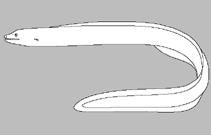 No image available for this species;
drawing shows typical species in Muraenidae.
Imagem do Google
drawing shows typical species in Muraenidae.
Classificação / Nomes Nomes comuns | Sinónimos | Catalog of Fishes(Género, Espécies) | ITIS | CoL | WoRMS | Cloffa
> Anguilliformes (Eels and morays) > Muraenidae (Moray eels) > Muraeninae
Etymology: Gymnothorax: Greek, gymnos = naked + Greek, thorax, -akos = breast (Ref. 45335); poikilospilus: Name from the Greek ‘poikilo’ for varied or variegated, and ‘spilos’ meaning a spot or stain, referring to its varied body markings between daytime and nighttime.
Etymology: Gymnothorax: Greek, gymnos = naked + Greek, thorax, -akos = breast (Ref. 45335); poikilospilus: Name from the Greek ‘poikilo’ for varied or variegated, and ‘spilos’ meaning a spot or stain, referring to its varied body markings between daytime and nighttime.
Ambiente: milieu / zona climática / intervalo de profundidade / gama de distribuição Ecologia
marinhas associadas(os) a recifes; intervalo de profundidade 10 - 20 m (Ref. 127463). Subtropical
Distribuição Territórios | Áreas FAO | Ecossistemas | Ocorrências | Mapa dos pontos | Introduções | Faunafri
Northwest Pacific: Taiwan.
Tamanho / Peso / Idade
Maturidade: Lm ? range ? - ? cm
Max length : 86.8 cm TL (female)
Max length : 86.8 cm TL (female)
Descrição breve Chaves de identificação | Morfologia | Morfometria
Vértebras: 141. This medium-sized species is distinguished by the following characters: typical muraenid shape, anus at mid-point of body; high dorsal fin; eyes above the mid-jaw; jaws slightly arched, do not completely close; cephalic sensory pores are small; uniserial teeth, are slender and pointed; predorsal vertebrae 4, preanal vertebrae 57-59, total vertebrae 141. Colouration: brown or gray-brown body; several rows of large dark brown patches on back of body and dorsal fin; patches are obscure during daytime and becoming obvious at night; dorsal head dark brown and spotless; when alive, the fins with fine greyish-white margins but these are invisible when preserved; inner skin of nostrils and head pores are whitish; oral cavity uniform brown; throat grooves are darkish; iris of the eye reddish-brown (Ref. 127463).
Cross section: oval.
Cross section: oval.
The holotype was reared from 10 June 2002 until 4 February 2005 in a laboratory aquarium. It accidentally crawled out of the aquarium during the night and died. It was dissected and many mature eggs were found in its abdominal cavity. The mature eggs were between 0.8-1.2 mm in diameter, and batch fecundity was about 20,000 eggs. Under microscope, there was the other immature egg group in its ovaries, the diameters of oocytes were about 0.15-0.26 mm. The paratype was also reared until its death on 22 September 2008. Under the microscope, its gonads belonged to immature ovaries, with 2 groups of oocytes with different egg diameter interval ranges: the larger group was 0.17-0.26 mm, while the smaller group was 0.07-0.13 mm. The two specimens were fed with fish and squid meat (Ref. 127463).
Ciclo de vida e comportamento de acasalamento Maturidade | Reprodução | Desova | Ovos | Fecundidade | Larvas
Referência principal
Carregar as suas referências | Referências | Coordenador | Colaboradores
Huang, W.-C., K.-H. Loh and H.-M. Chen, 2022. Gymnothorax poikilospilus, a new moray eel (Teleostei: Anguilliformes: Muraenidae) from Penghu Islands, western Taiwan. Zootaxa 5189(1):87-102. (Ref. 127463)
CITES
Not Evaluated
Ameaça para o homem
Harmless
Utilização humana
Pescarias: pouco comercial
FAO - Publication: search | FishSource |
Mais informação
Ecologia Trófica
Produtos alimentares (presas)
Composição da dieta
Consumo alimentar
Rações alimentares
Predadores
Produtos alimentares (presas)
Composição da dieta
Consumo alimentar
Rações alimentares
Predadores
Ecologia
Ecologia
Ecologia
Dinâmica das populações
Parâmetros de crescimento
Idades / tamanhos máximos
Comprimento-peso rel.
Comprimento-comprimento rel.
Frequência de comprimento
Conversão de massa
Recrutamento
Abundância
Parâmetros de crescimento
Idades / tamanhos máximos
Comprimento-peso rel.
Comprimento-comprimento rel.
Frequência de comprimento
Conversão de massa
Recrutamento
Abundância
Ciclo de vida
Reprodução
Maturidade
Maturidade/Rel. das guelras
Fecundidade
Desova
Agregações de desova
Ovos
Desenvolvimento dos ovos
Larvas
Dinâmica larvar
Reprodução
Maturidade
Maturidade/Rel. das guelras
Fecundidade
Desova
Agregações de desova
Ovos
Desenvolvimento dos ovos
Larvas
Dinâmica larvar
Anatomia
Área branquial
Cérebro
Otólitos
Área branquial
Cérebro
Otólitos
Fisiologia
Composição corporal
Nutrientes
Consumo de oxigénio
Tipo de natação
Velocidade de natação
Pigmentos visuais
Som de peixe
Doenças e Parasitas
Toxicidade (LC50s)
Composição corporal
Nutrientes
Consumo de oxigénio
Tipo de natação
Velocidade de natação
Pigmentos visuais
Som de peixe
Doenças e Parasitas
Toxicidade (LC50s)
Genética
genoma
Genética
Heterozigotia
Hereditariedade
Diversidade genética
genoma
Genética
Heterozigotia
Hereditariedade
Diversidade genética
Relacionado com o ser humano
Sistemas de aquacultura
Perfis para aquacultura
Estirpes
Casos de Ciguatera
Selos, moedas, diversos.
Sistemas de aquacultura
Perfis para aquacultura
Estirpes
Casos de Ciguatera
Selos, moedas, diversos.
Ferramentas
E-book | Guia de campo | Ferramenta auxiliar de frequências de comprimento | Ferramenta sobre a história de vida | Mapa dos pontos |
Captura-MSY |
Relatórios especiais
Descarregue XML
Fontes da internet
AFORO (otoliths) | Aquatic Commons | BHL | Cloffa | Websites from users | Consultar FishWatcher | CISTI | Catalog of Fishes: Género, Espécies | DiscoverLife | ECOTOX | FAO - Publication: search | Faunafri | Fishipedia | Fishtrace | GloBI | Google Books | Google Scholar | Google | IGFA World Record | Bases de dados nacionais | OneZoom | Open Tree of Life | Otolith Atlas of Taiwan Fishes | PubMed | Reef Life Survey | Socotra Atlas | TreeBase | Árvore da vida | Wikipedia: ir para, procurar | World Records Freshwater Fishing | Zoobank | Registo zoológico
Estimativas baseadas em modelos
Índice de diversidade filogenética (Ref. 82804): PD50 = 0.5000 [Uniqueness, from 0.5 = low to 2.0 = high].
Bayesian length-weight: a=0.00047 (0.00025 - 0.00088), b=3.28 (3.13 - 3.43), in cm total length, based on LWR estimates for this Genus-body shape (Ref. 93245).
Nível Trófico (Ref. 69278): 4.1 ±0.7 se; based on size and trophs of closest relatives
Resiliência (Ref. 120179): Baixo, tempo mínimo de duplicação da população 4,5 - 14 anos (Preliminary K or Fecundity.).