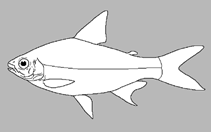
Classification / Names
ชื่อสามัญ | ชื่อพ้อง | Catalog of Fishes(สกุล, ชนิด) | ITIS | CoL | WoRMS | Cloffa
>
Characiformes (Characins) >
Curimatidae (Toothless characins)
Etymology: Cyphocharax: Greek, kyphos = curved, humpback + Greek, charax = a marine fish without identification (Ref. 45335); muyrakytan: Name derived from the Tupi muyrakyta (‘muiraquita’ in Portuguese), an amulet originally used by Indians of the Amazon valley, especially those belonging to the extinct Tapajo culture, usually carved as a sitting frog from a green jade stone; noun in apposition (Ref. 119424).
Environment: milieu / climate zone / ระดับความลึก / distribution range
นิเวศวิทยา
; น้ำจืด กลุ่มสัตว์หน้าดิน,กลุ่มสัตว์พื้นท้องน้ำ. Tropical
South America: Brazil.
ขนาด / น้ำหนัก / Age
วัยเจริญพันธุ์: Lm ? range ? - ? cm
Max length : 5.4 cm SL เพศผู้/กระเทย; (Ref. 119424)
Collected in floodplain tributaries (Ref. 119424).
Life cycle and mating behavior
วัยเจริญพันธุ์ | การสืบพันธุ์ | การวางไข่ | เซลสืบพันธ์ของเพศเมีย(ไข่) | ความดกของไข่ | ตัวอ่อน
Bortolo, G.C., F.C.T. Lima and B.F. Melo, 2018. A new Cyphocharax from the Lower Rio Tapajós, Amazon basin, Brazil (Characiformes: Curimatidae). Copeia 106(2):346-352. (Ref. 119424)
IUCN Red List Status (Ref. 130435: Version 2025-1)
Threat to humans
Harmless
Human uses
เครื่องมือ
Special reports
Download XML
แหล่งที่มาจากอินเตอร์เน็ต
Estimates based on models
Phylogenetic diversity index (อ้างอิง
82804): PD
50 = 0.5000 [Uniqueness, from 0.5 = low to 2.0 = high].
Bayesian length-weight: a=0.00776 (0.00318 - 0.01897), b=3.09 (2.90 - 3.28), in cm total length, based on LWR estimates for this Genus-body shape (Ref.
93245).
ความสามารถในการกลับคืนสู่ปกติ (อ้างอิง
120179): ความสูง, เวลาต่ำสุดที่จะทำให้ประชากรเพิ่มขึ้นเป็น 2 เท่าใช้เวลาน้อยกว่า 15 เดือน (Preliminary K or Fecundity.).
Fishing Vulnerability (Ref.
59153): Low vulnerability (10 of 100).
🛈