Klassifizierung / Names
Namen | Synonyme | Catalog of Fishes(Gattung, Arten) | ITIS | CoL | WoRMS | Cloffa
>
Siluriformes (Catfishes) >
Callichthyidae (Callichthyid armored catfishes) > Corydoradinae
Etymology: Corydoras: Greek, kory = helmet + greek, doras = skin (Ref. 45335).
Eponymy: In Greek mythology, Hephaestus was the god of fire, blacksmiths, metal-workers and other artisans. De Vis gives no reason for his choice of name. The Corydoras was so named due to the red (fiery) colour of its fins and parts of its body. (Ref. 128868), visit book page.
Environment: milieu / climate zone / Tiefenbereich / distribution range
Ökologie
; süßwasser demersal. Tropical
South America: Brazil.
Size / Gewicht / Alter
Geschlechtsreife: Lm ? range ? - ? cm
Max length : 3.3 cm SL Männchen/unbestimmt; (Ref. 111516)
Kurzbeschreibung
Bestimmungsschlüssel | Morphologie | Morphometrie
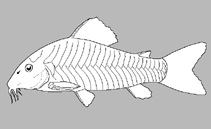
This is distinguised by the lack of connection between the posterio process of the parietosupraoccipital and the nuchal plate. There's also a prominent development of a ventral laminar expansion of the infraorbital 1, and the posterior margin of the pectoral-fin spine with serrations along almost its entire length, with an absence in the distal portion. It also has short dorsal and pectoral spines with an unusual color pattern in life.
Found on substrate with sand and dead leaves (Ref. 111516).
Life cycle and mating behavior
Geschlechtsreife | Fortpflanzung | Ablaichen | Eier | Fecundity | Larven
Ohara, W.M., L.F.C. Tencatt and M.R. Britto, 2016. Wrapped in flames: Corydoras hephaestus, a new remarkably colored species from the Rio Madeira basin (Teleostei: Callichthyidae). Zootaxa 4170(3):539-552. (Ref. 111516)
IUCN Rote Liste Status (Ref. 130435: Version 2025-1)
Bedrohung für Menschen
Harmless
Nutzung durch Menschen
Tools
Zusatzinformationen
Download XML
Internet Quellen
Estimates based on models
Phylogenetic diversity index (Ref.
82804): PD
50 = 0.5000 [Uniqueness, from 0.5 = low to 2.0 = high].
Bayesian length-weight: a=0.00741 (0.00286 - 0.01921), b=3.14 (2.91 - 3.37), in cm total length, based on LWR estimates for this (Sub)family-body shape (Ref.
93245).
Trophic level (Ref.
69278): 3.0 ±0.3 se; based on size and trophs of closest relatives
Widerstandsfähigkeit (Ref.
120179): hoch, Verdopplung der Population dauert weniger als 15 Monate. (Preliminary K or Fecundity.).
Fishing Vulnerability (Ref.
59153): Low vulnerability (10 of 100).
🛈