>
Gobiiformes (Gobies) >
Gobiidae (Gobies) > Gobiinae
Etymology: Varicus: Latin, varix = dilated vein (Ref. 45335); decorum: Species name from the Latin word for 'decorated', 'adorned', 'beautiful' or ''elegant', in reference to the beuatiful round yellow markings on the dorsal surface of the body (Ref. 113825).
Environment: milieu / climate zone / rango de profundidad / distribution range
Ecología
marino demersal; rango de profundidad 99 - 251 m (Ref. 113825). Tropical
Western Central Atlantic: Curacao.
Tamaño / Peso / Age
Madurez: Lm ? range ? - ? cm
Max length : 4.1 cm SL macho / no sexado; (Ref. 113825); 4.6 cm SL (female)
Short description
Claves de identificación | Morfología | Morfometría
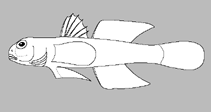
Radios blandos anales: 7 - 8; Vértebra: 27. This species can be distinguished by the following set of characters: D1 VII, without notably elongate spines; D2 I,9; A I,7-8; pectoral fin with 17 rays, 5th and 6th rays from ventral very elongate, extending well beyond other rays of fin, giving pectoral fin an asymmetrical appearance; pelvic fins I, 5, well separated with 5th pelvic-fin ray ca. 1/3-1/5 length of 4th, all pelvic-fin rays unbranched and some may have flattened fleshy tips; body and head entirely naked except for 2 modified ctenoid scales with enlarged ctenii present on each side of caudal-fin base; interorbital papillae row pb’ and pc’ present; no cephalic lateralis pores on head or preopercle present; single anal-fin pterygiophore inserted anterior to haemal arch; D1 fin with scattered yellow spots in life, some with small dark centers; dorsal surface of body with prominent round yellow circles of varying sizes; side of head with two distinct narrow yellow vertical stripes, one through eye and one through posterior margin of preopercle (Ref. 113825).
Cross section: oval.
Known from deep reefs. Collected from sandy habitats with scattered rocks and calcareous rubble. This species perch on open sand and retreat into crevices when disturbed (Ref. 113825).
Life cycle and mating behavior
Madurez | Reproducción | Puesta | Huevos | Fecundidad | Larva
Tornabene, L., J.L. Van Tassel, D.R. Robertson and C.C. Baldwin, 2016. Molecular phylogeny, analysis of discrete character evolution, and submersible collections facilitate a new classification for a diverse group of gobies (Teleostei: Gobiidae: Gobiosomatini: Nes subgroup), with descriptions of nine new species. Zoological Journal of the Linnean Society 177(4):764-812. (Ref. 113825)
IUCN Red List Status (Ref. 130435: Version 2025-1)
Threat to humans
Harmless
Human uses
Herramientas
Special reports
Download XML
Fuentes de Internet
Estimates based on models
Phylogenetic diversity index (Referencia
82804): PD
50 = 0.5010 [Uniqueness, from 0.5 = low to 2.0 = high].
Bayesian length-weight: a=0.00724 (0.00339 - 0.01546), b=3.10 (2.92 - 3.28), in cm total length, based on LWR estimates for this (Sub)family-body shape (Ref.
93245).
Nivel trófico (Referencia
69278): 3.2 ±0.3 se; based on size and trophs of closest relatives
Resiliencia (Referencia
120179): Alto, población duplicada en un tiempo mínimo inferior a 15 meses (Preliminary K or Fecundity.).
Fishing Vulnerability (Ref.
59153): Low vulnerability (10 of 100).
🛈