Klassifizierung / Names
Namen | Synonyme | Catalog of Fishes(Gattung, Arten) | ITIS | CoL | WoRMS | Cloffa
>
Siluriformes (Catfishes) >
Pseudopimelodidae (Bumblebee catfishes, dwarf marbled catfishes) > Pseudopimelodinae
Etymology: Rhyacoglanis: From the Greek words 'rhyax' (torrent) and 'glanis' (catfish), indicating a catfish inhabiting running waters in reference to its habitat (Ref. 128485); epiblepsis: Species name is an adjective from the Greek word 'epi' (up) and 'blepsis' (act of sight) in reference to the dorsal position of the eyes (Ref. 128485).
Environment: milieu / climate zone / Tiefenbereich / distribution range
Ökologie
; süßwasser demersal. Tropical
South America: Bolivia.
Size / Gewicht / Alter
Geschlechtsreife: Lm ? range ? - ? cm
Max length : 5.4 cm SL Männchen/unbestimmt; (Ref. 128485)
Kurzbeschreibung
Bestimmungsschlüssel | Morphologie | Morphometrie
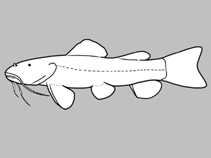
Rückenflossenweichstrahlen (insgesamt) : 6; Afterflossenstacheln: 3 - 4; Afterflossenweichstrahlen: 5 - 7; Wirbelzahl: 30 - 33. This species can be distinguished from all congeners by having numerous dark spots scattered on the body, and rounded caudal-fin lobes (vs. pointed lobes) (Ref. 128485).
Cross section: oval.
Prefers rheophilic habitats, with swift-flowing waters (Ref. 128485).
Life cycle and mating behavior
Geschlechtsreife | Fortpflanzung | Ablaichen | Eier | Fecundity | Larven
Shibatta, O.A. and R.P. Vari, 2017. A new genus of Neotropical rheophilic catfishes, with four new species (Teleostei: Siluriformes: Pseudopimelodidae). Neotropical Ichthyology 15(2):e160132. (Ref. 128485)
IUCN Rote Liste Status (Ref. 130435: Version 2025-1)
Bedrohung für Menschen
Harmless
Nutzung durch Menschen
Tools
Zusatzinformationen
Download XML
Internet Quellen
Estimates based on models
Phylogenetic diversity index (Ref.
82804): PD
50 = 0.5625 [Uniqueness, from 0.5 = low to 2.0 = high].
Bayesian length-weight: a=0.00389 (0.00180 - 0.00842), b=3.12 (2.94 - 3.30), in cm total length, based on all LWR estimates for this body shape (Ref.
93245).
Trophic level (Ref.
69278): 3.3 ±0.5 se; based on size and trophs of closest relatives
Fishing Vulnerability (Ref.
59153): Low vulnerability (10 of 100).
🛈