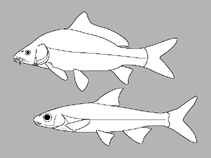
Classificação / Names
Nomes comuns | Sinónimos | Catalog of Fishes(Género, Espécies) | ITIS | CoL | WoRMS | Cloffa
>
Cypriniformes (Carps) >
Cyprinidae (Minnows or carps) > Smiliogastrinae
Etymology: Enteromius: Greek, enteron = intestine + Greek, myo, mys = muscle (Ref. 45335); pinnimaculatus: The specific epithet pinnimaculatus refers to the multiple small dark spots on the dorsal fin, which is a rare characteristic within Enteromius; an adjective in the nominative singular (Ref. 120231).
Environment: milieu / climate zone / intervalo de profundidade / distribution range
Ecologia
; Água doce bentopelágico. Tropical
Africa: Gabon.
Tamanho / Peso / Idade
Maturidade: Lm ? range ? - ? cm
Max length : 4.1 cm SL macho/indeterminado; (Ref. 120231)
Descrição breve
Chaves de identificação | Morfologia | Morfometria
Espinhos dorsais (total) : 0; Raios dorsais moles (total) : 10 - 11; Espinhos anais: 0; Raios anais moles: 8; Vértebras: 33 - 35. Diagnosis: A series of three or four dark spots along the flanks and a dorsal fin with multiple dar spots separates Enteromius pinnimaculatus from all other known species of Enteromius except E. walkeri; nevertheless, E. pinnimaculatus sometimes has one or more spots on the anal fin and lacks the dark spot immediately ventral to the dorsal-fin origin, while E. walkeri lacks pigmentation on the anal fin and has an additional dark spot ventral to the dorsal-fin origin; larger E. pinnimaculatus have noticeable pigmentation along the dorsal and ventral margins of most scale rows, while adult E. walkeri have two narrow bands of dark pigmentation dorsal and ventral to the lateral-line scale series on the anterior part of the body, but much less pronounced pigmentation at the intersection of other scale rows; the two species separate on the number of branched pectoral-fin rays, 11-12 in E. pinnimaculatus vs. 13-14 in E. walkeri, and the number of unbranched dorsal-fin rays, 3 in E. pinnimaculatus vs. 4 in E. walkeri, though an extra element at the anterior of the dorsal fin in E. walkeri is minute and only observed on radiographs; with the exception of developmentally aberrant individuals, specimens of E. pinnimaculatus have 33 vertebrae, while specimens of E. walkeri have 34 (Ref. 120231). Enteromius pinnimaculatus differs modally from E. walkeri in the number of total lateral line scales, 20 vs. 24; the number of lateral line scales to the point of caudal flexion, 18 vs. 22; the number of circumpeduncular scales, 10 vs. 12; and the number of branched dorsal-fin rays, 7 vs. 8; Enteromius pinnimaculatus reaches only half the maximum body size of E. walkeri; it has smaller pectoral fins than E. walkeri as well as shorter anterior barbels, with the difference in barbel length very pronounced in individuals of similar size; it also has, on average, a shallower body depth than E. walkeri and a longer caudal peduncle (Ref. 120231).
The species is omnivorous, with plant and insect material in the diet (Ref. 120231).
Life cycle and mating behavior
Maturidade | Reprodução | Desova | Ovos | Fecundidade | Larvas
Mipounga, H.K., J. Cutler, J.H. Mve Beh, B. Adam and B.L. Sidlauskas, 2019. Enteromius pinnimaculatus sp. nov. (Cypriniformes: Cyprinidae) from southern Gabon. J. Fish Biol. 96(5):1218-1233. (Ref. 120231)
Categoria na Lista Vermelha da IUCN (Ref. 130435: Version 2025-1)
Ameaça para o homem
Harmless
Utilização humana
Pescarias: sem interesse
Ferramentas
Relatórios especiais
Descarregue XML
Fontes da internet
Estimates based on models
Phylogenetic diversity index (Ref.
82804): PD
50 = 0.5000 [Uniqueness, from 0.5 = low to 2.0 = high].
Bayesian length-weight: a=0.01122 (0.00523 - 0.02406), b=3.01 (2.84 - 3.18), in cm total length, based on LWR estimates for this Genus-body shape (Ref.
93245).
Nível Trófico (Ref.
69278): 3.0 ±0.3 se; based on size and trophs of closest relatives
Resiliência (Ref.
120179): Elevada, tempo mínimo de duplicação da população menor que 15 meses (Preliminary K or Fecundity.).
Fishing Vulnerability (Ref.
59153): Low vulnerability (10 of 100).
🛈