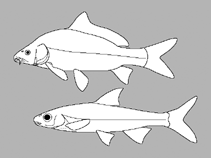
Classification / Names
Nomi Comuni | Sinonimi | Catalog of Fishes(Genere, Specie) | ITIS | CoL | WoRMS | Cloffa
>
Cypriniformes (Carps) >
Cyprinidae (Minnows or carps) > Smiliogastrinae
Etymology: Enteromius: Greek, enteron = intestine + Greek, myo, mys = muscle (Ref. 45335); radari: This species is dedicated to Dr. Honoris Radar Nishilu, former chief manager of the Kahuzi-Biega National Park (2008-2016), in recognition of his commitment to and support for biodiversity assessments and scientific research in the park and particularly for the investigations (Ref. 128600).
Environment: milieu / climate zone / distribuzione batimetrica / distribution range
Ecologia
; acqua dolce benthopelagico; pH range: 6.5 - 7.0. Tropical; 23°C - 23°C (Ref. 128600)
Africa: Democratic Republic of the Congo.
Size / Peso / Age
Maturità: Lm ? range ? - ? cm
Max length : 8.7 cm SL maschio/sesso non determinato; (Ref. 128600)
Short description
Chiavi di identificazione | Morfologia | Morfometria
Spine dorsali (totale) : 0; Raggi dorsali molli (totale) : 10 - 11; Spine anali: 0; Raggi anali molli: 8; Vertebre: 31 - 33. Diagnosis: Within the Congo basin, Enteromius radari belongs to the group of sawfin minnows with a thickened last unbranched dorsal-fin ray and is thereby distinguished from all congeners from the Congo basin with a soft last unbranched dorsal-fin ray (Ref. 128600). It differs from other species with a weakly thickened spine, notably E. mediosquamatus, E. taeniurus and E. tomiensis, by its serrations on the spine vs. unserrated dorsal spine (Ref. 128600). Within the group of the sawfin minnows, having a thickened spine with serrations, it differs from E. afrovernayi, E. apleurogramma, E. oligogrammus and E. petchkovskyi by its complete lateral line vs. incomplete; in addition, it differs from E. apleurogramma and E. oligogrammus by its weakly thickened dorsal spine vs. a strongly thickened, and further by its lower number of lateral line scales from E. afrovernayi, 22-26 vs. 29-32; it differs from the remaining sawfin minnows by its weakly thickened, thin dorsal spine of which only the middle part is weakly serrated, vs. a strongly thickened, stout spine, well serrated over almost its entire length in E. ansorgii, E. eutaenia, E. kerstenii as well as E. tangandensis, E. mattozi, E. miiolepis, E.neumayeri, E. pellegrini and E. trinotatus; it can further be distinguished from E. pellegrini by its lower number of lateral line scales, 22-26 vs. 28-30; it can be distinguished from E. afrohamiltoni, E. lukindae, E. neumayeri, E. paludinosus, E. trimaculatus and E. vanderysti by its lower number of lateral line scales, 22-26 vs. 29-33, 29-30, 30-31, 34-39, 30-36 and 29, respectively (Ref. 128600). Furthermore, based on its colour pattern, E. radari can be distinguished from E. eutaenia, E. devosi, E. miolepis and E. luikae by the presence of three or four blotces along the flanks, situated just above the lateral line, and interconnected or not by a narrow, sometimes inconspicuous, black stripe vs. a permanent, continuous, black mid-lateral band; E. radari can be distinguished from E. guirali and E. machadoi as well, by the presence of these black markings along the body flanks vs. absence; E. radari can be distinguished from E. multilineatus and E. trinotatus also, by the above black marking character vs. a large black, mid-lateral band on the body but with several thin longitudinal black bands above and below this main band, and three elongated, narrow black spots respectively (Ref. 128600). Within the group of Enteromius species with a weakly thickened, serrated spine, it differs from E. chicapaensis and E. chiumbeensis by its higher number of lateral line scales, 22-26 vs. 21-23 and 20-21, respectively; in addition, it differs from E. chicapaensis by the presence of a series of three or four black blotches just above the mid-lateral line of the body vs. absence; furthermore, within this group it differs from E. holotaenia and E. martorelli by a series of three or four black blotches just above the mid-lateral line of the body vs. a continuous black band; finally, E. radari differs clearly from E. janssensi by the absence of cephalic pitlines vs. presence, and by the presence of blotches vs. indistinct black band larger on the anterior part and narrowing at mid-body level, by its lower number of lateral line scales, 22-26 vs. 24-27, and its lower number of circumpeduncular scales, 10-12 vs. 12 (Ref. 128600).
Found in shallow areas, about 1 m of depth, of small streams, about 1-10 m width, under tree canopy cover; the bottom is composed of either silt, sand, gravel, or a combination with mud and detritus (Ref. 128600).
Life cycle and mating behavior
Maturità | Riproduzione | Deposizione | Uova | Fecundity | Larve
Kisekelwa, T., J. Snoeks, E. Decru, F.B.D. Schedel, M. Isumbisho and E. Vreven, 2022. A mismatch between morphological and molecular data in lineages of Enteromius (Cypriniformes: Cyprinidae) from the Lowa basin (East Democratic Republic of the Congo: DRC) with the description of a new species. Syst. Biodivers. 20(1,2135630):1-22. (Ref. 128600)
IUCN Red List Status (Ref. 130435: Version 2025-1)
Threat to humans
Harmless
Human uses
Pesca: di nessun interesse
Strumenti
Special reports
Download XML
Fonti Internet
Estimates based on models
Phylogenetic diversity index (Fonte Biblio.
82804): PD
50 = 0.5000 [Uniqueness, from 0.5 = low to 2.0 = high].
Bayesian length-weight: a=0.01122 (0.00523 - 0.02406), b=3.01 (2.84 - 3.18), in cm total length, based on LWR estimates for this Genus-body shape (Ref.
93245).
Trophic level (Fonte Biblio.
69278): 3.0 ±0.3 se; based on size and trophs of closest relatives
Resilienza (Fonte Biblio.
120179): Alto, tempo minimo di raddoppiamento della popolazione meno di 15 mesi (Preliminary K or Fecundity.).
Fishing Vulnerability (Ref.
59153): Low vulnerability (10 of 100).
🛈