Classificatie / Namen
Lokale namen | Synoniemen | Catalog of Fishes(Genus, Soort(en)) | ITIS | CoL | WoRMS | Cloffa
>
Siluriformes (Catfishes) >
Trichomycteridae (Pencil or parasitic catfishes) > Vandelliinae
Etymology: Paracanthopoma: Greek, para = the side of + Greek, akantha = thorn + Greek, poma, -atos = cover, operculum (Ref. 45335).
Environment: milieu / Klimaatzone / Diepte / distribution range
Ecologie
; zoet water demersaal. Tropical
South America: Brazil.
Grootte / Gewicht / Leeftijd
Maturiteit: Lm ? range ? - ? cm
Max length : 2.2 cm SL mannelijk / geslacht onbekend; (Ref. 124573)
Korte beschrijving
Determinatiesleutels | Morfologie | Morfometrie
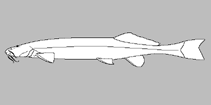
This species is distinguished from Paracanthopoma parva by the following characters: a short and anteriorly-displaced opercular patch of odontodes, leaving a large posterior free area of integument continuous with the rest of the head integument around it (in dorsal view the posterior tips of the opercular odontodes do not reach the base of the pectoral fin); pelvic fin 3 (vs. 5); opercle without an ascending process (vs. with ascending process); caudal peduncle spatulate by hypertrophied series of 22?29 (upper) and 20?29 (lower) procurrent caudal-fin rays (vs. caudal peduncle narrow, with 15-19 upper and 14-18 lower rays); median premaxillary dentition feeble, with 3 delicate teeth (vs. median premaxillary dentition robust, 9 large strong teeth); supraorbital canals opening as two separate s6 pores (vs. canals fused at midline and opening as single median s6 pore); caudal fin slightly convex or truncate, with round edges (the apparent emarginated margin is a preservation artifact) (vs. bilobed or emarginate, concave); supraoccipital no anterior median process (vs. supraoccipital with produced anterior process); origins of dorsal and anal fins approximately at same vertical (vs. origin of dorsal fin clearly anterior to vertical through origin of anal fin) (Ref. 124573).
Cross section: flattened.
The Rio Taquarizinho is ca. 15 m wide at the collection locality; the water is clear, slightly milky and with moderate current. Specimens were collected by seining on sand banks in the middle of the river, especially in sectors shaded by riparian vegetation. There was no aquatic vegetation and depth of collection ranged from 30-150 cm. This species is sympatric with Paravandellia oxyptera, both are relatively abundant at the type locality. These two species are psammophilic, but with different microhabitat preferences where P. saci favors fine sand, while P. oxytera prefers sectors with coarser granulation. Segregation is not complete however, and occasionally they were captured together in the same net. Some female specimens have large eggs, approximately eye-sized or slightly larger, visible by transparency. Eggs distributed along ventral margin of hypaxial musculature from shortly posterior to end of pectoral fin to nearly end of abdominal cavity, with approximately 20 eggs visible in lateral layer of each side (certainly more in inner portions of gonad) (Ref. 124573).
Levenscyclus en paargedrag
Maturiteit | Voortplanting | Paaien | Eieren | Fecunditeit | Larven
Dagosta, F.C.P. and M. de Pinna, 2021. Two new catfish species of typically Amazonian lineages in the Upper Rio Paraguay (Aspredinidae: Hoplymyzontinae and Trichomycteridae: Vandelliinae), with a biogeographic discussion. Pap. Avulsos Zool. 61:e20216147. (Ref. 124573)
Status op de Rode Lijst van het IUCN (Ref. 130435: Version 2025-1)
Gevaar voor de mens
Harmless
Gebruik door de mens
Visserij: van geen belang
Tools
Speciale rapporten
Download XML
Internetbronnen
Estimates based on models
Fylogenetische diversiteitsindex (Ref.
82804): PD
50 = 0.7500 [Uniqueness, from 0.5 = low to 2.0 = high].
Bayesian length-weight: a=0.00389 (0.00180 - 0.00842), b=3.12 (2.94 - 3.30), in cm total length, based on all LWR estimates for this body shape (Ref.
93245).
Trofisch niveau (Ref.
69278): 3.2 ±0.6 se; based on size and trophs of closest relatives
Fishing Vulnerability (Ref.
59153): Low vulnerability (10 of 100).
🛈