



Paracanthopoma saci Dagosta & de Pinna, 2021
muatnaik fotos/gambar dan video
imej Google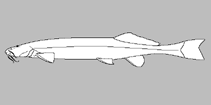 No image available for this species;
drawing shows typical species in Trichomycteridae.
imej Google
drawing shows typical species in Trichomycteridae.
klasifikasi / Nama Nama-nama umum | Sinonim (persamaan) | Catalog of Fishes(Marga, Jenis) | ITIS | CoL | WoRMS | Cloffa
> Siluriformes (Catfishes) > Trichomycteridae (Pencil or parasitic catfishes) > Vandelliinae
Etymology: Paracanthopoma: Greek, para = the side of + Greek, akantha = thorn + Greek, poma, -atos = cover, operculum (Ref. 45335).
Etymology: Paracanthopoma: Greek, para = the side of + Greek, akantha = thorn + Greek, poma, -atos = cover, operculum (Ref. 45335).
Lingkungan: lingkungan / zona iklim / kisaran kedalaman / jangkauan distribusi Ekologi
; air tawar dasar (demersal). Tropical
Penyebaran Wilayah | Daerah-daerah FAO | Ekosistem | Kemunculan | peta titik | Introduksi | Faunafri
South America: Brazil.
Ukuran / Berat / umur
deskripsi pendek Kunci identifiaksi (pengenalan) | Morfologi | Morfometrik
This species is distinguished from Paracanthopoma parva by the following characters: a short and anteriorly-displaced opercular patch of odontodes, leaving a large posterior free area of integument continuous with the rest of the head integument around it (in dorsal view the posterior tips of the opercular odontodes do not reach the base of the pectoral fin); pelvic fin 3 (vs. 5); opercle without an ascending process (vs. with ascending process); caudal peduncle spatulate by hypertrophied series of 22?29 (upper) and 20?29 (lower) procurrent caudal-fin rays (vs. caudal peduncle narrow, with 15-19 upper and 14-18 lower rays); median premaxillary dentition feeble, with 3 delicate teeth (vs. median premaxillary dentition robust, 9 large strong teeth); supraorbital canals opening as two separate s6 pores (vs. canals fused at midline and opening as single median s6 pore); caudal fin slightly convex or truncate, with round edges (the apparent emarginated margin is a preservation artifact) (vs. bilobed or emarginate, concave); supraoccipital no anterior median process (vs. supraoccipital with produced anterior process); origins of dorsal and anal fins approximately at same vertical (vs. origin of dorsal fin clearly anterior to vertical through origin of anal fin) (Ref. 124573).
Cross section: flattened.
Cross section: flattened.
The Rio Taquarizinho is ca. 15 m wide at the collection locality; the water is clear, slightly milky and with moderate current. Specimens were collected by seining on sand banks in the middle of the river, especially in sectors shaded by riparian vegetation. There was no aquatic vegetation and depth of collection ranged from 30-150 cm. This species is sympatric with Paravandellia oxyptera, both are relatively abundant at the type locality. These two species are psammophilic, but with different microhabitat preferences where P. saci favors fine sand, while P. oxytera prefers sectors with coarser granulation. Segregation is not complete however, and occasionally they were captured together in the same net. Some female specimens have large eggs, approximately eye-sized or slightly larger, visible by transparency. Eggs distributed along ventral margin of hypaxial musculature from shortly posterior to end of pectoral fin to nearly end of abdominal cavity, with approximately 20 eggs visible in lateral layer of each side (certainly more in inner portions of gonad) (Ref. 124573).
Siklus hidup dan perilaku kawin Kematangan | Reproduksi, perkembang biakan | Pemijahan | telur-telur | Fekunditas | Larva
rujukan utama
Unggah referensi Anda | Acuan | Koordinator : Pinna, Mário de | mitra
Dagosta, F.C.P. and M. de Pinna, 2021. Two new catfish species of typically Amazonian lineages in the Upper Rio Paraguay (Aspredinidae: Hoplymyzontinae and Trichomycteridae: Vandelliinae), with a biogeographic discussion. Pap. Avulsos Zool. 61:e20216147. (Ref. 124573)
CITES
Not Evaluated
ancaman kepada manusia
Harmless
penggunaan manusia
Perikanan: tidak ada kepentingan
FAO - Publication: search | FishSource |
informasi lanjut
Ekologi trofik
Item makanan (mangsa)
Komposisi makanan
Konsumsi makanan
Ransum makanan
Pemangsa
Item makanan (mangsa)
Komposisi makanan
Konsumsi makanan
Ransum makanan
Pemangsa
Ekologi
Ekologi
Ekologi
Dinamika populasi
Parameter pertumbuhan
Maks. usia / ukuran
Panjang-berat rel.
Panjang-panjang rel.
ukuran frekuensi
Konversi massa
pemulihan
Kelimpahan
Parameter pertumbuhan
Maks. usia / ukuran
Panjang-berat rel.
Panjang-panjang rel.
ukuran frekuensi
Konversi massa
pemulihan
Kelimpahan
Siklus hidup
Reproduksi, perkembang biakan
Kematangan
Kedewasaan / insang rel.
Fekunditas
Pemijahan
Agregasi pemijahan
telur-telur
pekembangan telor
Larva
Dinamika larva
Reproduksi, perkembang biakan
Kematangan
Kedewasaan / insang rel.
Fekunditas
Pemijahan
Agregasi pemijahan
telur-telur
pekembangan telor
Larva
Dinamika larva
Anatomi
Area insang
Otak
Otolith
Area insang
Otak
Otolith
Fisiologi
Komposisi tubuh
Nutrisi
Konsumsi oksigen
Jenis renang
Kecepatan berenang
Pigmen visual
Suara ikan
Penyakit & Parasit
Toksisitas (LC50)
Komposisi tubuh
Nutrisi
Konsumsi oksigen
Jenis renang
Kecepatan berenang
Pigmen visual
Suara ikan
Penyakit & Parasit
Toksisitas (LC50)
Genetika
genom
Genetika
Heterozigositas
Diturunkan
Keanekaragaman Genetik
genom
Genetika
Heterozigositas
Diturunkan
Keanekaragaman Genetik
Yang berhubungan dengan manusia
Sistem akuakultur
profil budidaya air
Strain
Kasus Ciguatera
Perangko, koin, dll.
Sistem akuakultur
profil budidaya air
Strain
Kasus Ciguatera
Perangko, koin, dll.
Alat, peralatan
E-book | Penuntun lapangan | tanda freqkuenci panjang | peringkat sejarah hidup | peta titik |
Tangkap-MSY |
laporan khas
muat turun XML
Sumber internet
AFORO (otoliths) | Aquatic Commons | BHL | Cloffa | Websites from users | semak peneliti ikan | CISTI | Catalog of Fishes: Marga, Jenis | DiscoverLife | ECOTOX | FAO - Publication: search | Faunafri | Fishipedia | Fishtrace | GloBI | Google Books | Google Scholar | Google | IGFA World Record | OneZoom | Open Tree of Life | Otolith Atlas of Taiwan Fishes | PubMed | Reef Life Survey | Socotra Atlas | TreeBase | Tree of Life | Wikipedia: pergi, Cari | World Records Freshwater Fishing | Zoobank | Catatan Zoologi
Estimasi berdasarkan model
Indeks keanekaragaman filogenetik (Acuan 82804): PD50 = 0.7500 [Uniqueness, from 0.5 = low to 2.0 = high].
Bayesian length-weight: a=0.00389 (0.00180 - 0.00842), b=3.12 (2.94 - 3.30), in cm total length, based on all LWR estimates for this body shape (Ref. 93245).
Tingkat Trofik (Acuan 69278): 3.2 ±0.6 se; based on size and trophs of closest relatives