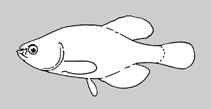
Classification / Names
आम नाम | उपशब्द | Catalog of Fishes(वर्ग, प्रजाति) | ITIS | CoL | WoRMS | Cloffa
>
Cyprinodontiformes (Rivulines, killifishes and live bearers) >
Rivulidae (Rivulines) > Rivulinae
Etymology: vieirai: Named for Gilberto da Silva Vieira who discovered the species (Ref. 128688).
Eponymy: Gilberto da Silva Vieira is a Brazilian biologist and environmentalist. He discovered and collected the type of the species with Maria da Conceição Pereira da Silva. (Ref. 128868), visit book page.
Environment: milieu / climate zone / गहराई सीमा / distribution range
पारिस्थितिकी
; स्वच्छ जल, अलवण जल बेनथोपिलाजिक. Tropical
South America: Brazil.
आकार / वज़न / Age
परिपक्व अवधि: Lm ? range ? - ? cm
Max length : 3.7 cm SL (female)
This species is found in spring that forms a Buritizal (wetland dominated by the buriti palm, Mauritia flexuosa). This source forms a small stream that flows through sugarcane field and is then dammed to create a small lagoon of crystalline water (Ref. 128688).
Life cycle and mating behavior
परिपक्व अवधि | पुनरुत्पत्ति | मछलीऔ का अंडे देना | अंडे | Fecundity | लार्वा
Nielsen, D.T.B., 2016. Description of two new species of Anablepsoides (Cyprinodontiformes: Cynolebiidae) from Rio Madeira, Amazon drainage, Rondonia State and from Rio Itapecuru basin, Maranhão State, Brazil. aqua Int. J. Ichthyol. 22(4):165-176. (Ref. 128688)
IUCN Red List Status (Ref. 130435: Version 2025-1)
Threat to humans
Harmless
Human uses
साधन
Special reports
Download XML
इंटरनेट स्रोत
Estimates based on models
Phylogenetic diversity index (संदर्भ
82804): PD
50 = 0.5000 [Uniqueness, from 0.5 = low to 2.0 = high].
Bayesian length-weight: a=0.00891 (0.00368 - 0.02159), b=3.11 (2.92 - 3.30), in cm total length, based on LWR estimates for this Genus-body shape (Ref.
93245).
Trophic level (संदर्भ
69278): 3.2 ±0.4 se; based on size and trophs of closest relatives
लौटाव (संदर्भ
120179): ऊंचा, न्यूनतम जनसंख्या दुगनी समय अवलागत 15 महीने। (Preliminary K or Fecundity.).
Fishing Vulnerability (Ref.
59153): Low vulnerability (10 of 100).
🛈