>
Trachichthyiformes (Roughies) >
Trachichthyidae (Slimeheads)
Etymology: Hoplostethus: Greek, hoplon = weapon + Greek, stetho, stethion = brest; literal = to prick a little breast (Ref. 45335); roseus: Name from Latin 'rose', referring to the rosy colouration dorsally on the body and on the dorsal, pectoral and caudal fins of fresh specimens.
Environment: milieu / climate zone / rango de profundidad / distribution range
Ecología
marino batidemersal; rango de profundidad 200 - 400 m (Ref. 129008). Subtropical
Distribución
Países | Áreas FAO | Ecosistemas | Ocurrencias, apariciones | Mapa de puntos | Introducciones | Faunafri
Western Pacific: Japan, Taiwan and New Caledonia.
Tamaño / Peso / Age
Madurez: Lm ? range ? - ? cm
Max length : 21.4 cm SL macho / no sexado; (Ref. 129008); 24.7 cm SL (female)
Short description
Claves de identificación | Morfología | Morfometría
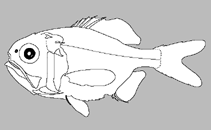
Espinas dorsales (total) : 6 - 7; Radios blandos dorsales (total) : 12 - 13; Espinas anales: 3; Radios blandos anales: 9 - 10; Vértebra: 26. This species is distinguished from its congeners by the following set of characters: pyloric caeca 65-84; predorsal scales 18-22; pectoral-fin rays 14-17 (modally 15-16); total gill rakers on first-gill arch 18-19; HF1 2.2%-3.7% SL; HF2 5.1%- 6.0% SL; postorbital width 17.1%-20.6% SL. Colouration: oral cavity, branchial cavity, top and underside of tongue, and peritoneum are uniformly black; base of caudal fin brownish; spinous dorsal-fin membrane with black distal margin. (Ref. 129008).
Cross section: oval.
The mature female specimen (24.7 cm SL) with well-developed eggs and the male specimen (21.4 cm SL) with well-developed testes; females (19.5-20.9 cm SL) with mature eggs, suggests that this species is a small species, which reproduces at a length c. 20.0 cm SL (Ref. 129008).
Life cycle and mating behavior
Madurez | Reproducción | Puesta | Huevos | Fecundidad | Larva
Su, Y., H.-C. Lin and H.-C. Ho, 2022. Hoplostethus roseus, a new roughy fish from the western Pacific based on morphology and DNA barcoding (family Trachichthyidae). J. Fish Biol. 101(3):441-452. (Ref. 129008)
IUCN Red List Status (Ref. 130435: Version 2025-1)
Threat to humans
Harmless
Human uses
Herramientas
Special reports
Download XML
Fuentes de Internet
Estimates based on models
Phylogenetic diversity index (Referencia
82804): PD
50 = 0.5000 [Uniqueness, from 0.5 = low to 2.0 = high].
Bayesian length-weight: a=0.01660 (0.00714 - 0.03859), b=3.05 (2.85 - 3.25), in cm total length, based on LWR estimates for this (Sub)family-body shape (Ref.
93245).
Nivel trófico (Referencia
69278): 3.6 ±0.6 se; based on size and trophs of closest relatives
Resiliencia (Referencia
120179): Muy bajo, población duplicada en un tiempo mínimo superior a 14 años (Preliminary K or Fecundity.).
Fishing Vulnerability (Ref.
59153): Low vulnerability (20 of 100).
🛈