Classification / Names
Noms communs | Synonymes | Catalog of Fishes(Genre, Espèce) | ITIS | CoL | WoRMS | Cloffa
Élasmobranches (requins et raies) (sharks and rays) >
Rajiformes (Skates and rays) >
Rajidae (Skates)
Environment: milieu / climate zone / profondeur / distribution range
Écologie
marin démersal; profondeur 25 - 350 m (Ref. 128044), usually 50 - 150 m (Ref. 128044). Tropical
Distribution
Pays | Zones FAO | Écosystèmes | Occurrences | Carte par point | Introductions | Faunafri
Southwestern Atlantic, from southern Brazil to at least the Beagle Channel (Argentina and Chile).
Taille / Poids / Âge
Maturité: Lm ? range ? - ? cm
Max length : 32.4 cm TL mâle / non sexé; (Ref. 128044)
Description synthétique
Clés d'identification | Morphologie | Morphométrie
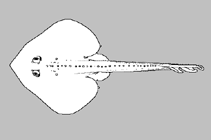
This relatively large species of skate with a rhombic-shaped disc is distinguished by the following set of characters: snout relatively large, 1.7-2.9 times tail length; tail short, 2.1-2.7 times in total length, with a short distance between the first gill openings, 3.42-4.19 times indirect disc length; dermal denticles mainly restricted to the rostral area, both in dorsal and ventral surfaces; denticles more conspicuous in adults, and can be absent or in less number in neonates and juveniles; tail with 3-5 rows of thorns (rarely only one); clasper relatively long and stout, 74-78% of the tail’s length in adult specimens; terminal bridge (Tb) straight towards the tip of dorsal terminal 2, and the spike is thin and does not reach the Tb; ventral terminal cartilage has a short apophysis, and its outer edge is narrow; distal tip of the axial is relatively narrow (Ref. 128044).
Cross section: flattened.
Life cycle and mating behavior
Maturité | Reproduction | Frai | Œufs | Fécondité | Larves
Gabbanelli, V., J. Díaz de Astarloa, M. González-Castro, D. Vázquez and E. Mabragaña, 2018. Almost a century of oblivion: Integrative taxonomy allows the resurrection of the longnose skate Zearaja brevicaudata (Marini, 1933) (Rajiformes; Rajidae). Comptes Rendus Biologies, 341(2018):454-470. (Ref. 128044)
Statut dans la liste rouge de l'IUCN (Ref. 130435: Version 2025-1)
Menace pour l'homme
Harmless
Utilisations par l'homme
Outils
Articles particuliers
Télécharger en XML
Sources Internet
Estimates based on models
Phylogenetic diversity index (Réf.
82804): PD
50 = 0.5625 [Uniqueness, from 0.5 = low to 2.0 = high].
Bayesian length-weight: a=0.00302 (0.00141 - 0.00645), b=3.24 (3.07 - 3.41), in cm total length, based on LWR estimates for this (Sub)family-body shape (Ref.
93245).
Niveau trophique (Réf.
69278): 3.7 ±0.5 se; based on size and trophs of closest relatives
Résilience (Réf.
120179): Milieu, temps minimum de doublement de population : 1,4 à 4,4 années (Preliminary K or Fecundity.).
Fishing Vulnerability (Ref.
59153): Low vulnerability (22 of 100).
🛈