Classification / Names
Κοινά ονόματα | Συνώνυμα | Catalog of Fishes(Γένος, Είδη) | ITIS | CoL | WoRMS | Cloffa
Ελασμοβράγχιοι (καρχαρίες και σαλάχια) (sharks and rays) >
Myliobatiformes (Stingrays) >
Dasyatidae (Stingrays) > Urogymninae
Etymology: Brevitrygon: Name from Latin 'brevis' meaning short and 'trygṓn' meaning stingray, referring to the short, semi-rigid tails of these stingrays; manjajiae: Named for Dr. Mabel Manjaji-Matsumoto (University of Malaysia, Sabah).
Environment: milieu / climate zone / εύρος βάθους / distribution range
Οικολογία
Θαλασσινό(ά) βενθικό(ς). Tropical
Western Indian Ocean: Pakistan and India (Arabian Sea); possibly in the Persian/Arabian Gulf and questionable in the Red Sea.
Μέγεθος / Βάρος / Age
Γεννητική Ωρίμανση: Lm ? range ? - ? cm
Short description
Κλείδες προσδιορισμού | Μορφολογία | Μορφομετρία
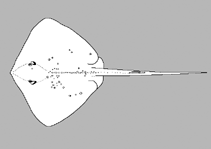
Σπόνδυλοι: 87 - 101. This species (based on the Arabian Sea material), measuring to at least 25 cm DW, is distinguished by the following set of characters: snout length 28-30% DW, angle 108-113°; disc is longer than wide; orbits are small, diameter 5-6% DW; nostrils 4-5% DW and internasal width 11-13% DW; tail is relatively short, longer in males (1.3-1.5 times DW) than in females (0.9-1.3 times DW), with rudimentary, ridge-like ventral fold and fleshy lateral ridges; pelvic fins are relatively small, length 17-19% DW; postcloacal length of clasper to 19% DW; scapular denticles1-5 (usually 1) are small, seed- or heart-shaped, no scute-like thorns on dorsal surface of disc; secondary denticle band is well developed and sharply demarcated in adults, not strongly constricted over branchial region, width across scapulocoracoid and over abdomen subequal, converging posteriorly near pectoral-fin insertions; tail with well-developed denticle band forward of sting, with 3-8 enlarged seed to weakly lanceolate denticles or small thorns (typically 2.5-5 mm long); dorsal surface predominantly, uniformly brownish when skin undamaged, disc margin slightly paler brown; ventral disc, pelvic fins, and tail white, margins of pectoral and pelvic fins dark; pectoral-fin radials 102-111; total vertebral count (excluding first synarcual centra) 87-101 (Ref. 130662).
Cross section: flattened.
Life cycle and mating behavior
Γεννητική Ωρίμανση | Αναπαραγωγή | Γεννοβολία | Αβγά | Γονιμότητα | Προνύμφες
Last, P.R., S. Weigmann and G.J.P. Naylor, 2023. The Indo-Pacific stingray genus Brevitrygon (Myliobatiformes: Dasyatidae): clarification of historical names and description of a new species, B. manjajiae sp. nov., from the western Indian Ocean. Diversity 15: 1-75. (Ref. 130662)
IUCN Red List Status (Ref. 130435: Version 2025-1)
Threat to humans
Harmless
Human uses
Εργαλεία
Special reports
Download XML
Διαδικτυακές πηγές
Estimates based on models
Phylogenetic diversity index (Αναφ.
82804): PD
50 = 0.5312 [Uniqueness, from 0.5 = low to 2.0 = high].
Bayesian length-weight: a=0.01023 (0.00486 - 0.02155), b=3.06 (2.87 - 3.25), in cm total length, based on LWR estimates for this (Sub)family-body shape (Ref.
93245).
Τροφικό Επίπεδο (Αναφ.
69278): 3.5 ±0.5 se; based on size and trophs of closest relatives
Fishing Vulnerability (Ref.
59153): Very high vulnerability (90 of 100).
🛈