Classification / Names
Common names | Synonyms | Catalog of Fishes(genus, species) | ITIS | CoL | WoRMS | Cloffa
Teleostei (teleosts) >
Blenniiformes (Blennies) >
Tripterygiidae (Triplefin blennies) > Tripterygiinae
Etymology: Enneapterygius: Greek, ennea = nine times + Greek, pterygion = little fin (Ref. 45335); sericus: Name from Latin 'sericus' meaning 'silk', referring to the shiny whitish body of this species; noun in apposition.
Environment: milieu / climate zone / depth range / distribution range
Ecology
Marine; reef-associated; depth range 5 - 20 m (Ref. 130804), usually 0 - 5 m (Ref. 130804). Subtropical
Western Pacific: Ryukyu Is., Taiwan, Indonesia, Australia and Solomon Is.; probably in the Mariana Is. (Guam) and the Hall Islands.
Size / Weight / Age
Maturity: Lm ? range ? - ? cm
Max length : 2.5 cm SL male/unsexed; (Ref. 130804)
Short description
Identification keys | Morphology | Morphometrics
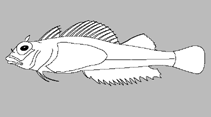
Dorsal spines (total): 15 - 17; Dorsal soft rays (total): 9 - 11; Anal spines: 1; Anal soft rays: 17 - 21. The new species is distinguished by the following set of characters: D1 III, D2 XII-XIV, D3 9-11, with first spine of D1 shorter than that of D2, its length 5.5-10.2% SL (mean 8.2%); pectoral-fin rays ii-v (iv) + 3-6 (4) + iv-viii (vii) = 13-16; A 17–21; scales below first notched lateral-line scale 3 or 3½; pored lateral line scales 15-18; scale rows in longitudinal series 32-37; circumpeduncular scales 8-12; single transverse scale row between posteriormost pored scale and anteriormost notched scale; mandibular-pore formula usually 3 + 1 + 3; orbital tentacle short, slender and pointed, its length shorter than nasal tentacle. Colouration: body generally semi-transparent white with reddish blotches and saddles; bright white blotches aligned along midlateral scale series; the dorsal surface of head with brownish blotches; head, snout and cheek, opercle, pectoral fin base, and base of 8 lowermost pectoral-fin rays black in nuptial males; undersurface of head, including pelvic-fin base, and anterior part of abdomen black, pigment sometimes extending to anus (Ref. 130804).
Cross section: oval.
Occurs usually on exposed shallow rocky reefs in depths less than 5 m, haracteristically on the upper surface of rocks covered by patches of ca. 1-2 mm length algae, whereas other congeners tend to occur on vertical surfaces. Reproductive season at Yaku-shima Island extends from the end of February to April (ca. 18-21 °C), spawning usually taking place in the morning. During the spawning season, males display nuptial coloration, which can alter quickly depending on the situation for as a female approaches the male’s melanophores on head become more obvious, forming a blackish mask on the head and body. Also, the brownish blotches on the dorsal head surface become paler and almost completely fade. During spawning, brownish pigmentation on the nape continues to change, sometimes forming blotches or lines, and becoming dense or pale. When alive, brownish blotches on the dorsal head surface are more distinct in young individuals, but paler in nuptial males and relatively large females (Ref. 130804).
Life cycle and mating behavior
Maturity | Reproduction | Spawning | Eggs | Fecundity | Larvae
Dewa, Y., S. Harazaki and H. Motomura, 2024. Enneapterygius sericus, a new species of triplefin (Perciformes: Tripterygiidae) from the western Pacific Ocean. Ichthyol. Res.: [1-13]. [First published online, pp. 1-13, 30 Jan. 2024.] (Ref. 130804)
IUCN Red List Status (Ref. 130435: Version 2025-1)
Threat to humans
Harmless
Human uses
Fisheries: of no interest
Tools
Special reports
Download XML
Internet sources
Estimates based on models
Phylogenetic diversity index (Ref.
82804): PD
50 = 0.5000 [Uniqueness, from 0.5 = low to 2.0 = high].
Bayesian length-weight: a=0.00617 (0.00288 - 0.01322), b=3.04 (2.86 - 3.22), in cm total length, based on LWR estimates for this (Sub)family-body shape (Ref.
93245).
Trophic level (Ref.
69278): 3.1 ±0.3 se; based on size and trophs of closest relatives
Resilience (Ref.
120179): High, minimum population doubling time less than 15 months (Preliminary K or Fecundity.).
Fishing Vulnerability (Ref.
59153): Low vulnerability (10 of 100).
🛈