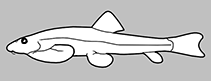
Classificação / Nomes
Nomes comuns | Sinônimos | Catalog of Fishes(Gênero, Espécies) | ITIS | CoL | WoRMS | Cloffa
>
Cypriniformes (Carps) >
Gastromyzontidae (Hillstream loaches)
Etymology: Bashimyzon: Name derived from Bashi (岜是), the local name of the Damingshan Mountain in Zhuang nationality language, and 'myzon', a common suffix used in the Balitoridae; damingshanensis: Named for the Damingshan Mountain, the head stream of the type locality.
Environment: milieu / Zona climática / intervalo de profundidade / distribution range
Ecologia
; Água doce demersal; intervalo de profundidade 0 - 1 m (Ref. 117923). Subtropical
Distribuição
Países | Áreas da FAO | Ecossistemas | Ocorrências | Mapa de pontos | Introduções | Faunafri
Asia: China.
Tamanho / Peso / Idade
Maturidade: Lm ? range ? - ? cm
Max length : 5.9 cm TL macho/indeterminado; (Ref. 130915)
Collected from a stream where the water flows into the Hongshuihe River, collected in fast flow, shallow water at width of 15-20 m, depths of 0.3-0.7 m amongst cobbles mixed with sand on the river bed. Found syntopic with Schistura fasciolata. Zacco platypus, Opsariichthys bidens, Pseudorasbora parva and Osteochilus salsburyi (Ref. 117923).
Ciclo de vida ou comportamento de acasalamento
Maturidade | Reprodução | Desova | Ovos | Fecundidade | Larvas
Gong, X. and E. Zhang, 2024. Bashimyzon cheni, a new genus and species of sucker loach (Teleostei, Gastromyzontidae) from South China. Zoosystematics and Evolution 100(1):309-324. (Ref. 130915)
Status na Lista Vermelha da UICN (Ref. 130435: Version 2025-1)
Ameaça para os humanos
Harmless
Uso pelos humanos
Pescarias: sem interesse
Ferramentas
Relatórios especiais
Baixar XML
Fontes da internet
Estimates based on models
Índice de diversidade filogenética (Ref.
82804): PD
50 = 0.7500 [Uniqueness, from 0.5 = low to 2.0 = high].
Bayesian length-weight: a=0.00617 (0.00268 - 0.01421), b=3.11 (2.91 - 3.31), in cm total length, based on LWR estimates for this (Sub)family-body shape (Ref.
93245).
Nível Trófico (Ref.
69278): 2.8 ±0.3 se; based on size and trophs of closest relatives
Fishing Vulnerability (Ref.
59153): Low vulnerability (10 of 100).
🛈