Классификация / Names
народные названия | синонимы | Catalog of Fishes(род, виды) | ITIS | CoL | WoRMS | Cloffa
>
Clupeiformes (Herrings) >
Engraulidae (Anchovies) > Engraulinae
Etymology: Stolephorus: Greek, stole, -es = garment + Greek, pherein = to carry (Ref. 45335); eclipsis: Name 'eclipsis refers to 'eclipse', referring to the concave pre-opercle of the new species.
Environment: milieu / climate zone / пределы глубины / distribution range
экология
морской pelagic-neritic. Tropical
Western Pacific: Indonesia.
Size / Вес / Возраст
половая зрелость: Lm ? range ? - ? cm
Max length : 4.4 cm SL самец/пол неопределен; (Ref. 130210)
Краткое описание
определительные ключи | морфология | морфометрия
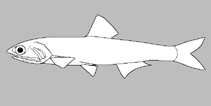
This species is distinguished by the following characters: gill rakers on upper limb of 1st gill arch, 19-21 (modally 20), on lower limb 26-30 (28), total 47-51 (47); gill rakers on upper limb of 2nd gill arch 13-16 (14), on lower limb 24-27 (25), total 37-42 (39); gill rakers on upper limb of 3rd gill arch 10-13 (12), on lower limb 14-16 (15), total 25-28 (27); gill rakers on upper limb of 4th gill arch 8-11 (9), on lower limb 11-13 (12), total 19-24 (21); prepelvic scutes 5-7 (6); total vertebrae 38-39 (39); long maxilla, its posterior tip just reaching or slightly short of posterior margin of opercle; with predorsal scute; pelvic scute no spine; body scales are deciduous; posterior border of pre-opercle concave, indented; paired dark patch on parietal area with little following pigmentation; distinct double pigment lines along dorsum posterior to the dorsal fin; no black spots below eye and on lower-jaw tip; anal-fin base is short, 17.6-19.3% (mean 18.6%) of SL; third dorsal-fin ray 16.5-18.8% (17.6%) of SL; pelvic fin is short, 8.7-9.9% (9.4%) of SL, its posterior tip usually not reaching to vertical through dorsal-fin origin when depressed; distance between posterior ends of supramaxilla and maxilla 4.7-5.4% (5.1%) of SL; pre-dorsal-fin length 51.3-54.9% (53.4%) of SL; dorsal-fin base is short, 13.1-14.5% (13.8%) of SL (Ref. 130210).
Cross section: compressed.
Life cycle and mating behavior
половая зрелость | размножение | нерест | икра | Fecundity | личинки
Hata, H., S. Lavoué and H. Motomura, 2022. Description of three new species previously identified as Stolephorus bengalensis (Dutt & Babu Rao, 1959) or Stolephorus insularis Hardenberg, 1933 and a re-description of S. bengalensis (Chordata, Osteichthyes, Clupeiformes, Engraulidae). ZooKeys 1121(0):145-173. (Ref. 130210)
Статус Красного Списка МСОП (Ref. 130435: Version 2025-1)
Угроза для людей
Harmless
Использование человеком
рыболовство: коммерческий
дополнительная информация
инструменты
Специальные отчеты
Скачать в формате XML
ресурсы в Интернет
Estimates based on models
Phylogenetic diversity index (ссылка
82804): PD
50 = 0.5000 [Uniqueness, from 0.5 = low to 2.0 = high].
Bayesian length-weight: a=0.00501 (0.00220 - 0.01140), b=3.14 (2.96 - 3.32), in cm total length, based on LWR estimates for this Genus-body shape (Ref.
93245).
Trophic level (ссылка
69278): 3.2 ±0.4 se; based on size and trophs of closest relatives
устойчивость к внешним воздействиям (ссылка
120179): высокий, минимальное время удвоения популяции до 15 месяцев (Preliminary K or Fecundity.).
Fishing Vulnerability (Ref.
59153): Low vulnerability (10 of 100).
🛈