Klassifizierung / Names
Namen | Synonyme | Catalog of Fishes(Gattung, Arten) | ITIS | CoL | WoRMS | Cloffa
>
Dactylopteriformes (Flying gurnards) >
Pegasidae (Seamoths)
Etymology: Pegasus: Named after the winged horse sprung from the blood of Medusa (Ref. 1418); nanhaiensis: Named for the South China Sea, where the holotype was collected.
Environment: milieu / climate zone / Tiefenbereich / distribution range
Ökologie
seewasser demersal; tiefenbereich 17 - 23 m (Ref. 131072). Tropical
Pacific Oceaan: China.
Size / Gewicht / Alter
Geschlechtsreife: Lm ? range ? - ? cm
Max length : 5.8 cm SL Männchen/unbestimmt; (Ref. 131072); 6.2 cm SL (female)
Kurzbeschreibung
Bestimmungsschlüssel | Morphologie | Morphometrie
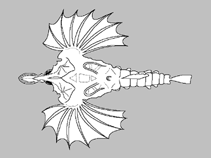
This species is distinguished from all its congeners by the following set of characters: a rounded hump-like tubercle on each of dorsal plates I, II, and III; clear hexagonal patterns in surface dorsal plate with a clear boundary; two paired caudolateral plates overlapping the junctions between tail rings II and III, and IV and V; formation of a bulge at the margin of the ventral plate that connected to the paired pelvic fins, and four strong rounded tubercles in the concave margin of the occipital (Ref. 131072).
Cross section: other (see remarks).
Collected by trawl from mud bottoms (Ref. 131072).
Life cycle and mating behavior
Geschlechtsreife | Fortpflanzung | Ablaichen | Eier | Fecundity | Larven
Zhang, R., Z. Wang, S. Wan, S. Ma and Q. Lin, 2020. A new species of Pegasus (Syngnathiformes: Pegasidae) from the South China Sea. Zootaxa 4894(4):521-534. (Ref. 131072)
IUCN Rote Liste Status (Ref. 130435: Version 2025-1)
Bedrohung für Menschen
Harmless
Nutzung durch Menschen
Fischereien: bycatch
Tools
Zusatzinformationen
Download XML
Internet Quellen
Estimates based on models
Phylogenetic diversity index (Ref.
82804): PD
50 = 0.5391 [Uniqueness, from 0.5 = low to 2.0 = high].
Bayesian length-weight: a=0.01000 (0.00244 - 0.04107), b=3.04 (2.81 - 3.27), in cm total length, based on all LWR estimates for this body shape (Ref.
93245).
Trophic level (Ref.
69278): 3.2 ±0.4 se; based on size and trophs of closest relatives
Fishing Vulnerability (Ref.
59153): Low vulnerability (10 of 100).
🛈