



Halichoeres sanchezi Victor, Frable & Ludt, 2024
Tail-spot wrasse
Sube tu fotos y Vídeos
Google image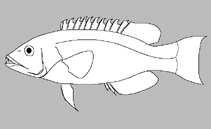 No image available for this species;
drawing shows typical species in Labridae.
Google image
drawing shows typical species in Labridae.
Clasificación / Nombres Nombres comunes | Sinónimos | Catalog of Fishes(Género, Especie) | ITIS | CoL | WoRMS | Cloffa
> Eupercaria/misc (Various families in series Eupercaria) > Labridae (Wrasses) > Julidinae
Etymology: Halichoeres: Greek, als, alis = salt + Greek, choiros = pig (Ref. 45335); sanchezi: Named for Prof. Carlos Armando Sanchez Ortiz, Programa de Investigacion para la Conservacion de la Fauna Arrecifal (PFA), Biologia Marina, Universidad Autonoma de Baja California Sur (UABCS) in La Paz, Baja California Sur, Mexico.
Etymology: Halichoeres: Greek, als, alis = salt + Greek, choiros = pig (Ref. 45335); sanchezi: Named for Prof. Carlos Armando Sanchez Ortiz, Programa de Investigacion para la Conservacion de la Fauna Arrecifal (PFA), Biologia Marina, Universidad Autonoma de Baja California Sur (UABCS) in La Paz, Baja California Sur, Mexico.
Entorno: milieu / zona climática / rango de profundidad / gama de distribución Ecología
marino asociado a arrecife; rango de profundidad 21 - 22 m (Ref. 131162). Tropical
Distribución Territorios | Áreas FAO | Ecosistemas | Ocurrencias, apariciones | Mapa de puntos | Introducciones | Faunafri
Eastern Pacific: Mexico (Revillagigedo Archipelago).
Tamaño / Peso / Edad
Descripción breve Claves de identificación | Morfología | Morfometría
Espinas dorsales (total) : 9; Radios blandos dorsales (total) : 12; Espinas anales: 3; Radios blandos anales: 12. This species is distinguished by the following characters: D IX,12; A III,12; pectoral-fin rays 13; lateral-line pored scales 26 (+1 on caudal-fin base); suborbital pores 6; gill rakers 14-16; a pair of large, projecting, and slightly recurved canine teeth anteriorly in each jaw, the lowers curving forward, fitting between uppers when mouth closed, a second pair of canines about half size of first, followed by rows of mostly caniniform teeth, no canine posteriorly at corner of mouth; body elongate, depth 3.6-4.2 in SL. width 2.2-3.0 in depth; caudal fin slightly rounded. Colouration: TP vermilion on head to orangish-brown on body, yellow-cream ventrally with a dark cross-hatch pattern outlining scales, opercular flap diffusely dark and purple; a prominent large black blotch covering rear caudal peduncle and proximal half of caudal fin, a pale patch over mid-abdominal area underlying pectoral fin; a small black spot on first dorsal-fin membrane; IP and juvenile fish grey ventrally becoming yellowish posteriorly with a broad midlateral red band from snout to caudal peduncle, often breaking up into horizontal block segments, including a distinct black crescent or oval spot on expanded soft flap of upper operculum, and ending in a horizontal oblong black spot at caudal-fin base; a similar narrower band runs along upper body below base of dorsal fin from snout to upper caudal peduncle; fins clear except for a large oblong black spot, edged in yellow dorsally, centered over membranes of last dorsal-fin spine and first three rays and extending partially onto upper body (present in both juvenile and IP adults) (Ref. 131162).
Body shape (shape guide): elongated; Cross section: compressed.
Body shape (shape guide): elongated; Cross section: compressed.
The collection site was a large, even plain, ca. 21-22 m deep, on volcanic gravel-rubble surrounded by lava boulders and with a few boulders dispersed in among the dark bottom, patches of white gravel were interspersed among the dark volcanic gravel-rubble areas. Juveniles and smaller IP fish were found generally just off the bottom around boulders and over lighter patches of gravel, while larger IP and TP individuals were observed slightly higher in the water column around the boulders on the eastern edge of the plain (Ref. 131162).
Ciclo vital y comportamiento de apareamiento Madurez | Reproducción | Puesta | Huevos | Fecundidad | Larva
Referencia principal
Suba sus referencias | Referencias | Coordinador : Westneat, Mark | Colaboradores
Victor, B.C., B.W. Frable and W.B. Ludt, 2024. Halichoeres sanchezi n. sp., a new wrasse from the Revillagigedo Archipelago of Mexico, tropical eastern Pacific Ocean (Teleostei: Labridae). PeerJ 12:e16828:1-28. (Ref. 131162)
CITES
Not Evaluated
Amenaza para el ser humano
Harmless
Usos humanos
FAO - Publication: search | FishSource |
Más información
Ecología Trófica
Alimentos (presas)
Composición de la dieta
consumo de alimento
Raciones de comida
Despredadores
Alimentos (presas)
Composición de la dieta
consumo de alimento
Raciones de comida
Despredadores
Ecología
Ecología
Ecología
Dinámica de la población
Coeficiente del crecimiento para
Edades / tallas máximas
Longitud-peso rel.
Longitud-longitud rel.
Longitud-frecuencias
Conversión de masas
Reclutamiento
Abundancia
Coeficiente del crecimiento para
Edades / tallas máximas
Longitud-peso rel.
Longitud-longitud rel.
Longitud-frecuencias
Conversión de masas
Reclutamiento
Abundancia
Ciclo de vida
Reproducción
Madurez
Madurez/Gills rel.
Fecundidad
Puesta
Agregaciones de desove
Huevos
Desarrollo de los huevos
Larva
Dinámica larvaria
Reproducción
Madurez
Madurez/Gills rel.
Fecundidad
Puesta
Agregaciones de desove
Huevos
Desarrollo de los huevos
Larva
Dinámica larvaria
Distribución
Territorios
Áreas FAO
Ecosistemas
Ocurrencias, apariciones
Introducciones
BRUVS - Vídeos
Territorios
Áreas FAO
Ecosistemas
Ocurrencias, apariciones
Introducciones
BRUVS - Vídeos
Anatomía
Superficie branquial
Cerebro
Otolito
Superficie branquial
Cerebro
Otolito
Fisiología
Composición corporal
Nutrientes
Consumo del oxígeno
Tipo de natación
Velocidad de natación
Pigmentos visuales
Sonido de peces
Enfermedades y parásitos
Toxicidad (CL50)
Composición corporal
Nutrientes
Consumo del oxígeno
Tipo de natación
Velocidad de natación
Pigmentos visuales
Sonido de peces
Enfermedades y parásitos
Toxicidad (CL50)
Genética
Genoma
Genética
Heterocigosidad
heritabilidad
Diversidad genética
Genoma
Genética
Heterocigosidad
heritabilidad
Diversidad genética
Relacionados con el ser humano
Sistemas de acuicultura
Perfiles de acuicultura
Razas
Ciguatera cases
Sellos, monedas, varios
Sistemas de acuicultura
Perfiles de acuicultura
Razas
Ciguatera cases
Sellos, monedas, varios
Herramientas
Libro electrónico | Guía de campo | Asistente para frecuencias de tallas | Herramienta de ciclo de vida | Mapa de puntos |
Catch-MSY |
Informes especiales
Comprobar el mantenimiento del acuario | Buscar fichas sobre especies | Consulte las hojas informativas sobre acuicultura
Descargar XML
Fuentes de Internet
AFORO (otoliths) | Aquatic Commons | BHL | Cloffa | Websites from users | Check FishWatcher | CISTI | Catalog of Fishes: Género, Especie | DiscoverLife | ECOTOX | FAO - Publication: search | Faunafri | Fishipedia | Fishtrace | GloBI | Google Books | Google Scholar | Google | IGFA World Record | OneZoom | Open Tree of Life | Otolith Atlas of Taiwan Fishes | PubMed | Reef Life Survey | Socotra Atlas | TreeBase | Árbol de la vida | Wikipedia: Go, búsqueda | World Records Freshwater Fishing | Zoobank | Expediente Zoológico
Estimaciones basadas en modelos
Índice de diversidad filogenética (Referencia 82804): PD50 = 0.5000 [Uniqueness, from 0.5 = low to 2.0 = high].
Bayesian length-weight: a=0.00501 (0.00215 - 0.01171), b=3.13 (2.92 - 3.34), in cm total length, based on LWR estimates for this (Sub)family-body shape (Ref. 93245).
Nivel trófico (Referencia 69278): 3.4 ±0.5 se; based on size and trophs of closest relatives
Resiliencia (Referencia 120179): Alto, población duplicada en un tiempo mínimo inferior a 15 meses (Preliminary K or Fecundity.).