Klassifizierung / Names
Namen | Synonyme | Catalog of Fishes(Gattung, Arten) | ITIS | CoL | WoRMS | Cloffa
>
Perciformes/Zoarcoidei (Eelpouts and pricklebacks) >
Zoarcidae (Eelpouts) > Gymnelinae
Etymology: Krusensterniella: Named after the Russian navigator explorer, Admiral I.F. Krusenstern, who led the first Russian circumnavigation (1803– 1806) and visited that part of the Sea of Okhotsk where the type species was found. Of the two Russian-language names 'krusensterniella' (Taranets, 1937) and 'kruzenshternia' (Sheiko and Fedorov, 2000)—the first one has come into scientific use (Ref. 130195); pseudomaculata: Name from Latin 'maculata' and the prefix 'pseudo', meaning 'false' or 'fake'.
Environment: milieu / climate zone / Tiefenbereich / distribution range
Ökologie
seewasser demersal; tiefenbereich 25 - 164 m (Ref. 130195). Subtropical
Northwest Pacific: Sea of Japan and Sea of Okhotsk.
Size / Gewicht / Alter
Geschlechtsreife: Lm ? range ? - ? cm
Max length : 12.7 cm TL Männchen/unbestimmt; (Ref. 130195)
Kurzbeschreibung
Bestimmungsschlüssel | Morphologie | Morphometrie
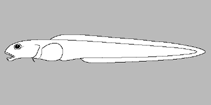
Rückenflossenstacheln (insgesamt) : 101 - 104; Afterflossenweichstrahlen: 84 - 86; Wirbelzahl: 104 - 107. This species is distinguished by the following characters: pungent spines of D2 VI-XI, starts in the middle of the length of the caudal part of the body, associated with the caudal vertebrae
22-37; all spiny rays (D1 + D2) 50-55; rays in D1 and in D3 is similar: 40-48 and 45-54; vertebrae 104-107; D 101-104 (40-48 VI-XI 45-54), A 84-86; well developed scales only on the caudal part, only single scales on the sides in front of the beginning of anal fin (Ref. 130195).
Cross section: compressed.
Collected from two captures, where the water temperature was 1.3 and 2.0°C; bottom sediments were silt, sand, pebbles, and stones (Ref. 130195).
Life cycle and mating behavior
Geschlechtsreife | Fortpflanzung | Ablaichen | Eier | Fecundity | Larven
Chernova, N.V., 2022. Review of prickled eelpouts of genus Krusensterniella (Zoarcidae) describing three new species from the far-eastern seas. J. Ichthyol. 62(2):153-172. (Ref. 130195)
IUCN Rote Liste Status (Ref. 130435: Version 2025-1)
Bedrohung für Menschen
Harmless
Nutzung durch Menschen
Fischereien: nicht kommerziell
Tools
Zusatzinformationen
Download XML
Internet Quellen
Estimates based on models
Phylogenetic diversity index (Ref.
82804): PD
50 = 0.5039 [Uniqueness, from 0.5 = low to 2.0 = high].
Trophic level (Ref.
69278): 3.2 ±0.4 se; based on size and trophs of closest relatives
Widerstandsfähigkeit (Ref.
120179): mittel, Verdopplung der Population dauert 1,4 - 4,4 Jahre. (Preliminary K or Fecundity.).
Fishing Vulnerability (Ref.
59153): Low vulnerability (10 of 100).
🛈