Classification / Names
Nombres comunes | Sinónimos | Catalog of Fishes(Género, Especie) | ITIS | CoL | WoRMS | Cloffa
>
Siluriformes (Catfishes) >
Loricariidae (Armored catfishes) > Hypostominae
Etymology: Yaluwak: Yaluwak is the Patamona Amerindian word for this species (and used generally for larger
loricariids). The pronunciation of the ‘l’ in Yaluwak is a guttural ‘lr’ sound; primus: Name from Latin word meaning first, foremost, chief or principal; referring to the large body size of
the species and the fact that it retains the evertible cheek odontodes, likely inherited from the common
ancestor of the Yaluwak/Corymbophanes clade. Also, the species name was inspired by our indefatigable Patamona guide, Mr Primus Peters, who led the collection effort for this species and assisted in innumerable other ways during our 2016 expedition to the upper Ireng River.
Environment: milieu / climate zone / rango de profundidad / distribution range
Ecología
; agua dulce bentopelágico. Tropical
Distribución
Países | Áreas FAO | Ecosistemas | Ocurrencias, apariciones | Mapa de puntos | Introducciones | Faunafri
South America: Guyana.
Tamaño / Peso / Age
Madurez: Lm ? range ? - ? cm
Max length : 12.3 cm SL (female)
Short description
Claves de identificación | Morfología | Morfometría
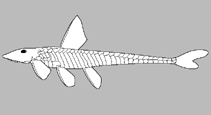
This species is distinguished from the Hypostominae genera Corymbophanes, Hypostomus and Pterygoplichthys and from all non-Hypostominae loricariids by having a cluster of > 25 evertible cheek odontodes (vs. no cheek odontodes or < 10); differs from all other members of the Hypostominae except some Ancistrus species Araichthys loro Zawadzki et al., 2016, Chaetostoma carrioni (Norman, 1935) and Leptoancistrus by the absence of an adipose fin, having instead a low ridge of azygous plates; differs from all Ancistrus species and Chaetostoma carrioni by having a fully plated snout, from Araichthys loro by having a taller caudal peduncle. 10.9, 14.2% SL (vs. ?8%) and longer tooth rows 23.7, 24.7% HL (vs. 19%) and from Leptoancistrus by lacking cheek odontodes that extend past the cleithrum and having dorsal fin ii,7 (vs. ii,8); differs from Corymbophanes by its larger maximum body size, 12.29 cm SL (vs. 10.06 cm SL) (Ref. 130535).
Cross section: oval.
Life cycle and mating behavior
Madurez | Reproducción | Puesta | Huevos | Fecundidad | Larva
Lujan, N.K., J.W. Armbruster, D.C. Werneke, T.F. Teixeira and N.R. Lovejoy, 2019. Phylogeny and biogeography of the Brazilian–Guiana Shield endemic Corymbophanes clade of armoured catfishes (Loricariidae). Zoological Journal of the Linnean Society 188:1213-1235. (Ref. 130535)
IUCN Red List Status (Ref. 130435: Version 2025-1)
Threat to humans
Harmless
Human uses
Pesquerías: sin interés
Herramientas
Special reports
Download XML
Fuentes de Internet
Estimates based on models
Phylogenetic diversity index (Referencia
82804): PD
50 = 1.0000 [Uniqueness, from 0.5 = low to 2.0 = high].
Resiliencia (Referencia
120179): Medio, población duplicada en un tiempo mínimo de 1.4-4.4 años (Preliminary K or Fecundity.).
Fishing Vulnerability (Ref.
59153): Low vulnerability (10 of 100).
🛈