Classification / Names
Tên thường gặp | Các synonym ( Các tên trùng) | Catalog of Fishes(Giống, Các loài) | ITIS | CoL | WoRMS | Cloffa
>
Cypriniformes (Carps) >
Danionidae (Danios) > Chedrinae
Etymology: Barilius: Latinization of 'barila', presumably a Bengali local name for Barilius barila, but it lacks a proper reference (J. Müller, pers. comm., April 2021, after information from native speakers); cyanochlorus: Name from Greek, 'kyano' for dark blue and 'khloros' for light green, referring to the blue-green mid-lateral color bands of the new fish.
Environment: milieu / climate zone / Mức độ sâu / distribution range
Sinh thái học
; Nước ngọt Sống nổi và đáy; Mức độ sâu 3 - 5 m (Ref. 124202). Tropical
Sự phân bố
Các nước | Các khu vực của FAO | Các hệ sinh thái | Những lần xuất hiện | Bản đồ điểm | Những chỉ dẫn | Faunafri
Asia: India.
Bộ gần gũi / Khối lượng (Trọng lượng) / Age
Chín muồi sinh dục: Lm ? range ? - ? cm
Max length : 7.0 cm SL con đực/không giới tính; (Ref. 124202)
Short description
Khóa để định loại | Hình thái học | Sinh trắc học
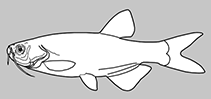
Các vây lưng mềm (tổng cộng) : 11; Tia mềm vây hậu môn: 13 - 14. This species is distinguished from all its congeners by the following characters: lateral line scales 37-39; predorsal scales 14-16; branched dorsal fin rays 11; snout with two pairs of minute barbels. Colouration: body with blackish-brown dorsal and upper laterals, greenish-yellow middle part and silvery lower lateral part, vertical bands on mid-lateral region 8, with each of these bands with two segments-lower blue part and upper green part-a large round blotch on caudal base with same color pattern, upper caudal lobe with a triangular black blotch, dorsal fin with basal 2/3 portion brown and distal part orange-red, anal fin orange-red and pectoral fin pale reddish (Ref. 124202).
Cross section: compressed.
This species is collected from a fast-flowing water stream named Eramkunnuchaal, Chully, Kasargod, Kerala; its width 2 - 5 m and depth of 5 - 3m . The stream basin is characterized by denudational hills and valley hills and the high level regions of the stream are blanketed by moderate to dense riparian vegetation. Major plant components include: Adenanthera pavonina, Albizia chinensis, Aegle marmelos, Areca catechu, Artocarpus heterophyllus, Artocarpus incisus. Averrhoa bilimbi, Borassus flabellifer, Corypha umbraculifera, Cocos nucifera, Dabergia latifolia, Erythrina stricta, Ficus auriculata, Hevea brasiliensis, Mangifera indica, Ochreinauclea missionis, Psidium guajava, Syzygium lanceolatum, Theobroma cacao, Terminalia bellirica, Syzygium jambos, Strychnos nux-vomica, Tamarindus indica, and others. Associated species include: Anguilla bengalensis, A. bicolor, Barilius bakeri, Devario malabaricus, Garra mullya, Haludaria fasciatus, Rasbora dandia, Mystus montanus, Ompok bimaculatus, Mesonoemacheilus pulchellus, and others (Ref. 124202).
Life cycle and mating behavior
Chín muồi sinh dục | Sự tái sinh sản | Đẻ trứng | Các trứng | Sự sinh sản | Ấu trùng
Plamoottil, M. and K. Vineeth, 2020. A new cyprinid fish Barilius cyanochlorus from Kerala, India. Biodiversitas 21(1):5389-5394. (Ref. 124202)
IUCN Red List Status (Ref. 130435: Version 2025-1)
Threat to humans
Harmless
Human uses
Các nghề cá: không ích lợi (thú vị)
Các công cụ
Special reports
Download XML
Các nguồn internet
Estimates based on models
Phylogenetic diversity index (Tài liệu tham khảo
82804): PD
50 = 0.5001 [Uniqueness, from 0.5 = low to 2.0 = high].
Mức dinh dưỡng (Tài liệu tham khảo
69278): 3.2 ±0.4 se; based on size and trophs of closest relatives
Thích nghi nhanh (Tài liệu tham khảo
120179): Chiêù cao, thời gian nhân đôi của chủng quần tối thiểu là dưới 15 tháng (Preliminary K or Fecundity.).
Fishing Vulnerability (Ref.
59153): Low vulnerability (10 of 100).
🛈