Environment: milieu / Zona climática / intervalo de profundidade / distribution range
Ecologia
marinhas associadas(os) a recifes. Subtropical
Southwest Pacific: off eastern Australia and New Caledonia.
Tamanho / Peso / Idade
Maturidade: Lm ? range ? - ? cm
Max length : 35.0 cm WD macho/indeterminado; (Ref. 114953)
Descrição suscinta
Chaves de identificação | Morfologia | Morfometria
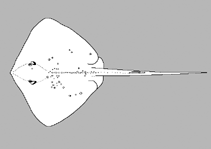
This species is described by the following: a small stingray with a smooth rhombic disc (usually thorns on nape absent); short tail with both dorsal and ventral folds; upper disc with small blue-edged white ocelli and black speckles; distinct mask-like marking around eyes; sides of tail mottled and tip banded; disc is broad, its width ca,1.3 times its length, trunk fleshy; pectoral-fin
apex abruptly angular; snout is short, bluntly angular, the tip not extended, the anterior margins almost straight to weakly undulate; eyes large, protruding, length of orbit and spiracle, ca. 1.4 in snout length, the interorbital space subequal to orbit length; mouth is very small, with 2 broad central oral papillae, the labial furrows and folds prominent, the jaws asymmetric; nasal curtain skirt-shaped, rather narrow, the margin concave, strongly fringed; nostrils narrow; skin often lacking denticles and thorns; tail firm, broad based and depressed slightly anteriorly, tapering gradually to caudal sting, it is slender, almost rounded below sting, flattened posteriorly (not long and
whip-like), the length slightly longer than DW, with usually 1 caudal sting, its ventral fold low, elongate, base ca.1.5 times distance from snout to 5th gill slit, the dorsal fold short based, lower than ventral fold; pelvic fins are large, the apices rather pointed (Ref. 114953).
Cross section: flattened.
Ciclo de vida ou comportamento de acasalamento
Maturidade | Reprodução | Desova | Ovos | Fecundidade | Larvas
Last, P.R., W.T. White, M.R. de Carvalho, B. Séret, M.F.W. Stehmann and G.J.P. Naylor, 2016. Rays of the world. CSIRO Publishing, Comstock Publishing Associates. i-ix + 1-790. (Ref. 114953)
Status na Lista Vermelha da UICN (Ref. 130435: Version 2025-1)
Ameaça para os humanos
Harmless
Uso pelos humanos
Ferramentas
Relatórios especiais
Baixar XML
Fontes da internet
Estimates based on models
Índice de diversidade filogenética (Ref.
82804): PD
50 = 0.5000 [Uniqueness, from 0.5 = low to 2.0 = high].
Nível Trófico (Ref.
69278): 3.4 ±0.3 se; based on size and trophs of closest relatives
Fishing Vulnerability (Ref.
59153): Moderate vulnerability (40 of 100).
🛈