



Myroconger pietschi Espíndola, Caires, Tighe, de Pinna & Melo, 2021
Upload your photos and videos
Google image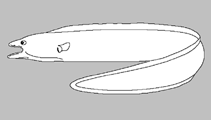 No image available for this species;
drawing shows typical species in Myrocongridae.
Google image
drawing shows typical species in Myrocongridae.
Classification / Names Common names | Synonyms | Catalog of Fishes(genus, species) | ITIS | CoL | WoRMS | Cloffa
Teleostei (teleosts) > Anguilliformes (Eels and morays) > Myrocongridae (Atlantic red eels)
Etymology: Myroconger: Greek, myros, -ou = male of morey eel + Latin, conger = conger (Ref. 45335); pietschi: Named for Theodore Wells Pietsch III for his contributions to the knowledge of deep-sea fishes (Ref. 124570).
Eponymy: Dr Theodore ‘Ted’ Wells Pietsch III (d: 1945) was a professor of ichthyology at the University of Washington, Seattle (1978 onwards) and is an American systematist and evolutionary biologist especially known for his studies of anglerfishes. [...] (Ref. 128868), visit book page.
Etymology: Myroconger: Greek, myros, -ou = male of morey eel + Latin, conger = conger (Ref. 45335); pietschi: Named for Theodore Wells Pietsch III for his contributions to the knowledge of deep-sea fishes (Ref. 124570).
Eponymy: Dr Theodore ‘Ted’ Wells Pietsch III (d: 1945) was a professor of ichthyology at the University of Washington, Seattle (1978 onwards) and is an American systematist and evolutionary biologist especially known for his studies of anglerfishes. [...] (Ref. 128868), visit book page.
Environment: milieu / climate zone / depth range / distribution range Ecology
Marine; bathydemersal; depth range 253 - ? m (Ref. 124570). Tropical
Distribution Territories | FAO areas | Ecosystems | Occurrences | Point map | Introductions | Faunafri
Southwest Atlantic: Brazil.
Size / Weight / Age
Short description Identification keys | Morphology | Morphometrics
Dorsal soft rays (total): 291; Anal soft rays: 190; Vertebrae: 125. This species can be distinguished from its congeners by the following characters: A 190; D 291; V 125; a short pectoral fin (16.6 % HL); the posterior portion of the ethmovomerine teeth arranged in a single row, teeth on lower and upper pharyngeal tooth plate 24 and 27, and 10 branchiostegal rays; having five lateral-line pores; ethmovomerine tooth patch extending to nearly half-length of upper jaw; preanal vertebrae 48; preoperculomandibular pores six. Colouration of preserved specimen: head and body generally orange; body whitish on belly and ventral third of caudal portion; ventral surface of the head is light yellow, covering the lower jaw and the ventral portion of the cheek; a single, broad, dichromatic stripe runs along the flank, pale yellow on the dorsal and ventral margins with a brown center, extending medially from the last lateral-line pore to the posterior third of the body; pectoral fin is predominantly orange, becoming lighter towards its distal third; anterior half of the dorsal fin is orange, transitioning to yellowish in the posterior half; anal fin whitish on its anterior third, while the posterior two-thirds are yellow (Ref. 124570).
Life cycle and mating behavior Maturity | Reproduction | Spawning | Eggs | Fecundity | Larvae
Main reference
Upload your references | References | Coordinator | Collaborators
Espíndola, V.C., R.A. Caires, K.A. Tighe, M.C.C. De Pinna and M.R.S. De Melo, 2021. A new species of the rare genus Myroconger Günther, 1870 (Anguilliformes: Myrocongridae) from Brazilian waters, tropical western Atlantic. Zootaxa 4965(3):529-540. (Ref. 124570)
IUCN Red List Status (Ref. 130435: Version 2025-2 (Global))
Data deficient (DD) ; Date assessed: 02 July 2024
CITES
Not Evaluated
Threat to humans
Harmless
Human uses
Fisheries: of no interest
FAO - Publication: search | FishSource |
More information
Trophic ecology
Food items (preys)
Diet composition
Food consumption
Food rations
Predators
Food items (preys)
Diet composition
Food consumption
Food rations
Predators
Ecology
Ecology
Ecology
Population dynamics
Growth parameters
Max. ages / sizes
Length-weight rel.
Length-length rel.
Length-frequencies
Mass conversion
Recruitment
Abundance
Growth parameters
Max. ages / sizes
Length-weight rel.
Length-length rel.
Length-frequencies
Mass conversion
Recruitment
Abundance
Life cycle
Reproduction
Maturity
Maturity/Gills rel.
Fecundity
Spawning
Spawning aggregations
Eggs
Egg development
Larvae
Larval dynamics
Reproduction
Maturity
Maturity/Gills rel.
Fecundity
Spawning
Spawning aggregations
Eggs
Egg development
Larvae
Larval dynamics
Anatomy
Gill area
Brain
Otolith
Gill area
Brain
Otolith
Physiology
Body composition
Nutrients
Oxygen consumption
Swimming type
Swimming speed
Visual pigments
Fish sound
Diseases & Parasites
Toxicity (LC50s)
Body composition
Nutrients
Oxygen consumption
Swimming type
Swimming speed
Visual pigments
Fish sound
Diseases & Parasites
Toxicity (LC50s)
Genetics
Genome
Genetics
Heterozygosity
Heritability
Genetic Diversity
Genome
Genetics
Heterozygosity
Heritability
Genetic Diversity
Human related
Aquaculture systems
Aquaculture profiles
Strains
Ciguatera cases
Stamps, coins, misc.
Aquaculture systems
Aquaculture profiles
Strains
Ciguatera cases
Stamps, coins, misc.
Tools
Special reports
Download XML
Internet sources
AFORO (otoliths) | Aquatic Commons | BHL | Cloffa | Websites from users | Check FishWatcher | CISTI | Catalog of Fishes: genus, species | DiscoverLife | ECOTOX | FAO - Publication: search | Faunafri | Fishipedia | Fishtrace | GloBI | Google Books | Google Scholar | Google | IGFA World Record | OneZoom | Open Tree of Life | Otolith Atlas of Taiwan Fishes | PubMed | Reef Life Survey | Socotra Atlas | TreeBase | Tree of Life | Wikipedia: Go, Search | World Records Freshwater Fishing | Zoobank | Zoological Record
Estimates based on models
Phylogenetic diversity index (Ref. 82804): PD50 = 0.5312 [Uniqueness, from 0.5 = low to 2.0 = high].
Bayesian length-weight: a=0.00102 (0.00046 - 0.00225), b=3.06 (2.88 - 3.24), in cm total length, based on all LWR estimates for this body shape (Ref. 93245).
Trophic level (Ref. 69278): 3.7 ±0.6 se; based on size and trophs of closest relatives