Classificação / Names
Nomes comuns | Sinónimos | Catalog of Fishes(Género, Espécies) | ITIS | CoL | WoRMS | Cloffa
>
Anguilliformes (Eels and morays) >
Myrocongridae (Atlantic red eels)
Etymology: Myroconger: Greek, myros, -ou = male of morey eel + Latin, conger = conger (Ref. 45335); pietschi: Named for Theodore Wells Pietsch III for his contributions to the knowledge of deep-sea fishes (Ref. 124570).
Eponymy: Dr Theodore ‘Ted’ Wells Pietsch III (d: 1945) was a professor of ichthyology at the University of Washington, Seattle (1978 onwards) and is an American systematist and evolutionary biologist especially known for his studies of anglerfishes. [...] (Ref. 128868), visit book page.
Environment: milieu / climate zone / intervalo de profundidade / distribution range
Ecologia
marinhas batidemersal; intervalo de profundidade 253 - ? m (Ref. 124570). Tropical
Southwest Atlantic: Brazil.
Tamanho / Peso / Idade
Maturidade: Lm ? range ? - ? cm
Max length : 43.1 cm TL macho/indeterminado; (Ref. 124570)
Descrição breve
Chaves de identificação | Morfologia | Morfometria
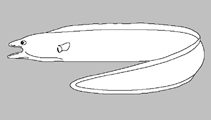
Raios dorsais moles (total) : 291; Raios anais moles: 190; Vértebras: 125. This species can be distinguished from its congeners by the following characters: A 190; D 291; V 125; a short pectoral fin (16.6 % HL); the posterior portion of the ethmovomerine teeth arranged in a single row, teeth on lower and upper pharyngeal tooth plate 24 and 27, and 10 branchiostegal rays; having five lateral-line pores; ethmovomerine tooth patch extending to nearly half-length of upper jaw; preanal vertebrae 48; preoperculomandibular pores six. Colouration of preserved specimen: head and body generally orange; body whitish on belly and ventral third of caudal portion; ventral surface of the head is light yellow, covering the lower jaw and the ventral portion of the cheek; a single, broad, dichromatic stripe runs along the flank, pale yellow on the dorsal and ventral margins with a brown center, extending medially from the last lateral-line pore to the posterior third of the body; pectoral fin is predominantly orange, becoming lighter towards its distal third; anterior half of the dorsal fin is orange, transitioning to yellowish in the posterior half; anal fin whitish on its anterior third, while the posterior two-thirds are yellow (Ref. 124570).
Life cycle and mating behavior
Maturidade | Reprodução | Desova | Ovos | Fecundidade | Larvas
Espíndola, V.C., R.A. Caires, K.A. Tighe, M.C.C. De Pinna and M.R.S. De Melo, 2021. A new species of the rare genus Myroconger Günther, 1870 (Anguilliformes: Myrocongridae) from Brazilian waters, tropical western Atlantic. Zootaxa 4965(3):529-540. (Ref. 124570)
Categoria na Lista Vermelha da IUCN (Ref. 130435: Version 2025-1)
Ameaça para o homem
Harmless
Utilização humana
Pescarias: sem interesse
Ferramentas
Relatórios especiais
Descarregue XML
Fontes da internet
Estimates based on models
Phylogenetic diversity index (Ref.
82804): PD
50 = 0.5312 [Uniqueness, from 0.5 = low to 2.0 = high].
Nível Trófico (Ref.
69278): 3.7 ±0.6 se; based on size and trophs of closest relatives
Fishing Vulnerability (Ref.
59153): Low to moderate vulnerability (33 of 100).
🛈