Classification / Names
Noms communs | Synonymes | Catalog of Fishes(Genre, Espèce) | ITIS | CoL | WoRMS | Cloffa
>
Siluriformes (Catfishes) >
Trichomycteridae (Pencil or parasitic catfishes) > Trichomycterinae
Etymology: Cambeva: Probably derived from the Tupi-Guarani, is a popular name for trichomycterid fishes in southern and south-eastern Brazil (Ref. 119381); duplimaculata: Derived from the Latin word (doubly maculated) which refers to its coloration patter in the flank: two overlapped spotted patterns in different skin layers (inner large black spots and outer small brown spots) (Ref. 129458).
Environment: milieu / climate zone / profondeur / distribution range
Écologie
; eau douce démersal. Tropical
South America: Brazil.
Taille / Poids / Âge
Maturité: Lm ? range ? - ? cm
Max length : 8.3 cm SL mâle / non sexé; (Ref. 129458)
Description synthétique
Clés d'identification | Morphologie | Morphométrie
Vertèbres: 39 - 40. Distinguished from its congeners by the following set of characters: D 12-13 (iii-iv + II + 7); A 10-11 (iii-iv + II + 5); P 7 (I + 6); pelvic-fin rays 5 (I + 4); principal caudal-fin rays 13 (I + 11 + I); dorsal procurrent rays 16-17 (xv-xvi + I); ventral procurrent rays 12-15 (xi-xiv + I); vertebrae 39-40; ribs 14 or 15; anal-fin origin in vertical through just anterior to posterior dorsal-fin base end; dorsal-fin origin in vertical through centrum of 20th or 21st vertebra; anal-fin origin in vertical through centrum of 24th or 25th vertebra; 16 or 17 dorsal procurrent caudal-fin rays; body width 10.8-11.8 % SL; well-developed pelvic fin, pelvic-fin length 7.0-8.6 % SL;
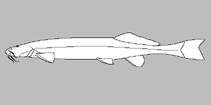
38-41 teeth on premaxilla and 35-39 dentary; 12-15 ventral procurrent caudal-fin rays; 11-13 opercular odontodes. Coloration: flank with rounded black spots arranged in three irregular longitudinal rows, overlapped by a high concentration of small dark brown spots that are placed at a more superficial skin layer are observed in adult specimens (ca. > 50 mm SL) (Ref. 129458).
Life cycle and mating behavior
Maturité | Reproduction | Frai | Œufs | Fécondité | Larves
Costa, W.J.E.M., C.R.M. Feltrin and A.M. Katz, 2021. Field inventory reveals high diversity of new species of mountain catfishes, genus Cambeva Katz, Barbosa, Mattos & Costa, 2018 (Siluriformes: Trichomycteridae), in south-eastern Serra Geral, southern Brazil. Zoosystema 43(art.28):659-690. (Ref. 129458)
Statut dans la liste rouge de l'IUCN (Ref. 130435: Version 2025-1)
Menace pour l'homme
Harmless
Utilisations par l'homme
Pêcheries: sans intérêt
Outils
Articles particuliers
Télécharger en XML
Sources Internet
Estimates based on models
Phylogenetic diversity index (Réf.
82804): PD
50 = 0.5001 [Uniqueness, from 0.5 = low to 2.0 = high].
Niveau trophique (Réf.
69278): 3.2 ±0.4 se; based on size and trophs of closest relatives
Fishing Vulnerability (Ref.
59153): Low vulnerability (10 of 100).
🛈