>
Gobiiformes (Gobies) >
Gobiidae (Gobies) > Gobionellinae
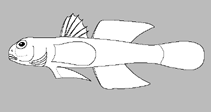
Etymology: Rhinogobius: Greek, rhinos = nose + Latin, gobius = gudgeon (Ref. 45335); macromaculatus: Named for its distinct feature, a 'large spot', bluish black pigmentation on the dorsal fin.
Environment: milieu / climate zone / intervalo de profundidade / distribution range
Ecologia
; Água doce bentopelágico. Subtropical
Distribuição
Países | Áreas FAO | Ecossistemas | Ocorrências | Mapa dos pontos | Introduções | Faunafri
Asia: Taiwan.
Tamanho / Peso / Idade
Maturidade: Lm ? range ? - ? cm
Max length : 3.5 cm SL macho/indeterminado; (Ref. 133058)
Descrição breve
Chaves de identificação | Morfologia | Morfometria
Espinhos dorsais (total) : 7; Raios dorsais moles (total) : 8; Espinhos anais: 1; Raios anais moles: 7; Vértebras: 27. This species is distinguished from its congeners by the following set of characters: D2 modally I,8; A I,7; pectoral fin rays modally 15; longitudinal scale series 27-28 (modally 28); perdorsal scales usually 14-15; scales between the first dorsal fin origin to upper pectoral fin base modally 8; vertebrae 27; males with rear edge of mouth merely extending to vertical of anterior margin of pupil. Colouration: male with lateral body with 7-8 longitudinal rows of bright orange to orange red spots about 1/2 to 1/3 of pupil diameter; female with orange brown spots less than 1/3 of pupil diameter; male with cheek and opercle with moderately large 32-36 orange spots while the female with small brown spots 12-16; larger cheek spot about 1/5 of pupil diameter; male with branchostegal membrane with 20-24 small reddish orange spots on either side, but spotless in female; with a large, middle black spot in front of third spine of first dorsal fin, its height 1/2 of second spine; male with basal region of first dorsal fin with 7-8 orange or brownish orange spots, and the second dorsal fin with 2-3 longitudinal rows of orange spots; male with pectoral fin with two rows usually 3+4 (totally 7-8 spots) of orange to reddish orange spots (Ref. 133058).
Cross section: oval.
Life cycle and mating behavior
Maturidade | Reprodução | Desova | Ovos | Fecundidade | Larvas
Chen, I-S and M.-F. Yeh, 2024. Two new freshwater gobiid species of Rhinogobius Gill, 1859 (Teleostei: Gobiidae) from Taiwan. Zootaxa 5550(1):333-353. (Ref. 133058)
Categoria na Lista Vermelha da IUCN (Ref. 130435: Version 2025-1)
Ameaça para o homem
Harmless
Utilização humana
Pescarias: sem interesse
Ferramentas
Relatórios especiais
Descarregue XML
Fontes da internet
Estimates based on models
Phylogenetic diversity index (Ref.
82804): PD
50 = 0.5000 [Uniqueness, from 0.5 = low to 2.0 = high].
Nível Trófico (Ref.
69278): 3.2 ±0.4 se; based on size and trophs of closest relatives
Resiliência (Ref.
120179): Elevada, tempo mínimo de duplicação da população menor que 15 meses (Preliminary K or Fecundity.).
Fishing Vulnerability (Ref.
59153): Low vulnerability (10 of 100).
🛈