Classification / Names
Noms communs | Synonymes | Catalog of Fishes(Genre, Espèce) | ITIS | CoL | WoRMS | Cloffa
>
Perciformes/Scorpaenoidei (Scorpionfishes) >
Scorpaenidae (Scorpionfishes or rockfishes) > Scorpaeninae
Etymology: Neomerinthe: Greek, neos = new + Greek, merinthos, -ou = thread (Ref. 45335); parallelaspina: Name 'parallelaspina' from Latin words 'parallela' and 'spina', meaning 'parallel' and 'spine', referring to the orientation of the 3rd and 4th preopercular spines.
Environment: milieu / climate zone / profondeur / distribution range
Écologie
marin démersal; profondeur 126 - 207 m (Ref. 133153). Tropical
Eastern Indian Ocean: Australia.
Taille / Poids / Âge
Maturité: Lm ? range ? - ? cm
Max length : 9.6 cm SL mâle / non sexé; (Ref. 133153)
Description synthétique
Clés d'identification | Morphologie | Morphométrie
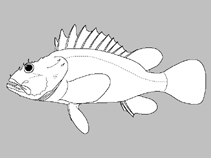
Épines dorsales (Total) : 12; Rayons mous dorsaux (Total) : 9. This species is distinguished by the following set of characters: D 9; pectoral-fin rays 19-21 (usually 20); scale rows in longitudinal series 40-45 (43); pored lateral-line scales 23-25 (24); scale rows above lateral line 4-6 (5), below lateral line 9-11 (10), between 6th dorsal-fin spine base and lateral line 5 or 6 (5), and between last dorsal-fin spine base and lateral line 4-6 (5); upper gill rakers 4-6 (5), lower gill rakers 10-15 (12) [7-10 (9) and 2-6 (3) on ceratohyal and hypobranchial, respectively], total gill rakers 15-20 (18); absence of longitudinal ridge on lateral surface of maxilla; presence of lateral lacrimal spine; 3 suborbital spines; presence of 2nd preopercular spine; 4th preopercular spine large, directed parallel to 3rd preopercular spine; absence of upper posttemporal spine; minute slit behind last gill arch; many small cycloid scales on base of pectoral fin and ventral surface of body from isthmus to beyond pelvic fin; posterior margin of soft-rayed portion of dorsal-fin rounded; fin membrane between last dorsal-fin soft ray and caudal peduncle absent; body depth 29.5-36.4 (32.9) % SL; 2nd dorsal-fin ray length 18.0-21.3 (19.8) % SL; 3rd dorsal-fin ray length 17.7-22.4 (20.1) % SL; 4th dorsal-fin ray length 18.3-22.6 (20.0) % SL; 5th dorsal-fin ray length 16.8-21.7 (19.6) % SL; 3rd preopercular spine length 2.3-6.1 (4.2) % HL; 4th preopercular spine length 1.4-4.7 (2.8) % HL; pale yellowish body and pectoral fins, with indistinct blotches above lateral line when preserved (Ref. 133153).
Cross section: compressed.
Life cycle and mating behavior
Maturité | Reproduction | Frai | Œufs | Fécondité | Larves
Matsumoto, T. and H. Motomura, 2024. Two new species of the scorpionfish genus Neomerinthe Fowler 1935
(Teleostei: Scorpaenidae) from northwestern Australia. Ichthyological Research 72(1):1-16. (Ref. 133153)
Statut dans la liste rouge de l'IUCN (Ref. 130435: Version 2025-1)
Menace pour l'homme
Harmless
Utilisations par l'homme
Pêcheries: sans intérêt
Outils
Articles particuliers
Télécharger en XML
Sources Internet
Estimates based on models
Phylogenetic diversity index (Réf.
82804): PD
50 = 0.5000 [Uniqueness, from 0.5 = low to 2.0 = high].
Niveau trophique (Réf.
69278): 3.6 ±0.6 se; based on size and trophs of closest relatives
Résilience (Réf.
120179): Haut, temps minimum de doublement de population inférieur à 15 mois (Preliminary K or Fecundity.).
Fishing Vulnerability (Ref.
59153): Low vulnerability (10 of 100).
🛈