التصنيف / Names
الأسماء الشائعة | مرادفات | Catalog of Fishes(جنس, الانواع) | ITIS | CoL | WoRMS | Cloffa
>
Siluriformes (Catfishes) >
Loricariidae (Armored catfishes) > Hypostominae
Etymology: Hypostomus: Greek, hypo = under + Greek, stoma = mouth (Ref. 45335); froehlichi: Named after Otávio Froehlich (1958-2015), a beloved friend and ichthyologist who devoted most of his work on the knowledge of the fishes from the Bodoquena Plateau, Mato Grosso do Sul; treated as a genitive.
Eponymy: Dr Otávio Froehlich (1958–2015) was a Brazilian zoologist whose bachelor’s degree was awarded by the University of São Paulo (1984) whist the Universidade Federal de Mato Grosso do Sul awarded both his master’s (2003) and doctorate (2010) and where [...] (Ref. 128868), visit book page.
Environment: milieu / climate zone / نطاق العمق / distribution range
البيئة
; المياه العذبة القاع. Tropical
South America: Brazil.
الحجم / وزن / العمر
النضج: Lm ? range ? - ? cm
Max length : 24.2 cm SL ذكر/ مختلط الجنس; (Ref. 123771)
وصف مختصر
مفاتيح التعريف | الوصف الخارجي | قياسات المظهر الخارجي
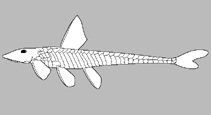
الأشواك الظهرية (المجموع) : 2; الأشعة الظهرية الناعمة (المجموع) : 7; أشعه شرجية لينه: 4. This species is distinguished by the following characters: teeth villiform and angle between dentaries usually larger than 80° (vs. spoon-or shovel-shaped teeth and angle between dentaries about 80°); no keels on lateral series of plates, moderate keel along dorsal series of plates; short unbranched caudal fin rays, with ventral unbranched caudal-fin ray similar in length to head length; one plate bordering supraoccipital; number of teeth 10-61; anterior portion of abdomen totally covered by platelets; pectoral-fin spine clearly longer than pelvic-fin spine; no hypertrophied odontodes along dorsal and mid-dorsal series of plates; plates on lateral series 24-27. Colouration: dark blotches on a clearer background; dark stripe margining dorsal-fin branched rays anteriorly; usually two rows of blotches per interradial membrane on dorsal, pectoral and ventral fins; caudal fin with dark blotches; juveniles with dark blotches on flanks (Ref. 123771).
Cross section: oval.
Generally found associated with rocky substrate. Young individuals were observed foraging during day and night, the larger ones were more active at night, being generally observed hiding in cavities at the margins of the stream during day. For juveniles, the smallest specimens (approximately 2,0 cm TL), were usually found in the fast currents of waterfalls in small rivers and streams, not hiding but foraging on rock formations in open water. However, these young specimens seem to prefer shaded areas, and are clearly diurnal. Middle-sized specimens (approximately 10.0 cm TL) were not observed in the waterfalls, inhabiting other parts of the small rivers and streams, usually hiding under rocks and driftwood. Although large specimens (approximately 60.0 cm TL) were observed in shallow waters, shoals were observed in deeper areas. Adult shoals are formed up to several hundred specimens, usually resting and feeding on the steep rocky shelves from one meter to more than 10 meters deep. It has been observed that the new species graze on hard substrates, from which they remove the periphytic matrix by scraping it. In the main rivers they seem to use rocky and clay cave formations as breeding sites. Both soft and hardened clay caves are used, with holes in the areas of soft clay substrate, apparently dug by large specimens. Contrary to the observation by Penatti (2010), larger adults were observed active during day (P. Petersen, pers. Comm., video file by Peter Petersen showing the new species in its natural habitat, the rio da Prata, is available at https://youtu.be/QJ62856SlIo). This species occurs with three congeners, H. basilisko, H. cochliodonand an undescribed species referred here as Hypostomus aff. ancistroides (Ref. 123771).
Life cycle and mating behavior
النضج | التكاثر | وضع البيض | بيض | الخصوبة | Larvae
Zawadzki, C.H., G. Nardi and L.F.C. Tencatt, 2021. The crystalline waters of the Bodoquena Plateau revealed Hypostomus froehlichi (Siluriformes: Loricariidae), a new armored catfish from the rio Paraguay basin in Brazil. Zootaxa 4933(1):98-112. (Ref. 123771)
IUCN Red List Status (Ref. 130435: Version 2025-1)
استخدامات بشرية
مصائد: غير ذات اهمية
أدوات
تقارير خاصة
Download XML
مصادر علي الأنترنت
Estimates based on models
Phylogenetic diversity index (مرجع
82804): PD
50 = 0.5000 [Uniqueness, from 0.5 = low to 2.0 = high].
المرونه (مرجع
120179): وسيط, الحد الزمني الأدني لتضاعف عدد أفراد المجتمع 1.4-4.4 سنة (Preliminary K or Fecundity.).
Fishing Vulnerability (Ref.
59153): Low vulnerability (20 of 100).
🛈