Classification / Names
Populärnamn | synonymer | Catalog of Fishes(Släkte, Arter) | ITIS | CoL | WoRMS | Cloffa
>
Siluriformes (Catfishes) >
Loricariidae (Armored catfishes) > Hypoptopomatinae
Etymology: Neoplecostomus: Greek, neos = new + Greek, plekos,-eos = twisted (Ref. 45335); altimontanus: Name 'altimontanus' in reference to the Upper Montane Atlantic Forest, a vegetation type only found in south and southeastern Brazil.
Environment: milieu / climate zone / djupintervall / distribution range
Ekologi
; sötvatten bottenlevande. Tropical
South America: Brazil.
Size / Vikt / Age
Könsmognad: Lm ? range ? - ? cm
Max length : 9.4 cm SL hane/ej könsbestämd; (Ref. 133471)
Short description
Bestämningsnycklar | Morfologi | Morfometri
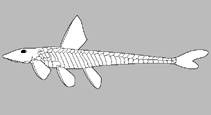
Mjukstrålar i ryggfenan (totalt) : 7; Mjukstrålar i analfenan: 5. This species is distinguished from its congeners by the following set of characters: the exposed area of the first plates of mid-ventral and ventral series narrower than the naked area surrounding each plate; sexual dimorphism in dentition, with males having more robust and fewer teeth compared to females; azygous pre-adipose plates absent; one or two posteronasal plates; extra canal-bearing plate between supraopercle and dorsal opening of preopercular canal present; conspicuous dark spots over body and fins present; slightly hypertrophied odontodes on the posterior portion of the plates of dorsal, mid-dorsal, median and mid-ventral series observed, resembling discontinuous keels on caudal peduncle; well-developed adipose fin, extending over four or five dorsal plates, usually five; lateronasal plate absent; nare length 3.0-9.0% vs. 9.9-14.1% of HL; premaxillary 31-42, modally 35 and dentary 31-40, modally 31 teeth counts in females (Ref. 133471).
Body shape (shape guide): elongated; Cross section: flattened.
The species inhabits shallow streams (<1 m) with clear, high flowing, low temperature and well-oxygenated water. The area is surrounded by a pristine riparian vegetaiton, composed mainly of Bryophytes, Pteridophytes, and Orchidaceae associated to trees and exposed stones (Ref. 133471).
Life cycle and mating behavior
Könsmognad | Reproduktion | Lek | Ägg | Fecundity | Larver
Uzeda, P.L.C., I. Paiola, P.S. Cesar, V.K.N. Okubo, W.J. Marques-Frisoni, B.N. Andrade and F. Langeani, 2024. Two new species of Neoplecostomus (Siluriformes: Loricariidae) from high altitudes of the upper rio Paraná basin, Brazil. Neotropical Ichthyology 22(4):e240021. (Ref. 133471)
IUCN Red List Status (Ref. 130435: Version 2025-1)
Threat to humans
Harmless
Human uses
Fiskeri: saknar intresse
Verktyg
Special reports
Download XML
Internet-källor
Estimates based on models
Phylogenetic diversity index (Ref.
82804): PD
50 = 0.5000 [Uniqueness, from 0.5 = low to 2.0 = high].
Resiliens (Ref.
120179): Hög, lägsta populationsfördubblingstid mindre än 15 månader (Preliminary K or Fecundity.).
Fishing Vulnerability (Ref.
59153): Low vulnerability (10 of 100).
🛈